
Friday, November 03, 2006
Youthful Desires
My reflection was gone from the window. The darkness outside had disappeared. A light steadily glowed, almost outshining the light in Norgrove's room. I stepped over to the sill and looked out at an enormous, ornate building with towering arched windows. They were scrolled with elaborate iron work, as if they were stained glass, missing the color. Through the leafy design, I saw what looked like large shadows, flying away from the windows and out of view, clearing a pristine hardwood floor that had been polished to a sheen. I couldn't tell if this was an empty cathedral, or an ornate gymnasium. The shadows glided past the glass, then disappeared again. I leaned closer to the window for a better look.
I could vaguely make out the building's exterior. It loomed up like a medieval cathedral, dark with gothic forboding. “Wild,” I breathed. “What is it?”
“A monastery, I think," said Norgrove. "I honestly don't know.”
I laughed. “There's a monastery in the middle of the university campus?”
“Apparently. Connected to St. Mike's, I'm told. No doubt there's some sort of academic angle to it. Hold on, here comes trouble.”
The shadows returned, swirling slowly in formation, then stood still and waited. Nuns — they looked like nuns. Their black robes were crisp and neat, swaying with gentle gravitas. I craned toward the window, squinting hard, trying to pick up some telling detail, like the expressions on their faces, which, from my addled perspective, were as blank as thumbs.
The women began to move. They slowly lifted their arms out to their sides, then held them aloft at shoulder height, forming a platoon of crosses draped in shadow. I could feel my heart and breath accelerating, driving hard. Suddenly, the platoon exploded into action. The women spun like dervishes, scurrying and whirling across the floor, grasping hands, twisting, pulling, catapulting, thumping their heels — their entire bodies — against the floor in a thunderous drumbeat.
I could vaguely make out the building's exterior. It loomed up like a medieval cathedral, dark with gothic forboding. “Wild,” I breathed. “What is it?”
“A monastery, I think," said Norgrove. "I honestly don't know.”
I laughed. “There's a monastery in the middle of the university campus?”
“Apparently. Connected to St. Mike's, I'm told. No doubt there's some sort of academic angle to it. Hold on, here comes trouble.”
The shadows returned, swirling slowly in formation, then stood still and waited. Nuns — they looked like nuns. Their black robes were crisp and neat, swaying with gentle gravitas. I craned toward the window, squinting hard, trying to pick up some telling detail, like the expressions on their faces, which, from my addled perspective, were as blank as thumbs.
The women began to move. They slowly lifted their arms out to their sides, then held them aloft at shoulder height, forming a platoon of crosses draped in shadow. I could feel my heart and breath accelerating, driving hard. Suddenly, the platoon exploded into action. The women spun like dervishes, scurrying and whirling across the floor, grasping hands, twisting, pulling, catapulting, thumping their heels — their entire bodies — against the floor in a thunderous drumbeat.
Come Back, Toby Tyler
Movies and Mennonites make for a conflicted bit of business, what with the former presenting so many worldly temptations to the latter. In the prairie village of my youth, some kids were allowed to see movies in the local cinema, others were not. Just about everyone, though, saw movies in school — twice a year, and always a Disney family flick.
Most of these were critter based adventures that required at least one romp through a well-stocked grocery store (followed by the inevitable “He doesn't belong here” speech from one of the parents). A few were more remarkable — Bambi and Old Yeller come to mind. But I'm guessing the movie that left the deepest imprint in most of us sprats was Toby Tyler.
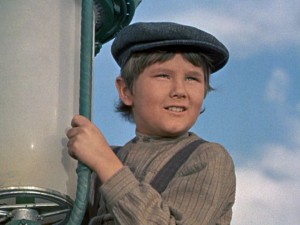 I haven't seen it in over 30 years, but I have a clear recollection of how I thought of it as a kid. Toby is an orphan, cared for by a soppy stern uncle and gormless aunt. The uncle wants him to stay home and tend to the pigs, but Toby just wants a break for once because the circus is in town. He watches the parade, gets caught up in the spectacle, the pigs run amok, and his uncle sends Toby to bed without any supper. Toby does the logical thing and runs away to join the circus.
What follows is a masculine version of Pollyanna. Toby faces adversity with a steadfast innocence, and eventually insinuates himself right to the heart of the circus. By movie's end, he is performing alongside the circus darling Mademoiselle Jeanette in front of a full house that includes his now penitent uncle and aunt. Even his beloved chimp Mr. Tibbs, felled by a hunter's bullet, is resurrected and restored to Toby's new, larger world.
Like so many of the Disney offerings of the day, Toby Tyler is a three-handkerchief weepy, resonant with messages a child intuitively takes to heart. Chief among these is its portrait of adults: when they don't begrudge a child's presence, they're quick to manipulate the kid to their own advantage. Compassion comes slowly, if at all.
I sometimes wonder if everyone from my generation didn't run away from that village to join the circus. We bartered away various pieces of our innocence, or put ourselves in situations where it was torn from us. Some of us came back — enough of us to keep the village growing — but I doubt any of us received applause for it. Citizens of small towns, contrary to the Disney stereotype, have more in common with Toby's hardscrabble circus-mates than they do with the yokels who applaud a boy performing stunts on a horse. In my experience, now as then, people from small towns are more cynical than most city residents. If that's not a quality you can live with and deal out in kind, you move to and stay in the city.
I'm not sure why I'm musing in this direction. My little family is navigating a bit of a rough patch, so maybe I'm just pining for that childhood sense of security that allowed a kid to relate to the ups and downs of a circus orphan, confident finally in one's ability to persevere and see some good come of it. Certainly I hope that's the point of view we're encouraging our children to adopt.
But there is also a characteristic of small towns that I'd like to see changed. Kids who like to play the “What If?” game quickly learn that a small town isn't the place for it. That's not necessarily a bad thing: there are some “What Ifs?” that are extremely imprudent to indulge. Having said all this, it still astonishes me to see some of the businesses people hope to set up in a small town. It's one thing to get a convenience store up and running, and quite another to try the same trick with a balloon bouquet outfit. So what if the balloon bouquet lady worked out a deal with the convenience store family? Well ... that's a “What If” you'll rarely see entertained in a small town. Rather than fail small, the balloon bouquet lady naturally figures it's better to swing for the bleachers.
Towns have such a tough time keeping their communities economically alive, but that ever-present cynical vibe doesn't make the task any easier.
Anyhow. Scattered thoughts while our family waits for the circus to come to town.
Most of these were critter based adventures that required at least one romp through a well-stocked grocery store (followed by the inevitable “He doesn't belong here” speech from one of the parents). A few were more remarkable — Bambi and Old Yeller come to mind. But I'm guessing the movie that left the deepest imprint in most of us sprats was Toby Tyler.
 I haven't seen it in over 30 years, but I have a clear recollection of how I thought of it as a kid. Toby is an orphan, cared for by a soppy stern uncle and gormless aunt. The uncle wants him to stay home and tend to the pigs, but Toby just wants a break for once because the circus is in town. He watches the parade, gets caught up in the spectacle, the pigs run amok, and his uncle sends Toby to bed without any supper. Toby does the logical thing and runs away to join the circus.
What follows is a masculine version of Pollyanna. Toby faces adversity with a steadfast innocence, and eventually insinuates himself right to the heart of the circus. By movie's end, he is performing alongside the circus darling Mademoiselle Jeanette in front of a full house that includes his now penitent uncle and aunt. Even his beloved chimp Mr. Tibbs, felled by a hunter's bullet, is resurrected and restored to Toby's new, larger world.
Like so many of the Disney offerings of the day, Toby Tyler is a three-handkerchief weepy, resonant with messages a child intuitively takes to heart. Chief among these is its portrait of adults: when they don't begrudge a child's presence, they're quick to manipulate the kid to their own advantage. Compassion comes slowly, if at all.
I sometimes wonder if everyone from my generation didn't run away from that village to join the circus. We bartered away various pieces of our innocence, or put ourselves in situations where it was torn from us. Some of us came back — enough of us to keep the village growing — but I doubt any of us received applause for it. Citizens of small towns, contrary to the Disney stereotype, have more in common with Toby's hardscrabble circus-mates than they do with the yokels who applaud a boy performing stunts on a horse. In my experience, now as then, people from small towns are more cynical than most city residents. If that's not a quality you can live with and deal out in kind, you move to and stay in the city.
I'm not sure why I'm musing in this direction. My little family is navigating a bit of a rough patch, so maybe I'm just pining for that childhood sense of security that allowed a kid to relate to the ups and downs of a circus orphan, confident finally in one's ability to persevere and see some good come of it. Certainly I hope that's the point of view we're encouraging our children to adopt.
But there is also a characteristic of small towns that I'd like to see changed. Kids who like to play the “What If?” game quickly learn that a small town isn't the place for it. That's not necessarily a bad thing: there are some “What Ifs?” that are extremely imprudent to indulge. Having said all this, it still astonishes me to see some of the businesses people hope to set up in a small town. It's one thing to get a convenience store up and running, and quite another to try the same trick with a balloon bouquet outfit. So what if the balloon bouquet lady worked out a deal with the convenience store family? Well ... that's a “What If” you'll rarely see entertained in a small town. Rather than fail small, the balloon bouquet lady naturally figures it's better to swing for the bleachers.
Towns have such a tough time keeping their communities economically alive, but that ever-present cynical vibe doesn't make the task any easier.
Anyhow. Scattered thoughts while our family waits for the circus to come to town.
Thursday, November 02, 2006
Mike Mentzer, R.I.P.
Anderson snapped off the music. “You're the best you been, brother, no question there,” he said.
“But?” seethed Theo.
Anderson gave a cavalier shrug. “I doubt I even need to say it. I'm talking about your delts. They're there, they're shredded, it's just you need a little more symmetry, is all.”
Was he right? Theo was ready to clock the little fucker, that's just how right he was. Theo suffered from the Mentzer Midriff — a trunk so large he couldn't suck his gut in far enough. Getting his pecs and delts big enough to offset the abdominals was a never-ending struggle. He gritted his teeth. “So what's the prognosis, doctor?”
Anderson shook his head. “That was the prognosis, Einstein. The prescription is this: incremental doses of synthol in your final two weeks leading up to the event. We do it right, the only thing people will notice is your winning form. The big question, however, is this: are you willing to do a little more work for me?”
“But?” seethed Theo.
Anderson gave a cavalier shrug. “I doubt I even need to say it. I'm talking about your delts. They're there, they're shredded, it's just you need a little more symmetry, is all.”
Was he right? Theo was ready to clock the little fucker, that's just how right he was. Theo suffered from the Mentzer Midriff — a trunk so large he couldn't suck his gut in far enough. Getting his pecs and delts big enough to offset the abdominals was a never-ending struggle. He gritted his teeth. “So what's the prognosis, doctor?”
Anderson shook his head. “That was the prognosis, Einstein. The prescription is this: incremental doses of synthol in your final two weeks leading up to the event. We do it right, the only thing people will notice is your winning form. The big question, however, is this: are you willing to do a little more work for me?”
Naïveté Is Not Equal To Innocence
Over the last ten years I've read Alan Wolfe's work with interest (none of the books, mind you, but the articles he's done for The Atlantic, etc.). I doubt I've seen anyone who stands outside the Evangelical Culture work so hard at understanding these people and giving their point of view a fair hearing. It's not uncommon, however, for me to sigh as I read: having had some experience from inside that culture, I've often thought his empathy bleeds too frequently into sympathy. Still, empathy for anything "other" is in short supply these days, and his demonstration of it is welcome.
Slate links to this Wolfe review of former Washington insider David Kuo's biography of disenchantment. (It's at TNR, so you'll have to register or resort to one of those "already-registered" websites). If Wolfe's take is accurate, my use of "disenchantment" may be premature. I get the feeling Wolfe read the book, pounded his fist on his desk, then rolled up his sleeves and got to work. Not that I still didn't sigh from time to time, but I am gratified to see Wolfe take on one of North American Evangelicalism's most hallowed sacred cows: naïveté.
Slate links to this Wolfe review of former Washington insider David Kuo's biography of disenchantment. (It's at TNR, so you'll have to register or resort to one of those "already-registered" websites). If Wolfe's take is accurate, my use of "disenchantment" may be premature. I get the feeling Wolfe read the book, pounded his fist on his desk, then rolled up his sleeves and got to work. Not that I still didn't sigh from time to time, but I am gratified to see Wolfe take on one of North American Evangelicalism's most hallowed sacred cows: naïveté.
Wednesday, November 01, 2006
Tar And Feathers
His friend Roger was taking care of a professor's house, a bi-level suburban fortress with a back yard pool and a cantankerous outdoor fridge packed with beer. He and Troy helped Roger clean the pool, treat the water and skim off the floating elm seeds before diving in and cooling off. Come nightfall, they'd retire to the lawn chairs, and savor their mutual loneliness while listening to the buzz of dying cicadas compete with the rumble of neighboring air-conditioners.
One afternoon, he pedaled his bicycle into the back yard and found Roger standing naked in the middle of the pool, his tall gaunt figure taut with concentration, long wiry arms stretched out in simulated flight. Roger said nothing in greeting, so he asked Roger what he was doing. Roger was silent a while, then he murmured, “I'm trying not to slip into the abyss.”
One afternoon, he pedaled his bicycle into the back yard and found Roger standing naked in the middle of the pool, his tall gaunt figure taut with concentration, long wiry arms stretched out in simulated flight. Roger said nothing in greeting, so he asked Roger what he was doing. Roger was silent a while, then he murmured, “I'm trying not to slip into the abyss.”
Youthful Desires Publishing Update
Once I figured out pagination, the rest of my formatting proceeded without a hitch. Lulu has my file, and I've placed my order. I now await my proofing hard-copy of Youthful Desires. If the message boards at Lulu are any indication, I'll receive it within two weeks' time.
I'll repeat for the record that this is not my Chinese Democracy (a 763-page little something I once wrote is a more likely candidate for that category). As the signs say when you slow down and finally come to a complete stop for road repair: Thank you for your patience!
I'll repeat for the record that this is not my Chinese Democracy (a 763-page little something I once wrote is a more likely candidate for that category). As the signs say when you slow down and finally come to a complete stop for road repair: Thank you for your patience!
Subscribe to:
Posts (Atom)