Busy time out here - we're hosting my family from Manitoba, so I stay off-line most days. My brother the nerd is rearranging all my software furniture, keeping the sightlines clean, clearing a path in the clutter so's I can do what I do with less effort (at least, that's the goal). Everything is under consideration, including a merger with Whisky Prajer and My Day-Gig: Stay Home, Daddy-O (both written by yours truly).
"Whisky Prajer" was the moniker I adopted when I first started blogging. I'd hoped to spare my Reverend father a little embarrassment by anonymously posting my less-orthodox musings. He, however, set the record straight by forwarding both my sites to anyone he thought might be interested. So here I sit, rattling off my weirdness on this site, and coloring within the lines on my other site, and thinking, Perhaps this is counter-productive? If I could post pictures on my other site, I'd probably bring my archived material from WP and add it to Daddy-O and do all my work there, because (a) that's who I am, and (b) that's the site I've got the most control over.
If you have any thoughts or recommendations, let me know.
Saturday, November 12, 2005
Wednesday, November 09, 2005
Shake Hands With The Menno, Part II
David Bergen wins the coveted Giller Prize for his novel The Time In Between - congratulations! A friend has asked me to opine on the state of Mennonite literature. So far I've demurred, having no wish to become a Mennonitische Northrop Frye. Besides, I have dreams of winning my own Giller. First we take Altona, then we take New Berlin! (or "Kitchener", as it's come to be known)
Monday, November 07, 2005
Gilead by Marilynne Robinson
Now, at that point I did feel that Jack Boughton was, so to speak, winning the conversation, and furthermore, that he was no happier about it than I was, maybe even a little disgusted. Certainly I found myself in a false position yet again. I felt like pleading old age. But I was sitting there in my church, with the sweet and irrefragable daylight pouring in through the windows. And I felt, as I have often felt, that my failing the truth could have no bearing at all on the Truth itself, which could never conceivably be in any sense dependent on me or on anyone. And my heart rose up within me — that's exactly what it felt like — and I said, “I have heard any number of fine sermons in my life, and I have known any number of deep souls. I am well aware that people find fault, but it seems to me to be presumptuous to judge the authenticity of anyone's religion, except one's own. And that is also presumptuous.”
And I said, “When this old sanctuary is full of silence and prayer, every book Karl Barth ever will write would not be a feather in the scales against it from the point of view of profundity, and I would not believe in Barth's own authenticity if I did not also believe he would know and recognize the truth of that, and honor it, too.”
I hope readers who have absorbed and taken nourishment from Marilynne Robinson's brilliant novel, Gilead, will find fault with my choice of excerpt. It could be the most didactic bit of prose you will find in the novel's entirety, only hinting at the sublime pleasures and tensions she sustains with her articulate attention to the poetic rhythms of a spiritual life. But I think it highlights the strength of character in this novel of hers, and this novel is all character.
This excerpt captures perfectly those vain arguments we all enter, foolishly hoping to be persuaded out of our convictions. Jack Boughton has broached the subject of Karl Barth, the neo-orthodox theologian who John Ames, the book's narrator, reads with delight. Boughton slides in and cunningly uses Barth as a means to critique the piety he faces in Ames (a tactic not dissimilar, perhaps, to some of my own). Ames is wise enough to intuit that such fault-finding is thin and bitter broth for young Boughton, but does not yet have the insight to appreciate the torment within his tormentor. Ames's life has not been without its own sorrows, but as ever he reaches for the only constants he knows: “sweet, irrefragable daylight”; “silence and prayer.”
This proves to be a conversation-stopper, as so many of his poetic metaphors are. The only internal monologue any of us can be certain of is our own, and as Ames articulates his, we realize just how dodgy this monologue can get without the external impertinences of an engaged life. The book begins with the elderly Ames joyously ready to shed his mortal coil, and choosing to fill his notebook with reminiscences of previous difficulties and the eternal delights that seem to have flowered in their wake. Life has one final difficulty to fling at him, however, in the form of a namesake he never asked for.
I hesitated to read this book because too many people were recommending it. It seems to win over the faithful and the infidel alike. The fine folks at Books & Culture are smitten with it; so are atheists like James Wood and Nick Hornby (in fact, after singing Robinson's praises, Hornby promptly declared he was ready to spend the next several years in a theological college — a claim he quickly renounced in his next month's column after having read (insert sound of my grinding teeth) A Complicated Kindness by Miriam Toews).
Furthermore, I was informed by DV that the Amazon “recommendation engine” had noted his recent purchase of Peter DeVries' The Blood of the Lamb, and had “thought he might also enjoy” ... Gilead. Visitors who have followed my reading habits will already be aware that DeVries, born to a Calvinist household, takes it upon himself to deflower the Calvinist TULIP — first with ribald glee, and finally with a savage and irrefutable anguish. Now, Ms. Robinson has stated for the public record that she is a resolute Calvinist (possibly the only Calvinist to gain full access to the American public square — no small feat). Can this absurd disparity, generated by this absurd engine, co-exist promisingly for the perceptive reader?
To my incredulity and delight, it can. Hornby and Wood are right on the money in their generous appraisal. “Robinson's words have a spiritual force that's very rare in contemporary fiction,” says Wood, an indication he has come across a genuine find. Hornby says Gilead achieves “an astonishing hush” that has turned him into “a wiser and better person.” Hornby's being somewhat cheeky in the latter statement, but only a little. He says, “I didn't even mind that it's essentially a book about Christianity, narrated by a Christian; in fact, for the first time I understood the point of Christianity — or at least, I understood how it might be used to assist thought.” The emphasis is mine, and it's important. Typically, whenever Christianity is used as the starting point of any discussion, whether by friend or foe, it is not in an effort to assist thought — quite the opposite. In one slim, magnificent novel, Marilynne Robinson provides the antidote, proving that if a “religious” writer can assiduously measure the height, breadth and depth of human experience, they can achieve what all writers strive for: transcendence.
And I said, “When this old sanctuary is full of silence and prayer, every book Karl Barth ever will write would not be a feather in the scales against it from the point of view of profundity, and I would not believe in Barth's own authenticity if I did not also believe he would know and recognize the truth of that, and honor it, too.”
I hope readers who have absorbed and taken nourishment from Marilynne Robinson's brilliant novel, Gilead, will find fault with my choice of excerpt. It could be the most didactic bit of prose you will find in the novel's entirety, only hinting at the sublime pleasures and tensions she sustains with her articulate attention to the poetic rhythms of a spiritual life. But I think it highlights the strength of character in this novel of hers, and this novel is all character.
This excerpt captures perfectly those vain arguments we all enter, foolishly hoping to be persuaded out of our convictions. Jack Boughton has broached the subject of Karl Barth, the neo-orthodox theologian who John Ames, the book's narrator, reads with delight. Boughton slides in and cunningly uses Barth as a means to critique the piety he faces in Ames (a tactic not dissimilar, perhaps, to some of my own). Ames is wise enough to intuit that such fault-finding is thin and bitter broth for young Boughton, but does not yet have the insight to appreciate the torment within his tormentor. Ames's life has not been without its own sorrows, but as ever he reaches for the only constants he knows: “sweet, irrefragable daylight”; “silence and prayer.”
This proves to be a conversation-stopper, as so many of his poetic metaphors are. The only internal monologue any of us can be certain of is our own, and as Ames articulates his, we realize just how dodgy this monologue can get without the external impertinences of an engaged life. The book begins with the elderly Ames joyously ready to shed his mortal coil, and choosing to fill his notebook with reminiscences of previous difficulties and the eternal delights that seem to have flowered in their wake. Life has one final difficulty to fling at him, however, in the form of a namesake he never asked for.
I hesitated to read this book because too many people were recommending it. It seems to win over the faithful and the infidel alike. The fine folks at Books & Culture are smitten with it; so are atheists like James Wood and Nick Hornby (in fact, after singing Robinson's praises, Hornby promptly declared he was ready to spend the next several years in a theological college — a claim he quickly renounced in his next month's column after having read (insert sound of my grinding teeth) A Complicated Kindness by Miriam Toews).
Furthermore, I was informed by DV that the Amazon “recommendation engine” had noted his recent purchase of Peter DeVries' The Blood of the Lamb, and had “thought he might also enjoy” ... Gilead. Visitors who have followed my reading habits will already be aware that DeVries, born to a Calvinist household, takes it upon himself to deflower the Calvinist TULIP — first with ribald glee, and finally with a savage and irrefutable anguish. Now, Ms. Robinson has stated for the public record that she is a resolute Calvinist (possibly the only Calvinist to gain full access to the American public square — no small feat). Can this absurd disparity, generated by this absurd engine, co-exist promisingly for the perceptive reader?
To my incredulity and delight, it can. Hornby and Wood are right on the money in their generous appraisal. “Robinson's words have a spiritual force that's very rare in contemporary fiction,” says Wood, an indication he has come across a genuine find. Hornby says Gilead achieves “an astonishing hush” that has turned him into “a wiser and better person.” Hornby's being somewhat cheeky in the latter statement, but only a little. He says, “I didn't even mind that it's essentially a book about Christianity, narrated by a Christian; in fact, for the first time I understood the point of Christianity — or at least, I understood how it might be used to assist thought.” The emphasis is mine, and it's important. Typically, whenever Christianity is used as the starting point of any discussion, whether by friend or foe, it is not in an effort to assist thought — quite the opposite. In one slim, magnificent novel, Marilynne Robinson provides the antidote, proving that if a “religious” writer can assiduously measure the height, breadth and depth of human experience, they can achieve what all writers strive for: transcendence.
Sunday, November 06, 2005
Unspeakable: Facing Up To Evil In An Age Of Genocide And Terror by Os Guinness
I should state at the outset that my first inclination is to give this book a silent pass. I've been told, though, that members of my larger family occasionally drop by to read my thoughts. I don't know if my infrequent testing of evangelical waters surprises them, gives them hope, or causes them grievous disappointment, but I do feel compelled to acknowledge those times when I look over my shoulder at a pasture that to my mind has grown inhospitable to my soul. If nothing else, I know Gideon Strauss stops by from time to time — this one's for you, Tathagata!
"A guide to life's greatest challenge," claims Unspeakable's cover blurb. These bits of ad-copy are usually just publisher's hyperbole, often stamped on the book-jacket without the author's knowledge or consent. It might well have been approved by Guinness, however: he attempts precisely that, and he frequently achieves acute insight. Guinness's perspicacity, however, is not unblinkered — is even, at times, ungenerous — a trait you can expect me to mirror here and now.
First some perspective: this is not my first exposure to Dr. Guinness. I first encountered him when I was an ardent contributing member of a church youth group. My zeal and idealism set me up for frequent despair (still does). More often than not, the resulting anguish brought me to my father's library where I searched the stacks for some morsel of encouragement. In my late teens, I pulled out a large book with a doozy of a title: The Dust of Death: A Critique of the Establishment and the Counter Culture and the Proposal for a Third Way — by Os Guinness. Even now my heart beats with hopeful anticipation! "The proposal for a third way"! A quick look at the back only added to my hopes: this Guinness guy sported a trim Van Dyke beard (anti-establishment!) and was an heir to the famed brewery giant (establishment)! I pinched it, and read it in the space of a week.
Guinness's coverage of the Counter Culture was dizzying. He catalogued not just the usual American suspects (the Weathermen, the Diggers, and the Black Panthers) but introduced me to the antics of those zany bike-pedaling anarchists in Amsterdam: Provo. I was transfixed by this generational litany of idealistic rage that expressed itself in both tragedy (the Weathermen/Black Panthers) and comedy (Diggers/Provo). As a bonus, I could take absolute comfort in Guinness's clear-sighted over-arching critique that was, he assured me, his effort to "reclaim the culture" The proof? He came out as a staunch advocate of Larry Norman's evangelical rock & roll.
I haven't read that book in over 20 years, and I still recall various tidbits that delighted me. I think I was just encouraged that someone could be intelligent, culturally observant and pious (a word that, I still believe, has been unfairly maligned). But I lost track of Guinness not long after that — pretty much around the time I got tired of listening to Larry Norman. Norman wasn't doing anything particularly innovative with his art, and it seemed to me that neither was Guinness — a lot of finger-wagging, and "here's where you're wrong and scripture is right". Guinness might claim with some justification that what he does is somewhat distinct from "artistry", but I would say otherwise. I think Jean Luc Godard hit the nail on the head when he said, "The way to properly critique a movie is to make another movie." And in that manner, Guinness has been riffing out the ink-and-paper equivalent of Normanesque evangelical rock & roll for the last 20 years.
Guinness's evangelical rock & roll, while "classic," is not without nuance. It seems he has cultivated a profound kinship with many perspectives of Orthodox Judaism. His insight into the work and person of Elie Wiesel, for instance, is among the most unique and penetrating I've seen, and he speaks with genuine authority on the thought of Primo Levi, Simon Wiesenthal and Philip Hallie. There is some shared ground in the "Judeo-Christian" landscape, even for an evangelical, and Guinness finds it and cultivates it.
Alas, he does not do so for the Eastern religions. Perhaps life is too short - perhaps there is only so much one man can achieve, intellectually and spiritually - but his encapsulation of eastern thought and teaching, while strenuous, is not empathetic. Worse than that, it is reductionist and unsympathetic, despite his protests to the contrary. In the wake of Vietnam and the Khmer Rouge in Cambodia, Buddhists have done a great deal of soul-searching on the nature of evil, and have a great deal more to say, with a great deal more nuance, than Guinness suggests.
On this issue Guinness plays the numbers game, and is to some degree right in doing so, by pointing out how the "western" religions are numerically more prone to address injustice than the "eastern" ones have been. But on the issue of Vietnam alone, it would do him and all of North American evangelicalism well to acknowledge a) the profound and unrelenting trans-generational carnage that our chemical warfare has caused, and b) that the chief efforts of relief and redress have not been "Christian", but have come from these same eastern religions Guinness paints indirectly as apathetic.
Perhaps I'm being overly-simplistic of current political realities. Guinness does address the genocides of the Holocaust, Bosnia/Serbia, and Rwanda, as well as the horrors of My Lai and Abu Ghraib among others. Worthy coverage, to be sure. The current author photo portrays a smiling bald man who no longer sports the Van Dyke. It is no longer in him to sit up all night and write a book recounting a litany of what has transpired and how little has been done to acknowledge/stem the tide.
Personally, my artistic and spiritual sensibilities must include and incorporate an "eastern" sensibility. It's all well and good to assert with Solzhenitsyn that "The line dividing good and evil cuts through the heart of every human being"; it's something a touch more suggestive to say "our hearts are black and white like a zebra's stripes" (Guinness). But there are Buddhists who would assert something even more controversial: that our boldest efforts to do good are most easily employed to do the very opposite when we are not intimately attentive to the subtleties of their method.
Guinness's current efforts to transform the culture amount to a cry to wake up and do something. As such, I simply can't recommend this book, except to evangelicals who are horrified at the mass-indulged Magick-think behind The Prayer of Jabez. But in the face of such popular, facile, evangelical best-sellers and the larger, more-horrific realities they permit, I don't mind echoing the sentiments of the French Huguenots in the village of Le Chambon, who rescued thousands of Jewish children from the Nazis, and who Guinness echoes as well: "Always ready to help" And conversely (Solzhenitsyn, via Guinness): evil might seek to dominate the world through The Lie, "but not through me."
"A guide to life's greatest challenge," claims Unspeakable's cover blurb. These bits of ad-copy are usually just publisher's hyperbole, often stamped on the book-jacket without the author's knowledge or consent. It might well have been approved by Guinness, however: he attempts precisely that, and he frequently achieves acute insight. Guinness's perspicacity, however, is not unblinkered — is even, at times, ungenerous — a trait you can expect me to mirror here and now.
First some perspective: this is not my first exposure to Dr. Guinness. I first encountered him when I was an ardent contributing member of a church youth group. My zeal and idealism set me up for frequent despair (still does). More often than not, the resulting anguish brought me to my father's library where I searched the stacks for some morsel of encouragement. In my late teens, I pulled out a large book with a doozy of a title: The Dust of Death: A Critique of the Establishment and the Counter Culture and the Proposal for a Third Way — by Os Guinness. Even now my heart beats with hopeful anticipation! "The proposal for a third way"! A quick look at the back only added to my hopes: this Guinness guy sported a trim Van Dyke beard (anti-establishment!) and was an heir to the famed brewery giant (establishment)! I pinched it, and read it in the space of a week.
Guinness's coverage of the Counter Culture was dizzying. He catalogued not just the usual American suspects (the Weathermen, the Diggers, and the Black Panthers) but introduced me to the antics of those zany bike-pedaling anarchists in Amsterdam: Provo. I was transfixed by this generational litany of idealistic rage that expressed itself in both tragedy (the Weathermen/Black Panthers) and comedy (Diggers/Provo). As a bonus, I could take absolute comfort in Guinness's clear-sighted over-arching critique that was, he assured me, his effort to "reclaim the culture" The proof? He came out as a staunch advocate of Larry Norman's evangelical rock & roll.
I haven't read that book in over 20 years, and I still recall various tidbits that delighted me. I think I was just encouraged that someone could be intelligent, culturally observant and pious (a word that, I still believe, has been unfairly maligned). But I lost track of Guinness not long after that — pretty much around the time I got tired of listening to Larry Norman. Norman wasn't doing anything particularly innovative with his art, and it seemed to me that neither was Guinness — a lot of finger-wagging, and "here's where you're wrong and scripture is right". Guinness might claim with some justification that what he does is somewhat distinct from "artistry", but I would say otherwise. I think Jean Luc Godard hit the nail on the head when he said, "The way to properly critique a movie is to make another movie." And in that manner, Guinness has been riffing out the ink-and-paper equivalent of Normanesque evangelical rock & roll for the last 20 years.
Guinness's evangelical rock & roll, while "classic," is not without nuance. It seems he has cultivated a profound kinship with many perspectives of Orthodox Judaism. His insight into the work and person of Elie Wiesel, for instance, is among the most unique and penetrating I've seen, and he speaks with genuine authority on the thought of Primo Levi, Simon Wiesenthal and Philip Hallie. There is some shared ground in the "Judeo-Christian" landscape, even for an evangelical, and Guinness finds it and cultivates it.
Alas, he does not do so for the Eastern religions. Perhaps life is too short - perhaps there is only so much one man can achieve, intellectually and spiritually - but his encapsulation of eastern thought and teaching, while strenuous, is not empathetic. Worse than that, it is reductionist and unsympathetic, despite his protests to the contrary. In the wake of Vietnam and the Khmer Rouge in Cambodia, Buddhists have done a great deal of soul-searching on the nature of evil, and have a great deal more to say, with a great deal more nuance, than Guinness suggests.
On this issue Guinness plays the numbers game, and is to some degree right in doing so, by pointing out how the "western" religions are numerically more prone to address injustice than the "eastern" ones have been. But on the issue of Vietnam alone, it would do him and all of North American evangelicalism well to acknowledge a) the profound and unrelenting trans-generational carnage that our chemical warfare has caused, and b) that the chief efforts of relief and redress have not been "Christian", but have come from these same eastern religions Guinness paints indirectly as apathetic.
Perhaps I'm being overly-simplistic of current political realities. Guinness does address the genocides of the Holocaust, Bosnia/Serbia, and Rwanda, as well as the horrors of My Lai and Abu Ghraib among others. Worthy coverage, to be sure. The current author photo portrays a smiling bald man who no longer sports the Van Dyke. It is no longer in him to sit up all night and write a book recounting a litany of what has transpired and how little has been done to acknowledge/stem the tide.
Personally, my artistic and spiritual sensibilities must include and incorporate an "eastern" sensibility. It's all well and good to assert with Solzhenitsyn that "The line dividing good and evil cuts through the heart of every human being"; it's something a touch more suggestive to say "our hearts are black and white like a zebra's stripes" (Guinness). But there are Buddhists who would assert something even more controversial: that our boldest efforts to do good are most easily employed to do the very opposite when we are not intimately attentive to the subtleties of their method.
Guinness's current efforts to transform the culture amount to a cry to wake up and do something. As such, I simply can't recommend this book, except to evangelicals who are horrified at the mass-indulged Magick-think behind The Prayer of Jabez. But in the face of such popular, facile, evangelical best-sellers and the larger, more-horrific realities they permit, I don't mind echoing the sentiments of the French Huguenots in the village of Le Chambon, who rescued thousands of Jewish children from the Nazis, and who Guinness echoes as well: "Always ready to help" And conversely (Solzhenitsyn, via Guinness): evil might seek to dominate the world through The Lie, "but not through me."
Friday, November 04, 2005
Thursday, November 03, 2005
NHL Brand-Doctoring and Real Hockey: A Consumer Follow-Up
Last year, in the peace and quiet of the NHL lockout, I happily dissed the league, inferring its imminent demise. So it comes as a bit of a surprise to watch the "new" game, and find myself ... well, more or less pleased with the changes made.
Just listening to the sports highlights on the radio can be a thrill. Take last night's scores: the Ottawa Senators thumped the Buffalo Sabres 10-4. Ten to four! The score climbed into the double-digits! I won't bother googling stats to prove myself wrong, but the last time I remember that kind of score was the 1970s. High scores are a good thing. For the past twenty years, and particularly the last seven, the score rarely broke five, and usually peaked at three. We're talking about the ascension (if you want to call it that) of dump-and-chase, clutch-and-grab hockey, which can be translated to a single Canadian letter: Zzzzzzzz. Now, it's almost a gaurantee each team will pocket at least one goal per period, giving the build-up of audience tension the necessary explosive release to keep them watching to the last minute. At this rate, even the Leafs might be able to turn in an entertaining game.
That's not to say I completely advocate all the changes. I think (heaven forfend) Don Cherry has a point when he complains about the current "firing line" that's been established by the blue line: allowing a sharp-shooter forward to sit at the point and fire slapshot after slapshot without getting knocked off his skates does not make for attractive hockey. Still and all, it's nice to see a game that more closely resembles what you see in Europe.
 But the hockey game I'm currently most taken with resides not in the arena (or the GameCube) but on the kitchen table. Yep: tabletop hockey. The model you see here is precisely the same as the one I played when I was a kid. It belonged to my father, so I'm guessing its vintage is mid-1950s (I cadged the photo from here). The players are tin, the teams are The Original Six. The pictured model is in near immaculate condition (note the glossy "ice" surface) - not at all the condition our game was in when we finally sold it in a yard sale. Still, it amazes me to consider just how well this model endured the ravages of time. Two generations of players, and boys at that.
The "ice" was constructed of a sort of fibre-board that almost resembled cardboard. Resilient stuff, that. Whenever our centre player managed to monopolize the puck, we would carefully line up the shot, then ram it home with near deadly force. It wasn't uncommon to have to reach for the band-aids after a game: we frequently tore open the skin on our fingertips in our frenzied working of the metal rods. I'm not sure if they were ever "capped", either. I only remember the electrical tape that was wrapped around the ends. When we finally sold the game, it had developed some serious flaws (the fibre board was finally all but shredded) and couldn't be played. Still, that game was good for nearly 30 years of play.
Now that my daughters are at an age where they don't mind proving their superiority over the old man, I'm looking out for something similar. Just browsing around the web, it looks like Stiga has claimed table-top dominion (I'd be grateful for any recommendations on this!). I somehow doubt the current models could endure 10 years of abuse, never mind thrice that, but I'll take what I can get and be happy for that. Because as fun as video hockey can be, the physical thrill of table hockey beats button-mashing (bloodied) hands down.

Just listening to the sports highlights on the radio can be a thrill. Take last night's scores: the Ottawa Senators thumped the Buffalo Sabres 10-4. Ten to four! The score climbed into the double-digits! I won't bother googling stats to prove myself wrong, but the last time I remember that kind of score was the 1970s. High scores are a good thing. For the past twenty years, and particularly the last seven, the score rarely broke five, and usually peaked at three. We're talking about the ascension (if you want to call it that) of dump-and-chase, clutch-and-grab hockey, which can be translated to a single Canadian letter: Zzzzzzzz. Now, it's almost a gaurantee each team will pocket at least one goal per period, giving the build-up of audience tension the necessary explosive release to keep them watching to the last minute. At this rate, even the Leafs might be able to turn in an entertaining game.
That's not to say I completely advocate all the changes. I think (heaven forfend) Don Cherry has a point when he complains about the current "firing line" that's been established by the blue line: allowing a sharp-shooter forward to sit at the point and fire slapshot after slapshot without getting knocked off his skates does not make for attractive hockey. Still and all, it's nice to see a game that more closely resembles what you see in Europe.
 But the hockey game I'm currently most taken with resides not in the arena (or the GameCube) but on the kitchen table. Yep: tabletop hockey. The model you see here is precisely the same as the one I played when I was a kid. It belonged to my father, so I'm guessing its vintage is mid-1950s (I cadged the photo from here). The players are tin, the teams are The Original Six. The pictured model is in near immaculate condition (note the glossy "ice" surface) - not at all the condition our game was in when we finally sold it in a yard sale. Still, it amazes me to consider just how well this model endured the ravages of time. Two generations of players, and boys at that.
The "ice" was constructed of a sort of fibre-board that almost resembled cardboard. Resilient stuff, that. Whenever our centre player managed to monopolize the puck, we would carefully line up the shot, then ram it home with near deadly force. It wasn't uncommon to have to reach for the band-aids after a game: we frequently tore open the skin on our fingertips in our frenzied working of the metal rods. I'm not sure if they were ever "capped", either. I only remember the electrical tape that was wrapped around the ends. When we finally sold the game, it had developed some serious flaws (the fibre board was finally all but shredded) and couldn't be played. Still, that game was good for nearly 30 years of play.
Now that my daughters are at an age where they don't mind proving their superiority over the old man, I'm looking out for something similar. Just browsing around the web, it looks like Stiga has claimed table-top dominion (I'd be grateful for any recommendations on this!). I somehow doubt the current models could endure 10 years of abuse, never mind thrice that, but I'll take what I can get and be happy for that. Because as fun as video hockey can be, the physical thrill of table hockey beats button-mashing (bloodied) hands down.

Wednesday, November 02, 2005
Star Wars: Redux
"Star Wars, at its secret, spiky intellectual heart, has more in common with films like Peter Greenaway's Prospero's Books or even Matthew Barney's The Cremaster Cycle than with the countless cartoon blockbusters it spawned."
Oh, no question - them, and Ed Wood's Plan 9 From Outer Space. Someone prone to a little common sense would simply assert that the last four Star Wars movies demonstrate Lucas's inept management of the most basic elements of storytelling. But that's the beauty of po-mo self-consciousness: wield it deftly enough, and you can get a giggle out of the very stones beneath your feet. Aidan Wasley of Slate gives Lucas the po-mo treatment, here.
My last word on the matter: I have, in a moldy cardboard box in my basement, several Star Wars magazines that were rushed into print the summer of 1977 - most of them spin-offs from Forrest J. Ackerman's Fangoria press. It's all breathless stuff, printed on pulp paper, with typos and poorly reproduced b&w stills from the movie. In its own weird and inevitable way, it probably contributes to the myth of Lucas's genius more significantly than the first two movies did. One of these rags (a "Poster-Mag!" - a large single sheet of medium-gloss paper that folds out into a large poster of Darth Vader and Storm Troopers boarding the Rebel cruiser) provides a lengthy history of Darth Vader and his origins. This was pulled, we are told, from George Lucas's fabled "red spiral-bound notebook" - an original text as mythical and valuable to SW fans as Q or the Dead Sea Scrolls are to New Testament scholars. Read 25 years later, it's amusing to see where the "history" meets the final product, and where it veers. The origins of Vader's apparatus are bang-on, right up to the light-sabre duel with Kenobi in the volcanic caverns, even while Lucas (I assume) cagily asserts that Vader physically kills Anakin Skywalker. It's almost enough to get a dewy-eyed fan wondering if this Red Notebook - an original document, a repository of every Star Wars Galaxy detail and mythical nuance - is the real deal.
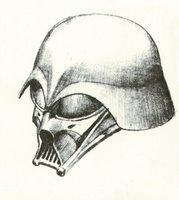 Again, the last four movies should make that theory smell like last month's baloney. And for the hold-outs who refuse to accept the evidence before their eyes, there's the "Making Of Star Wars" documentary that comes with the original boxed set. We get glimpses of Lucas' original studio proposal: they paint a picture of a man who is wildly uncertain as to what the adventures of "Luke Starkiller" (a 64-year-old general) actually entail. Before this proposal makes it to an executive's desk, someone passes it to Ralph McQuarrie, thinking a few of his illustrations might help sell the story. Mystery of mysteries, at this point the project begins to cohere.
There's yer genius, kids: Ralph McQuarry. Instead of looking for the Red Notebook, buy this book, and start making your own movies, because Lucas gave up on you 20 years ago.
Oh, no question - them, and Ed Wood's Plan 9 From Outer Space. Someone prone to a little common sense would simply assert that the last four Star Wars movies demonstrate Lucas's inept management of the most basic elements of storytelling. But that's the beauty of po-mo self-consciousness: wield it deftly enough, and you can get a giggle out of the very stones beneath your feet. Aidan Wasley of Slate gives Lucas the po-mo treatment, here.
My last word on the matter: I have, in a moldy cardboard box in my basement, several Star Wars magazines that were rushed into print the summer of 1977 - most of them spin-offs from Forrest J. Ackerman's Fangoria press. It's all breathless stuff, printed on pulp paper, with typos and poorly reproduced b&w stills from the movie. In its own weird and inevitable way, it probably contributes to the myth of Lucas's genius more significantly than the first two movies did. One of these rags (a "Poster-Mag!" - a large single sheet of medium-gloss paper that folds out into a large poster of Darth Vader and Storm Troopers boarding the Rebel cruiser) provides a lengthy history of Darth Vader and his origins. This was pulled, we are told, from George Lucas's fabled "red spiral-bound notebook" - an original text as mythical and valuable to SW fans as Q or the Dead Sea Scrolls are to New Testament scholars. Read 25 years later, it's amusing to see where the "history" meets the final product, and where it veers. The origins of Vader's apparatus are bang-on, right up to the light-sabre duel with Kenobi in the volcanic caverns, even while Lucas (I assume) cagily asserts that Vader physically kills Anakin Skywalker. It's almost enough to get a dewy-eyed fan wondering if this Red Notebook - an original document, a repository of every Star Wars Galaxy detail and mythical nuance - is the real deal.
 Again, the last four movies should make that theory smell like last month's baloney. And for the hold-outs who refuse to accept the evidence before their eyes, there's the "Making Of Star Wars" documentary that comes with the original boxed set. We get glimpses of Lucas' original studio proposal: they paint a picture of a man who is wildly uncertain as to what the adventures of "Luke Starkiller" (a 64-year-old general) actually entail. Before this proposal makes it to an executive's desk, someone passes it to Ralph McQuarrie, thinking a few of his illustrations might help sell the story. Mystery of mysteries, at this point the project begins to cohere.
There's yer genius, kids: Ralph McQuarry. Instead of looking for the Red Notebook, buy this book, and start making your own movies, because Lucas gave up on you 20 years ago.
Subscribe to:
Posts (Atom)