Showing posts with label books. Show all posts

Wednesday, June 22, 2022

KEITH RICHARDS: UNDER THE INFLUENCE dir. Morgan Freeman

Truth: I would rather listen to the people Robert Johnson has inspired than listen to the man himself. Also true: Keith Richards makes me want to dust off Johnson and give him another listen. I saw Under The Influence on Netflix. 

"Rock and Roll had nothing on these guys" -- Keith Richards on American Country Music in general and Johnny Cash and Carl Perkins in particular. 

Yeah , but there was a time when The Rolling Stones were particularly scary. Read Sway for some idea. And Keef is big on going straight to the source. Robert Johnson didn't record much, so The Centennial Collection should do you. Plus you get a spiffy essay by Jimmy Page. If you can find it I recommend The Sun Years by Howlin' Wolf. And I recommend the recently rebuffed Damn Right, I've Got The Blues by Buddy Guy -- the album that turned everything around (for Buddy Guy, of course). 

Sunday, March 18, 2012

Swinging The Bawdy Eclectic, With Sleigh Bells, Updike and DFW

What's an ambitious rock duet gotta do to distinguish itself from all the other riff-raff duets out there? Sleigh Bells surely know, but they ain't telling.


The prestige treatment they received in the glossies prior to the release of their sophomore album was something I hadn't seen since the Followill Boys groused their way to drunken stardom. Every glossy on the stand seemed to offer a blizzard of Photoshopped snaps of Derek E. Miller and Alexis Krauss in full-pout mode. A solid month of facing these two cutie-pies as they copped a surly 'tude made me want to bring them home and liquor them up with peach schnapps, just so I could watch them pee on the roses and puke on the cat.

I settled instead for buying the CD — Reign of Terror — at Walmart, and I've gotta say: I should have stocked up on the schnapps. Reign Of Terror is fine enough. It has its moments of sonic interest, even catchiness, and certainly suggests what must be a terrific stage show. But it's not going to get much repeat play in this household.

Another recent, impulsive CD purchase that won't be getting much repeat play: The Song Remains The Same. In Zep's case, though, I'm very fond of the music and the performances; it's just unlikely that I'll often be in the mood to indulge Jimmy Page's 28-minute attempts at tripping the light fantastic for his New York audience. Nor was he alone. All four of those dudes were ready and willing to unleash solos that ran as long as the average Sleigh Bells concert. I'll say this about that: whenever Zep took over a stage or studio or abandoned castle they made a point of hammering out music that they, at least, would never get bored playing.

A lofty ideal which, if Robert Plant's current attitude is any indication, ultimately failed them. It's also an ideal which the super-fragmented digital culture has lost all track of. Audiences and performers have changed, as they must, but I can't help nursing the codgery thought that today's music is just a wee bit (gasp!) disposable. But so it goes. Lofty expectations rarely serve anyone well in the mercurial world of rock 'n' roll.


I had lofty thoughts of my own, back when I was Sleigh Bells-aged. That was the early 80s, when I spent most weekday evenings penning Very Important Prose in Scribner notebooks. Like any young “artiste” I approached my chosen form the way Houdini approached a pair of handcuffs. Every short story was a brilliant reinvention of the wheel; every longer piece was . . . well, who knows what the hell they were? In the end they became a huge pile of paper in a box.
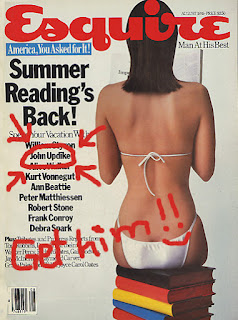
As I wrote I didn't mentally bother with any of my peers. If the cover of Esquire was any indication, they had yet to distinguish themselves. And while the generation of writers just ahead of me weren't without interest, I didn't pay much attention to them, either. My get-published strategy, such as it was, was to head directly for the king of the hill and push him off with the apparent immediacy of my own brilliant spin on their game. I figured there were three guys who routinely seized the title of America's Most Important Writer: Philip Roth, Norman Mailer and John Updike. Or, as my “peer” David Foster Wallace succinctly described them: the Great Male Narcissists.

My strategy (thankfully) didn't pan out. My peers, however, developed a unified strategy of their own that did indeed distinguish themselves from the GMNs, a protagonist they've shared in common: The Great American Loser. Elaine Blair surveys the field and admits it's a tactic that works, for her and a whole lot of other readers. But at what cost?

It's been curious to me the collective sigh of relief we've breathed at the passing of the GMNs. Roth still stirs a few people because he's still alive and writing, but is either Mailer or Updike on anyone's required reading list? It's been years since I bothered with either of them, so I recently thought I'd try an Updike, to see if the contents retained any sort of potency. I reached for Couples, figuring the voluminous sexual activity would, if nothing else, retain my interest.

After 75 pages I resorted to speed reading. A few more tries at that, and I finally put the book down, unfinished. The sex is boring, chiefly because the women are pliant ciphers. A few hundred pages of that can leave the reader with an impression of a fantasist whose masturbatory goals are best accomplished to the sound of his own voice.

This was a tune the GMNs never got bored of singing. It may be true that in the passing of their voices, our culture has swung decidedly to the fragmentary and disposable. But who could blame us?

Thursday, March 08, 2012

Current Curiosities

There's an old (2005) CD I dusted off, after hearing someone lament the unknown stature of the band that recorded it. I spun it while doing the housework, and thought, “Not bad.” I spun it again while taxiing the daughters to their various gigs, and thought, “Actually, this is pretty damn good.” Somewhere around the half-dozenth spin I was thinking, “Why aren't these guys a household name?”

Breaks Co-Op
— originally from New Zealand, now residing London, UK — have a unique and entirely palatable sound. It's hard to pin down. Apple calls it “Electronica,” someone else qualified it as “House.” I'm catching traces of Peter Gabriel and Talking Heads, Paul Simon and Trap Door-era T Bone Burnett — “World Beat,” I suppose. But then I'm also catching Buffalo Springfield, so what are you going to do with that? Any way you want to cut and dry their sound, Breaks Co-Op is deeply infectious. You should retrieve your own copy of The Sound Inside and give a spin or two, just to see if you don't find yourself listening to it for the half-dozenth time and thinking . . . there's something happening here.


Speaking of infectious: Here We Go Magic has released their first single, “Make Up Your Mind,” from their forthcoming album, A Different Ship due out in early May. It's got a lot of what I like, particularly in its West African-style guitar riff. Stream it, or even download the mp3, over here. And if the spectre of young women in their skivvies contorting in a squeamish state of erotic despair is your thing, by all means watch the creepy video, too.
"Gasp! Is that ... Plotto?!"
The case for bricks-and-mortar bookstores: some books really should be bought on spec, and not in good faith. Philip K. Dick's Exegesis is chief among them. Having skimmed through In Pursuit Of VALIS, the earlier Reader's Digest version of the Exegesis, I'm inclined to trust Rob Latham's judgement: Dick's metaphysics are best absorbed in his fiction, which has the incalculable benefit of having being written with publication in mind. And yet, and yet . . . looking at the list of contributors adding annotation to Dick's tome, I am still sorely tempted. (Addendum: r. crumb gives you his summary.)

Also worth a glance, if not a purchase, Plotto by William Wallace Cook. Its press makes it sound a bit like the first “Choose Your Own Adventure” book. But I could also envision (vaguely, at this point) a novel in which this book attempts to enforce a plot on the central character, and even the reader. Did Plotto anticipate the meta-plot? If so, this book poses a threat to life as we know it — and belongs on my shelf. (Addendum: uh-oh: Lytle Shaw knows!)

Wednesday, October 05, 2011

Jim Harrison, Among Others

Like Pete Dexter, I too am a fan of Jim Harrison. However, it will be some time before I get around to reading the new novel. I still have his last three books in the pile beside my bed, and I am very slowly picking my way through his memoir, Off To The Side. Happily for me, Harrison rewards slow reading, which may not be the greatest asset to his book sales (although it hasn't slowed my tendency as a buyer). The other weekend I watched this documentary (trailer below) of Gary Snyder and Jim Harrison. Snyder occupies the centre of it, as he should — a lifetime (more or less) of relative self-discipline has left him verbally articulate to a degree that his more indulgent brethren (ahem) can only aspire to.

Also for your consideration: Tom Bissell's fine account of encountering Harrison, both on and off the page.

Tuesday, September 20, 2011

Writer's 'n' Beans


You answer the door. It's your cousin Margaret, presenting you with a hot caserole dish for the Thanksgiving dinner. You smile, or wince, and accept the dish. “Baked beans?” you say, dreading the answer. She silently smiles — or smirks.

The family gathers around the table, the dishes are served, and everyone has to admit: those are damn fine beans. “In fact,” your husband offers, “I don't believe anyone does beans quite like our Margaret.”

“They're different this year,” says your mother. “Margaret, you've done something different with the beans.”

Again the smile/smirk. “Cardamom,” she says. “I try to do something different every year. This was the year for cardamom!” Happy laughter and smiles all around for cousin Margaret's incomparable baked beans.

Your cousin Margaret's beans are my metaphor in response to Dwight Garner's plea for our Important Novelists to step up production. I say, with one caveat, that a novel every ten years ought to be the writerly ideal, especially if the writer is really good at what she does. The list of Important Novelists whose yearly dish of baked beans wore out my welcome — incomparable though that dish may be — is a very long one, and recedes to a vanishing point as time goes on.

Garner trots out Dickens and Trollope as examples of what volubility can accomplish, but what about Thomas Hardy? Much has been made of the negative review that truncated Hardy's career as a novelist, but what if the poisonous toad who wrote it actually did Hardy a favour, making Hardy's the name that rings through the ages? If Hardy had managed a Dickensian output, would we still talk about him? Who wants to read 30 novels detailing the carnage that occurs when our flightiest romantic yearnings meet the hard whetstone of reality? No, three or four books of that nature will do just fine, thank you. And, let's face it, soul-crushing disappointment is what most Important Writers are all about. If you want to deluge the market with product, best to be cheerful and unassuming (like Trollope) or a sly crowd-pleaser (like Dickens).

Caveat: there are some Important Writers who apparently need to get three or four questionable books out of their system before they knock off something truly delicious and nutritious. T.C. Boyle comes to mind. Actually, so does Hardy. Really nobody should be actively discouraged from writing — or publishing. But even if you're an Oates or an Updike or an Atwood who can be relied upon for a delicious bowl of beans every Thanksgiving, don't take it too personally if the overwhelmed guests at the table forgo the pleasure of eating them.

Monday, September 12, 2011

Any Tears For Borders?

We were nervous when Chapters finally opened in downtown Toronto. Our little bookstore had recently celebrated its centenary — a narrow victory, from some vantage points, even if we were turning a profit. We were hustling just to stay relevant, never mind competitive.

The Bloor Street Chapters was the franchise's “flagship” store. The architect designed the façade to be reminiscent of an ocean liner. Obviously this store was going to be much, much bigger than ours.

It had been open for nearly a week before I mustered up the courage to check it out. It was indeed large, but still shy of the size and scale of some of the Borders and Barnes & Noble outlets I’d seen in California. I perused the stock and tried to ascertain the sales potential. Most of what I saw was backlist — books we didn’t have the shelf-space for, and wouldn’t have stocked even if we did. Backlist titles don't sell with nearly enough frequency to justify stocking. We’d just be sending them back to the publishers after three or four months of watching them grow yellow, a shabby business for both us and the publishers.

At the time, the government of Canada had just shut down a bid by Heather Reisman to bring Borders north of the 49th Parallel. The Canadian Booksellers Association was gratified; they'd fought Reisman with every resource they had, arguing that Borders’ distribution alone would be ruinous not just to Canadian bookstores, but to the entire publishing industry. I wondered if the Chapters model would be any better, but as I looked around their flagship store the one recurring thought I had was, There’s no point legislating against this. Too many people want it. Whether they could sustain it for anywhere near as long as 100 years was, I thought, doubtful. But regardless, that particular business model would just have to run its course.

The course has been run, so far as Borders is concerned. Some people are crying the blues, and I can sympathize. I’ve made purchases in Borders and Barnes & Noble. And Chapters — now Reisman's property — continues to get my money, chiefly with its remainders and magazines. But I’m not shedding any tears. I think it is a shame, in the most complete sense of that word, to see the “big” experiment fail. After witnessing the near extinction of small independents, it would have been a faint scrap of comfort to see something still standing. But so it goes. No more buffalo, as the bard has sung.


Photo, of a final stone being flung from within Borders' glass house, courtesy of Su.

Sunday, August 21, 2011

"Well, you do have eclectic taste."

A jolly shout-out to C & M Books of Anchorage, AK, my most recent favorite used book store, where the proprietress greeted me with the above evaluation of the books I queued up to buy. Last Sunday I spent several hours there, poring over the shelves and piles and boxes of books. This is one of those fabulous places of considerable character, where there seem to be an endless supply of unexpected treasures silently pleading to be discovered. C & M Books also houses a formidable collection of aviation-themed coffee mugs. If you're in the neighborhood, do yourself a favor and drop in.

Saturday, July 30, 2011

Hitting The Beach With Hipster Lit

We just returned from our yearly retreat to Maine (surely la belle Province de la belle Province; Maine's schools would do well to teach French as a second language). Alas, I left the beach before I perused this link from Darko: Bookhampton's Hipster Lit Shelf by Macy Halford.

When we were packing for the trip I seriously considered carting Roberto Bolaño's 2666 down to the sand and sea, but reached instead for a used and very weathered copy of Buffalo Girls by Larry McMurtry — a complete hipster fail, on my part, but also an effortless, emotionally rewarding read.

Halford notes the absence of female authors, and offers as a correctional Flavorwire's Ultimate Hipster Reading List. I think the search for the female literary hipster could be aided by the additions of Sheila Heti and Miriam Toews.

Wednesday, July 13, 2011

Harry In Retrospect


Today is a big deal for Harry Potter fans. For me, not so much. Back when I had the opportunity to get in on the ground floor of Potter mania, I stalled. I bought the first book, but found the author's tone too disagreeable to get me past fifty pages. Years later, when our family faced a lengthy car trip across the Canadian prairie I reached in desperation for the audio recording. To my surprise, Jim Dale's robust performance of the book won me over. He relayed the narrative as if, in fact, its twists and turns were jolly surprises to him. The next few years promised several lengthy car trips, so I bought or borrowed the rest of the series, which we finished last summer.

By then I was more than ready for it to be over. I'd grown weary of the Potter Plotline — begin with Squalid Episode in Harry's adoptive Muggle family; transport Harry to Hogwarts where he and his cohort sneak around to determine why Something Mysterious is happening; conclude with Perilous Quest and wrap it all up with Affirmational Epilogue — which Rowling took increasingly more time to lay out. I still wanted to know where it was all leading, but I tuned out for vast stretches of Dale's performance, often cluing in belatedly after someone in the car gasped with surprise.

Anyone who gets kids excited about reading, though, is someone to hold in high esteem, and J.K. Rowling more than qualifies. The Pottter Plotline worked, but more than that, the characters were compelling, especially to younger readers (again, as the characters grew to be all-too-convincing adolescents, my own interest thinned to near non-existence). But more than that, the magical environment these characters interacted in was entirely beguiling.

Near the end of the series, as the tone of the adventures grew increasingly gloomy, I can recall a critic tangentially lamenting that he hoped there might still be room in the (then) forthcoming books for another Quidditch match or two. It strikes me that this remark cuts closest to what has made those books and movies so successful: a landscape of enchantment, imagination and play that entices the reader to speculate and roam further. A little Googling seems to bear this out. Potter fan-fic is booming, and there are all sorts of folks trying to mount a successful Harry Potter on-line RPG.

RPGs . . . Harry Potter appeared just as Dungeons & Dragons was fading from suburban basements, and shortly before video games became persuasively immersive to both genders. Rowling so fabulously bridged that gap, I have to wonder: what might it look like to approach and weave together the next such nexus?

Friday, March 18, 2011

Marginalia

Whenever I had a university paper due, the library books I reached for were the ones that had been re-bound. The books were uniformly ugly: the re-binding was frequently lime green. The information within was often dated, the pages were leathery from overuse, and it was clear the next step for these resource materials was going to be the pulper. So why the preference? One word: marginalia.

Man, with some of those old books, the essays practically wrote themselves! Key texts were underlined (sometimes highlighted, which annoyed me with its visually jarring colors), and arguments for and against were outlined in the formerly white spaces on either side of the print, often with reference to other works I could look up and include. The feckless and inexperienced preferred newer books to these stinky old things. But at the end or early dawning of the day, who needed Cliff's Notes or even an essay-writing service when these troves were so freely available?

My own contributions to marginalia, on the other hand, should be ignored. Inspired by what I saw, I tried my hand at commentary. After a year or so, when I reread what I'd scrawled (in pen!) I was shamed in realizing what a pretentious twit I'd become. The marginalia promptly stopped.

Anyhow, teh interwebz is abuzz with the seemingly endangered art of marginalia. Will digital deprive us of this pleasure, this artform? Kevin Charles Redmon compiles a number of links exploring the issue, and contributes a few thoughts of his own. But so far, my favorite essay comes from Victor LaValle, who brings a ballsy disregard for the book as totem, over here. Perhaps the time to again uncap my pen has finally arrived.


Marginalia, David Foster Wallace-style.

Thursday, February 17, 2011

NIKOLSKI, by Nicolas Dickner: A Final Defense

Trussed up in his army-surplus sleeping bag, with his flashlight wedged under his chin, Noah examines the old map. He watches the mist rising from his mouth and thinks of Leonard, a classmate who at this very moment is busy stirring the venerable dust in Hydra in the Saronic Gulf. Noah has the feeling he is on the wrong island. He has thought several times of dropping out of university, but without a satisfactory alternative he could not bring himself to face the real world. And yet, here he is, stretched out on a bed of lichen, looking at an old map of the Caribbean, shivering (Nikolski, page 163). 

 In 1991 I owned a portable word-processor. It was roughly twice the size of a laptop, and its unique storage cartridge could hold up to a half-kilobyte of information. I composed my final year’s worth of underaduate university papers on it, and one or two stories, then printed those out on the clattering daisy-wheel printer that came with it.

That printer broke down, time and again. There was an office equipment store across the street from where I lived, so I walked the item over for repair, and discussed matters with the store owner. It was a very small business, run from a bungalow house. We talked the trade. “Over 99% of my business is out there,” he said, with a vague wave. “You’re the only one who comes in.” After a few exchanges with the man, he looked me over and said, “I need a sales/customer service person to look after clients north of the 401. You interested?”

I thanked him, and said, “I’m afraid I don’t own a car.” 

That exchange seemed to sum up too much of where I was coming from, and where I was — and wasn’t — going. I’d left the prairies for the big city, but what now? My younger brother was on the west coast, farming salmon. My youngest sister was studying in England. I had friends studying in Paris, others teaching English in Tokyo, Seoul, and the newly liberated Prague and Berlin. Toronto was . . . well, the only certain thing I could say for it was it was expensive. The whole business of “what next?” put me in an abysmal state of mind. 

A car — hell, it was a struggle scraping together enough coins for the self-addressed-stamped-envelopes that were returning my submissions with the usual rejection slips. And now I’d racked up a debt of a few thousand dollars to finish a degree that didn’t promise any sort of professional recompense upon completion. Was this really a good time to take out an additional loan to buy a car and apply myself to a trade whose future seemed increasingly dubious? 

Instead I applied for, and got, a job at the city’s oldest bookstore. It seemed like a reasonable compromise. History would have to play itself out on television screens, while I settled in amongst the books to pay off my debts and contemplate my next move.

I should mention that I’ve always found it hard to establish ties to people. It seems I’m too withdrawn, too much of a homebody. None of my very few lovers was ever able to understand why I was content to make a living selling books. Sooner or later they would end up asking themselves — and, inevitably, asking me — why I didn’t want to travel, study, pursue a career, earn a better salary. There are no simple answers to these questions. Most people have clearly defined opinions on the subject of free will: Fate (no matter what you call it) either exists or does not exist. There can be no approximations, no in-betweens. I find this hypothesis reductive. In my view, fate is like intelligence, or beauty, or type z+ lymphocytes — some individuals have a greater supply than others. I, for one, suffer from a deficiency; I am a clerk in a bookstore whose life is devoid of complications or a storyline of its own. My life is governed by the attraction of books. The weak magnetic field of my fate is distorted by those thousands of fates more powerful and more interesting than my own (page 147). 

Friendships formed, most of them with a profundity that continually catches me off-guard. We coupled up, disbanded, re-coupled. Children were born and raised, occasionally released to another's care. The lightness of it all was almost to be expected — the world is changing, who can keep up? — but the emotional depth and weight that haunted us all was the inevitable surprise. There are friends my wife and I see every two years or so, and in those rare meetings the relief we feel when we first catch sight of each other is palpable. 

And now the bookstores are closing. There are more television screens than ever, and they are once again filled with crowds of people demanding change. Our children travel to distant countries, then return to the family table for supper. Their own social and sexual congress seems at once lighter and more haunted than what we remember from our early adult years. And is there any trade or profession they can rely on for provision?

This fingernail clipping of personal history is all I can offer by way of literary criticism to defend my attraction to Nicolas Dickner’s novel, Nikolski. Our personal stories have a shape and continuity to them that will not be denied, but these shapes elide. Late revelations are always forthcoming, and like the novel’s late revelations they confuse as much as they clarify. 

Still, there is an appeal to this book that is almost musical. Like so many of Dylan’s marathon songs (“Brownsville Girl,” “Lily, Rosemary, And The Jack Of Hearts”) this novel introduces people with passions that defy both summary and satisfaction. Dickner has said that, after hearing Leonard Cohen’s “Famous Blue Raincoat” for the first time, he threw the manuscript for this novel into the trash, and fled his apartment. I’m grateful he retrieved it and pressed on. This is a novel with a fade-out “conclusion,” suggesting the song carries on even after the listener moves on to the next bit of entertainment. It is as humane and optimistic a conclusion as literature can offer.

My earlier Nikolski ruminations are here.

Tuesday, January 18, 2011

The DK Handbook


Dorling Kindersley is one of the most innovative publishers working in print today. Even consumers who steer clear of bookstores will recognize a DK product: the unmistakable DK layout is visually striking and wholly unique, At first glance it often looks like DK's primary emphasis is on illustration (typically color photography), making it is easy to underestimate just how germane the textual content is. But whether the product in question is a travel guide, a cook book or a children's reference book the written content works in tandem with the illustrations to bring about a profoundly informative reading experience.

Several DK publications have proven invaluable to our family. We have Eyewitness travel guides that are well-worn with use (particularly the one to San Francisco). In years past the girls relied on Eyewitness Ancient Greece, Rome and Medieval Life to give them clear direction through school projects. And of all the bicycle maintenance books I own, the one I refer to most is a portable, plastic-sheathed guide from DK that fits easily in my bicycle seat bag.

This morning the daily feed from Amazon recommended The DK Handbook. At first glance it struck me as an odd project for DK to attempt: a visually intuitive composition handbook for entrance-level university students. I glanced at the content available on Amazon, then went over to the official site for the DK Handbook and looked through what they had on offer, including the videos. The longer I considered the project, the greater its potential seemed.

The Amazon user comments are interesting. The raves seem to confirm the project's promise. The dismissals, of course, are predictably huffy and old-school. “After 30 years in education,” sniffs one user, “it seemed to me that most of the first part of the book is taught in fourth grade.” Well, that might* have been true 30 years ago, but today's university profs will regale you at length about just how wretchedly prepared entrance-level students are for basic composition.

Regardless of how well it finally achieves its mandate, the DK technique is revolutionary and always worth a closer look. It could well be that DK's visual approach is exactly what today's profs and students require.


*Actually, 25 years ago Canadian universities began establishing basic rhetoric classes as a requirement for first-year students precisely because this level of comprehension was not there.

Thursday, November 18, 2010

Mr. Darwin's Shooter, Take One

It was like the brain had several parts, each representing a faculty of thought, such as love, morality, veneration, greed, preferment, lasciviousness. Covington knew that his own head was a lumpy job. He knew which qualities gave him an itch in the belly, and which made him whistle with hope and pleasure when he woke in the morning and jumped to his duties after saying his prayers. Between the bumps on his head and the blood in his veins there was this third capacity making him glad. It was the spirit of the Lord, the joy of being alive. He would be robbed of his meaning without it.

Thanks to the limits of inter-library loans, at some point today I will have to sit and quaff down the remaining 135 pages of Roger McDonald's fine novel, Mr. Darwin's Shooter (A). I have savored it at a leisurely pace, which I think is how the book begs to be read. Unfortunately I have been too leisurely in my savoring and have exhausted my limit of renewals.

I could, and probably will, buy the book on-line, but I'm now thirsty for the conclusion. This isn't a narrative built on unforeseeable surprises. We meet two Covingtons as the book progresses: a young man taken up by “the spirit of the Lord” and eagerly exploring every pleasure in the wide natural world; and an older, bitter man hobbled with manifold injuries, the worst of which is inflicted on his consciousness. We know from the title some of what has taken place to bring about the latter. Covington is Mr. Darwin's shooter, and in the course of his assisting the young doctor in his efforts to establish the theory of natural selection will find himself bereft of the spirit of the Lord.

McDonald's historical fiction is lovingly detailed, but he imbues his protagonist with a ferocious energy and activity that carves tantalizing gaps in this tapestry. The full story is knit-together — re-knit, really — over the course of the novel. I don't expect it, but even if the final third of the novel were to fall flat, Mr. Darwin's Shooter would be a candidate for the most memorable novel read this year.

Saturday, November 13, 2010

Circumnavigating Coupland

I know I've been a bit snippy toward Douglas Coupland lately. I've been a bit snippy toward nearly everyone and everything lately, so, World: I apologize. I'll try to do better.

Getting back to Coupland: he was tapped on the shoulder to do this year's CBC Massey Lecture series — here is the official link. Did you see that bit about being "widely regarded as the most important public lectures in Canada"? Kinda says more than the flack who wrote those words probably intended, doesn't it? But first time listeners should be forewarned: it's usually only a matter of time before the stuffed shirt delivering the lectures gets your back up.

Last year's lectures by Wade Davis (A) certainly accomplished that with me. A well-traveled, studied, accomplished anthropologist, Davis is appropriately horrified at the precipice our species teeters on thanks to its heedless submission to the tenets of modernity and materialism. His five lectures tucked into a feast of delicious detail culled from the just-barely-surviving wisdom traditions from a few tenacious tribal cultures in extreme climates. While I appreciated much, if not most, of his appeal, his lush praise for the ancient also struck me as a tad naive, if not conveniently two-faced. In the early 70s my grandfather pastored a Mennonite colony in Paraguay, and was frequently amused by the meddling of ardent anthropology students from el Norte. He told of a meeting he encountered between a tribe and a student. The erstwhile anthropologist was lecturing the chief, beseeching him to pull his people back into the jungle where life was good. The chief listened patiently. When he finally was given a chance to respond, he basically hiked a thumb over his shoulder and said, "The bush is that way, kid. If you like our ancient way of life so much, you're welcome to live it."

So, yeah: Coupland should feel right at home with this format. And you may find yourself, as I frequently do, tried by the tone of voice. But if you don't mind the provocation — if, indeed, you actively seek it out — "the most important public lectures in Canada" might just be your cup of tea.

They are, for the moment, available as a downloadable podcast here (scroll down to 2010 CBC Massey Lectures and right-click on the links). Or, if you prefer a more flingable format, the book can be had at Amazon.

Wiki: Massey Lectures.

Thursday, November 11, 2010

How 'bout That?

Well, well. I don't know why, but I expected someone else to win -- the Mennonite, maybe (again). But there you have it: Gaspereau will now make a few people very, very happy at Christmas -- or not.

Thursday, October 14, 2010

Soundtrack For The Slough

Neither of my trusty comfort food authors — George Pelecanos or James Lee Burke — seem to be reaching me this time around. There’s no point in me getting technical about the distance, since they’re doing pretty much what I’ve always paid them to do. The problem lies with me: I’m momentarily mired in a wee slough of despond, in which the usual charmers have lost their powers to distract. There are a number of reasons for this. I left my job in June. It was, and remains, the right thing for me to do, and it freed me up wonderfully for the summer. But I haven’t yet found another to replace it, and I miss the contact with other people, especially now that the girls are back in school.

Also, this month marks the second anniversary of my father-in-law’s death, and I think my wife and I miss him more this year than we did last. So it goes. Although there is a certain amount of activity a person should engage in to prevent grief from slipping into self-indulgence, the absence must be acknowledged. Attention must be paid.

Even in this condition, however, it surprises me that Mordecai Richler’s social dyspepsia fails to move me. In preparation for Montreal I pulled Barney’s Version off the shelf, figuring I’d best give it one last read before Paul Giamatti’s mug permanently burned itself into my brain as the lovably difficult (to say the least) Barney Panofsky. I have to say, 45 is a much better age to read this book than 32 was. Even so, I’m taken aback to realize that nearly all the cultural/historical points of reference that Richler/Panofsky comment on with such acidity have pretty much passed their “best before” date. Richler seems to have sensed this eventuality, and wields these details with a canny awareness of their, and his narrator’s — and his own — mortality. Still, it makes my bittersweet read of the book more bitter than sweet. I can’t imagine a 25-year-old Canadian reader connecting with this book at all, never mind at the pleasantly superficial level I seemed to 13 years ago.

Thankfully, music still hath charms. In a last-minute scramble to use up my monthly downloads at eMusic, I tripped across Signify by Porcupine Tree — and fell in love. PT’s rep seems to be “new prog.” I haven’t heard enough of what they’re up to lately to comment, but this artifact from 1996 is moody and ethereal (“atmospheric” to use the parlance), occasionally lyrical in a Flaming Lips sort of way. Sampling is judiciously resorted to: one or two evangelists are recruited for sound-bites that could, but needn’t, be heard ironically (although if one of these evangelists is, as I suspect, Benny Hinn, irony is better than he deserves). They struck me as a Life After God echo, which has a winning sincerity of sentiment for me. Signify plays like the last soundtrack to be broadcast before the Blade Runner world of indentured serfs and privileged enforcers finally took over.
My most recent aural fixation is with True Love Cast Out All Evil by Roky Erickson, former front-man for the 13th Floor Elevators. When it was first released in April I took only vague note of it. Erickson’s reputation to date had been as one of rock ‘n’ roll’s most spectacular acid casualties, a la Syd Barrett and Brian Wilson — here’s the wiki. True Love Cast Out All Evil was hailed as a recovery/comeback for Erickson, a designation that, for me, has all the appeal of reheated left-overs.

On one of my recent forays as Taxi-Driver To The Adolescents, I retrieved a copy of Mojo collecting dust on our coffee-table. I’d bought it some months earlier, but hadn’t yet leafed through it. I perused while waiting for the event to conclude, and found it to be exactly the sort of issue Mojo is occasionally brilliant at. Tom Waits “guest edits”, so that flavors much of what’s present. He interviews Hank III; Joe Henry interviews Harry Belafonte. And Bill Holdship gives a rave review for True Love Cast Out All Evil.

Until I read Holdship, I hadn’t realized just how deep an abyss Erickson has emerged from. And while True Love is all about the gift of recovery, it has a sound that echoes back into that void. Okkervil River, who I never had much of an ear for, prove themselves to be Erickson’s ideal collaborators, conjuring a background that drifts from dreamy to jarring to triumphant. The album is very much a gospel tent extravaganza, with a bloody-heart-on-the-shirtsleeves sincerity that will either convert the listener or send him back out to the cold back alleys of Hell. Something like this will never appeal to everyone, but it certainly feels like it has found me, and not the reverse.

Thursday, September 30, 2010

Stuck In The Middle With Franzen

'Tis the silly season for lovers of the printed (virtually or otherwise) word. It all began with the industry that's built itself up around Jonathan Franzen, of course. Time Magazine and a whole heap of others think he's Jesus with a Mac Book; others are sure he's the anti-Christ. This guy (linked via ALD) equates Franzen et al with "our bankers" -- to which I can only say, "Dude: time for a reality check." If there's a family sleeping in their car because Franzen spent five years writing Freedom, let me know at once.

It's either love or hate Franzen, isn't it? I haven't yet read the new book, but I kind of like his earlier stuff. I have very distinct visual memories from The Corrections, particularly of a younger Alfred in a white shirt, standing on a railroad trestle with a ball-peen hammer in hand. Franzen is, were I to resort to a reviewer-cliche, certainly an evocative writer.

Until it comes to sex: suddenly everything feels staged, and his characters have a distant, critical, authorial point of view I simply can't buy. Perhaps I should be the last to cast a stone, but I thought Enid's discussion of family financial strategy while fellating Alfred (complete with the Crumb-y onomatopoeia "glub") was a particularly vexatious low point in The Corrections -- and it occurs just pages after the scene on the trestle.

In the main, however, I do look forward to reading the new book -- as soon as it's available at the local library.

Elsewhere: I can't write in cafes -- especially not in my former place of employment, where everybody really does know my name. But malls? Give me a Bic and scribbler, and I'm off to the races.

Wednesday, June 23, 2010

The Secret To A Successful Novel Series

Lee Child has garnered a very loyal fan-base with his Jack Reacher novels, especially among the glossy mag corner office set. After David Granger suggested Child might be on par with Hammett and Chandler, I walked over to the library and picked up the first Child title my eyes set on: One Shot (A). I polished it off, and was happy for the experience, but the title might well be self-prophetic. Whether or not I reach for another Reacher novel is strictly a question of circumstance: if he happens to be the most attractive option then, yes, I'll read another novel by Child.

Child's work is meticulous. He does wonders with the standard Road Runner storyline, building suspense with narrative distractions and sleight-of-hand (“Good Lord, that's a big cannon! How's the bird going to get the coyote to be the payload recipient?”). The Road Runner bookshelf is getting a bit crowded — Carl Hiaasen and Stephen Hunter are two other practitioners who come to mind — but Child stands out by keeping hero and hijinx somber: Reacher rights wrongs for personal reasons, some of which might seem high-minded at first glance, but usually boil down to an emotional, “I'm gonna git you, suckah. ” I'll take such bald narcissism over Hunter & Hiaasen any day: Hunter's heroes can't help but explain the ways of God to men, while Hiaasen's capers veer into the truly cartoonish. Neither of these writers became a habit of mine.

Which gets me wondering: how does a writer reach out and hook a reader for life? There aren't many who have managed that feat with me; maybe it's not the writer, but the reader. There are two novelists I follow religiously who usually release a title a year: George Pelecanos and James Lee Burke. Burke got to me because I first read him shortly after an emotional break-up, a vulnerable moment when I could very much identify with a washed-up Catholic cop whose wife had just died. After that I wanted to keep tabs on my fictional “buddy.” As for Pelecanos, he writes crime novels: Road Runner wannabes generally don't fare too well in his world (yes!). After these two, there aren't many others I'll indulge with a yearly sit-down.

Alright, let's open the floor: who are the writers you pick up, year after year? What's the “trick” that makes it work for these artists? Inquiring minds want to know.

Tuesday, June 22, 2010

In Praise Of Youthful Dystopias

In the early days of parenthood I silently vowed I'd read everything my daughters were reading, to gain that precious insight into their developing psyches. These days as my daughters tip-toe through the minefield of adolescence (and I speed toward my fifth decade) that vow has proven itself . . . naïve. I can barely tolerate the novels I enjoyed in my 20s; what hope is there for me of ever finishing anything, say, Twilight related?

That is why I am grateful for Laura Miller's survey of dystopian “YA” fiction. Both my daughters will tell you they can't wait for August, when Suzanne Collins' concluding book to “The Hunger Games” will finally hit the shelves. When the girls describe these and other books to me, my first reaction is fatherly concern: This sounds rather grim and bloody for a young girl — n'est-ce pas? My second reaction is a hesitant, Um, should I be reading this?

Of course, as the girls regale me with their excited (and lengthy) summaries I reconnect with some of my own adolescent reading habits. S.E. Hinton's fatalistic weepies seemed to be popular with everyone, and I can remember enjoying a handful of them. During the fall of 1977 I devoured every Jay Bennett thriller I could get my hands on, beginning with The Birthday Murderer. The wiki summary is spot on: “The usual Bennett hero was a late-teenage loner drawn by circumstances beyond his control into a treacherous and confusing situation. A recurring theme was the need to reject alienation in favor of reaching out to others.” As I recall, Bennett made it quite clear that “reaching out to others” was genuinely difficult work, a message that resonated with me as profoundly as did the “treacherous and confusing situation.”

That halcyon season of Bennett thrillers was a short one, to be sure. I can well remember the sinking feeling I had when I realized I knew the mysterious villain's identity within pages of opening the third book. Bennett's “O. Henry” template was too inflexible to cultivate a deep readership.

There were also the pulps, and that sole Stephen King novel, which, had I known it was Stephen King, probably would have changed everything. After that it was “adult” reading: Alistair MacLean and Louis L'Amour inevitably leading to James Jones and Ernest Hemingway and all the rest of 'em.

Getting back to Miller, she title-drops some of the dystopian “youth” novels from the past, but the only one I read was Z For Zachariah, which I thought was criminally tedious. The direct antidote to that book was The Road Warrior, one of the first “Restricted” movies I bluffed my way into. That movie was the YA book I'd wanted to read. Sure, a nuclear holocaust would be a downer — in reality. But I wanted a perilous, action-packed fantasy. It sounds to me like those are the books Collins is writing, and I'm just grateful someone's providing this for my kids.

Addendum: Caitlin Flanagan recommends adolescent girls read Testimony by Anita Shreve, one book I'd definitely read before passing along. (A)

Tuesday, April 27, 2010

NIKOLSKI by Nicolas Dickner

Legend has it that Noah drew his first breath in Manitoba, somewhere between Boissevain and Whitewater, near the railroad tracks, in a spot that, according to the road maps, is located at the exact geographic centre of Canada. The truth is that it was the exact centre of nothing at all: an immense forest of spruce stretched to the east, blackish peat bogs to the north. To the south, the Turtle Mountains, and to the west, a plain that appeared to end in China.

“The truth is that it was the exact centre of nothing at all” is true enough, on one level, but grossly misleading on another. If you make a big deal out of the fact that this guy was born in the center of a map, take pains to describe the geographical terrain, then shrug and say, “It's really no big deal,” you've more than doubled its significance. And so it goes throughout Nicolas Dickner's delightful first novel, Nikolski (A), which follows the migratory patterns of three characters and their social cohort. This is a book that makes pleasant mischief on reader expectations — not with po-mo smartypants “gotchas!” but with a sincere affection for characters, their response to time and place and their deepest yearnings.

Dickner employs a deceptively light tone to examine the ties that bind: family, passion, genetics, love, history, mystery, sex. “In my view,” says the nameless narrator, “fate is like intelligence, or beauty, or type z+ lymphocytes — some individuals have a greater supply than others. I, for one, suffer from a deficiency; I am a clerk in a bookstore whose life is devoid of complications or a storyline of its own. My life is governed by the attraction of books. The weak magnetic field of my fate is distorted by those thousands of fates more powerful and more interesting than my own.” Again, his own story, which is so integral to the proceedings, gives lie to the sentiment he has just expressed. There is a near-truth to what he is saying, but the larger truth of his significance is embedded deeply within the book itself.

I think the "Nikolski Compass," which points to the titular town a few degrees removed from True North, suggests there is a pull to humanity that almost corresponds to explanation, scientific or otherwise, defying summary just enough to bring joy to our attempts at the same. With Nikolski, Dickner has cooked up a most scrumptious literary invitation for readers to delight in, which now properly belongs near the top of this list.

Post-script: a little scouting for responses to this book turns up the usual, "I liked/disliked it" trove. Patrick Ness's thoughts resonated with my own, here. On the other side of the spectrum, James Grainger pans it, here. Neither reader indulges in spoilers, but I think they're both best read after the fact.