When I was a kid in the 70s, the summer camp I went to held a yearly “cyclathon” fundraiser. Kids rode their bicycles to the camp; the camp collected money (and mailing addresses) from the marks who sponsored the kids. It was a pennies-per-mile arrangement, and the distance to the camp was rounded down to 100 miles, completed over two consecutive days.
I managed this feat twice, when I was 12 and 13 years old. I rode a CCM five-speed, wore cheap sneakers, tube-socks and polyester gitch purchased at the local “Style-Rite” store, and threw on a pair of recent cut-offs. T-shirt was optional (for boys) and using sunscreen (or “suntan lotion,” as it was so quaintly referred to) was unheard of.
There was a great deal to endure besides the dreary reality of churning through a day’s worth of Canadian grasslands. The event drew an enormous crowd of participants, which put me on edge even back then. Participants were divvied up into groups of six or eight; you could request, and be reasonably assured of, the company of a friend, but after that it was the luck of the draw who you wound up with. My memories of both groups are marked by disagreeable loud-mouthed lunks who were maybe two years away from impregnating and marrying their first wives. And despite the fact that everyone had just pedaled close to 60 miles that first day, it seemed like I was the only one keen on getting a good night’s sleep.
In the days leading up to my second cyclathon I was bed-ridden with a wrenching case of diarrhea. Nevertheless, the dawn of departure found me gingerly perched on top of my bicycle, ready to go. Ten miles later, I was lying in a ditch, staring up at the blue sky and wondering why I wasn’t on my bike anymore. I sat in the camp director’s truck for a few minutes, sipping on a warm coke and answering the man’s questions (“How much money did you raise? How are you feeling now?”). He urged me on, so on I went. Lunch was hot dogs, chips and pop; supper was sloppy joe sandwiches.
And yet — and yet — despite all this my predominant emotional memory of these two rides is one of happiness. Despite being too sore to walk, never mind ride, the second day of cycling felt like a gift. The flat and wind-swept prairies were decisively left behind for the rugged and rolling terrain of the Canadian Shield, a welcome variety that couldn’t help but lift the spirits. Even better, our group leader was now worn down to indifference, and no longer made any effort to keep the group together. Now my buddy and I could pedal in peace, enjoying the scenery and discussing what mattered most — Star Trek — while the others pushed ahead to see who could arrive at the camp and plunge into the frigid waters first.
But more than that, those trips offered a very welcome and lasting change in perspective. An adolescent kid living in a small town surrounded by seemingly endless prairie will tend to think of himself as “stuck” if he doesn’t have access to a car with a full tank of gas. A 12-year-old kid who got on his bike and pedaled from that small town to his favorite summer camp 100 miles away thinks very differently about his circumstances — so long as he has access to a bicycle. There are at least four guys I know from my cyclathon days who went on to do fabulous multi-week bicycle tours of exotic locales, long before “outfitters” showed up to offer their decadently comfortable and nutritious versions of the cyclathon.
Last Saturday as the fam celebrated my birthday with pecan pie on the porch, the younger asked me where I’d bicycled that morning. “Zephyr,” I said.
“Whoah. That’s far.”
It was a 65 kilometre round trip. But far? Well . . . .
Showing posts with label bicycles. Show all posts
Showing posts with label bicycles. Show all posts
Tuesday, June 21, 2011
Sunday, September 28, 2008
An Experiment
I realized this morning, and not for the first time, that bicycle riding changes my thought patterns. Subject matter that is mulled over the duration of a ride is often distilled into something almost manageable by ride's end. I'm not sure why I should bother with a public log that chronicles this and other insights, except as some sort of recompense to my faithful readers for any lack of insightful blogging here.
If you're truly curious about the trivial turns of my aging mind as I spin my wheels (in every sense of that phrase) go here and read on.

If you're truly curious about the trivial turns of my aging mind as I spin my wheels (in every sense of that phrase) go here and read on.

Friday, September 12, 2008
How To Inspire Bicycle Lust

BoingBoing links to Ray Dobbins' photo-workshop, where he explains how to take jaw-droppingly gorgeous shots of bicycles while on a budget. I followed some of his instruction until the neat-as-a-pin garage/workshop caught my eye and distracted me. His gallery is here. Medici, de Rosa, Eddy Merckx ... what: no Sekine? You're still slummin' it, dude!
Thursday, June 26, 2008
Bicycles, One Year Later
“You know, we really don’t need more than three speeds on a bicycle.” So said my friend as we rode to the riverbanks. This was 21 years ago. I had just dropped $1000 on a bike with 18 gear configurations. His bike was a spanky 12 speed. And he was right: for Winnipeg riding, most healthy young adults will be well served by three gears.
I moved to Toronto shortly after that. It's a city of many hills plus a ravine or two, if you’re up to it. I now resorted to a total of seven gear configurations. The trouble was, these seven configurations required three gears on the chainwheel and four on the freewheel. That’s how we end up owning 12-speed bicycles.
My friend’s observation snickered in the back halls of my memory when I had my conversation with a guy at this shop last summer. The fellow I talked to was in the business of making bicycles for Winnipeg, and he was loathe to install any sort of derailleur system at all. Derailleurs are touchy devices: they require constant readjustment, no matter how many “improvements” are made to the technology. I could see the beauty of his argument, but the style of riding I wanted to do and the locale I was going to be doing it in required some gearing flexibility, so I went with an 18-speed bike.
 The hills I face look pretty manageable, don’t they? The guy I bought the Jake from said it was perfect for touring, and showed me a picture of a customer riding one in the Canadian Rockies. She’d apparently taken it from the West Coast to the East.
I can’t quite believe it — at least, not with the gearing my bike has. It’s technically a competition bicycle, so even on these weenie hills, I find myself struggling to make it up the grade on my lowest gear. Granted, I’m a 43-year-old male working on increasing his lung capacity, but I still can’t imagine that young lady grinding up the mountains of British Columbia using the standard-issue gearing. Conversely, I’ve yet to use the Jake’s highest gear. Perhaps it’s the gravel surface (plus the occasionally startled deer or bear) that prevents me from throwing all caution to the wind, but I get alarmed at the speeds I reach as I hurtle down the hills, and I’m usually three gears away from the top. Note to self: should I attempt anything longer than a day’s journey, I’ll probably want lower gearing.
 Derailleur adjustment is something I seem to be doing more of with this bicycle than I did with my last. I’m also not too crazy about the shifting system. For one thing, the location is a little inconvenient: you twist the brake levers or thumb the shifter on the inside of the lever hood. This has to be done with your hands on top of the bars, as opposed to inside the drop bars, where you generally want to be as you prepare to zoom downhill. For another, shifters are “indexed” these days: the rider punches and clicks the gear combo he wants, and — ka-chunk! — Bob’s-yer-uncle. Again, this is a very nice shifting system to have if you’re in competition; so long as it’s combined with a finely-tuned derailleur it will save you many precious split-seconds. For my purposes, however, I can’t help but think fondly back to...

...those old friction shifters. *sigh* It took some time to acquire a feel for the gearing combinations, but once you’d adjusted the extreme ends of the shifting spectrum (and let’s face it: if you’re riding hills, that’s where the majority of your gearing resides anyway) your maintenance work was done — usually for months afterward. As for shifter position, just a few inches south on the down tube was darn near perfect no matter how you gripped the handlebars.
Speaking of handlebars, another look at the Jake's reveals an irony I rather enjoy:

See those little silver brake levers? If you’re a cyclist of a certain age, they’ll remind you of this:
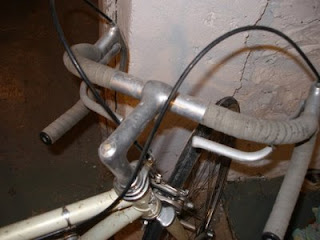
Oh, how gauche those levers were — in 1985! Those were kiddy-brakes, a mere half-step removed from training wheels. If you had ‘em on your bike, you were a dilettante and not a serious cyclist — in 1985. My, how times have changed (although it’s worth noting that the old brake levers were not good in emergencies, and that the new brake levers are actually tighter than the ones on the drop bars).
Alright, enough kvetching. The bottom line is, I love riding this baby — love it. It is far and away the lightest, fastest bicycle I have owned. Once I get on it, I don’t want to get off, even after an hour-and-a-half of country hills. The frame geometry is more stable than the Sekine’s, and more comfortable, too. As with my beloved Fisher, the Jake's wheels absorb the bulk of the shock and are built to withstand unbelievable punishment — certainly far more than I take on with these washboard roads. On the other hand, aluminum is noticeably more rigid than chromoly steel, so I’ll be curious to see what shape the frame is in some 15 years from now.
Now all it needs is a gun-rack, for those pesky bears....

I moved to Toronto shortly after that. It's a city of many hills plus a ravine or two, if you’re up to it. I now resorted to a total of seven gear configurations. The trouble was, these seven configurations required three gears on the chainwheel and four on the freewheel. That’s how we end up owning 12-speed bicycles.
My friend’s observation snickered in the back halls of my memory when I had my conversation with a guy at this shop last summer. The fellow I talked to was in the business of making bicycles for Winnipeg, and he was loathe to install any sort of derailleur system at all. Derailleurs are touchy devices: they require constant readjustment, no matter how many “improvements” are made to the technology. I could see the beauty of his argument, but the style of riding I wanted to do and the locale I was going to be doing it in required some gearing flexibility, so I went with an 18-speed bike.
 The hills I face look pretty manageable, don’t they? The guy I bought the Jake from said it was perfect for touring, and showed me a picture of a customer riding one in the Canadian Rockies. She’d apparently taken it from the West Coast to the East.
I can’t quite believe it — at least, not with the gearing my bike has. It’s technically a competition bicycle, so even on these weenie hills, I find myself struggling to make it up the grade on my lowest gear. Granted, I’m a 43-year-old male working on increasing his lung capacity, but I still can’t imagine that young lady grinding up the mountains of British Columbia using the standard-issue gearing. Conversely, I’ve yet to use the Jake’s highest gear. Perhaps it’s the gravel surface (plus the occasionally startled deer or bear) that prevents me from throwing all caution to the wind, but I get alarmed at the speeds I reach as I hurtle down the hills, and I’m usually three gears away from the top. Note to self: should I attempt anything longer than a day’s journey, I’ll probably want lower gearing.
 Derailleur adjustment is something I seem to be doing more of with this bicycle than I did with my last. I’m also not too crazy about the shifting system. For one thing, the location is a little inconvenient: you twist the brake levers or thumb the shifter on the inside of the lever hood. This has to be done with your hands on top of the bars, as opposed to inside the drop bars, where you generally want to be as you prepare to zoom downhill. For another, shifters are “indexed” these days: the rider punches and clicks the gear combo he wants, and — ka-chunk! — Bob’s-yer-uncle. Again, this is a very nice shifting system to have if you’re in competition; so long as it’s combined with a finely-tuned derailleur it will save you many precious split-seconds. For my purposes, however, I can’t help but think fondly back to...
...those old friction shifters. *sigh* It took some time to acquire a feel for the gearing combinations, but once you’d adjusted the extreme ends of the shifting spectrum (and let’s face it: if you’re riding hills, that’s where the majority of your gearing resides anyway) your maintenance work was done — usually for months afterward. As for shifter position, just a few inches south on the down tube was darn near perfect no matter how you gripped the handlebars.
Speaking of handlebars, another look at the Jake's reveals an irony I rather enjoy:

See those little silver brake levers? If you’re a cyclist of a certain age, they’ll remind you of this:

Oh, how gauche those levers were — in 1985! Those were kiddy-brakes, a mere half-step removed from training wheels. If you had ‘em on your bike, you were a dilettante and not a serious cyclist — in 1985. My, how times have changed (although it’s worth noting that the old brake levers were not good in emergencies, and that the new brake levers are actually tighter than the ones on the drop bars).
Alright, enough kvetching. The bottom line is, I love riding this baby — love it. It is far and away the lightest, fastest bicycle I have owned. Once I get on it, I don’t want to get off, even after an hour-and-a-half of country hills. The frame geometry is more stable than the Sekine’s, and more comfortable, too. As with my beloved Fisher, the Jake's wheels absorb the bulk of the shock and are built to withstand unbelievable punishment — certainly far more than I take on with these washboard roads. On the other hand, aluminum is noticeably more rigid than chromoly steel, so I’ll be curious to see what shape the frame is in some 15 years from now.
Now all it needs is a gun-rack, for those pesky bears....

Wednesday, April 30, 2008
Meet The New Bike
This February, emboldened by my visit with the good folk at Natural Cycle, I determined to disassemble my trusty old bicycle and give it the sophisticated attention it so desperately needed. I took the bike into the basement, pulled out my tools and carefully laid them out the way a surgeon might. Then I retrieved my manuals and set them beside the tools.
I considered my first move.
Then I reconsidered. Why not see what it would cost to get a pro to do this? I took it to my local outfitters, and asked.
"So you want a basic overhaul?" he said.
"Well, certainly that. But there are a few other things I'll need as well." I began to enumerate, and watched as his eyes glazed over.
"Well ... I can do that," he said, once I finished my list. "I have to give you fair warning, though. Here's what it's going to cost, not including parts replacement."
He told me. It was time for my eyes to glaze over. I cleared my throat and said, "Remember that bike we talked about last spring? It's a cyclocross model."
"The Jake?"
"That's the one. What's the sticker price?"
"Actually, I've got two left over from last season that I'm trying to get rid of."
"Any chance one of those might fit me?" I asked.
"Oh, there's a pretty good chance, I'd say...."

I considered my first move.
Then I reconsidered. Why not see what it would cost to get a pro to do this? I took it to my local outfitters, and asked.
"So you want a basic overhaul?" he said.
"Well, certainly that. But there are a few other things I'll need as well." I began to enumerate, and watched as his eyes glazed over.
"Well ... I can do that," he said, once I finished my list. "I have to give you fair warning, though. Here's what it's going to cost, not including parts replacement."
He told me. It was time for my eyes to glaze over. I cleared my throat and said, "Remember that bike we talked about last spring? It's a cyclocross model."
"The Jake?"
"That's the one. What's the sticker price?"
"Actually, I've got two left over from last season that I'm trying to get rid of."
"Any chance one of those might fit me?" I asked.
"Oh, there's a pretty good chance, I'd say...."

Friday, August 31, 2007
The Winnipeg Neighborhood
There were parts of the old neighborhood that had changed significantly. An elementary school that had been located around the corner from my family's house was razed and its enormous yard rezoned for further suburban development. That added a few new streets, and a few dozen houses.
Commercially speaking, it was a case of the more things change, the more they stay the same. The mall where I first bought pizza by the slice and hung out with my mates was gone; in its place was a "Power Center" -- a parking lot hemmed in by the usual franchises and outlets. The automotive parts shop that kept my motorbike running was now a very flashy fitness center. A privately owned family restaurant where a number of my friends got their first job built a larger, swankier-looking restaurant -- right beside the old one, which was empty and looking for a renter. A little further down the main drag we passed a former Pizza Hut that now housed a dentist's office.
The dentist's office caught my wife's imagination. "That's Winnipeg right there," she said. "There's no telling what people will do with the buildings that are available to them. I mean, a dentist's office? The roof is still red, for Pete's sake!"
There is a certain degree of cognitive dissonance at play in commercial Winnipeg. Commercial Winnipeg has precious few neighborhoods, but it stretches through the entire city in very distinct arteries. As a consequence, the commercial life-cycles tend to be short-lived and the storefronts often shabby. Contrast this to Ottawa, a city of similar size, but with distinct commercial neighborhoods where a person can spend a few pleasant hours strolling.
When Carol Shields' Republic of Love received a rave in the NYTBR, Winnipeggers were duly proud. But when the reviewer concluded the piece by saying she wanted to take the next flight to Winnipeg to see these magical locations, even those of us who loved the city had to snicker. Shields consciously made use of existing locales, but if this person ever did catch that flight she was sure to have been shocked by what she saw. Winnipeg has a penchant for malls (due in no small part to the extremes in weather), but frequently struggles to come up with common spaces that are as vibrant and inviting as the tiny pockets portrayed by Ms. Shields.
But enough of my yakking. This is the storefront of my former employer (blogged about here):
 The businesses on either side aren't much to look at; the drugstore-grill I mentioned has been re-tooled into a cheque-cashing joint and a Halal meat market, and a used-clothing store has taken residence to the east. I think the National Typewriter building is indicative of the challenge that Winnipeg faces on a massive scale. Here we have a pre-Depression era business building, more solidly constructed with an acute eye toward aesthetics than anything built in the last 50 years -- yet it languishes.
 Here is another detail shot of the gables holding up what must now be a very leaky roof.
 The stained glass detailing is simple and elegant. Unfortunately, what was once an apartment for a family is now in ruins, holding nothing but trash. There goes the neighborhood.
A little further east is the University of Winnipeg, which government man Lloyd Axworthy has taken under his wing as his next uber-project. The entirety of the U of W's green space is gone, and a massive redevelopment is under way. The university is uniquely located: literally next door to the city's bus depot. Also within easy access: the Salvation Army, the YMCA, the Hudson's Bay and the arena formerly known as Eatons. Just how Axworthy's development scheme will actually contribute to the neighborhood remains to be seen. I certainly wish it success, but can't help being somewhat skeptical. Winnipeg has seen its share of grand developments that missed crucial little details.
The tendency is for Winnipeg politicians to think big and act bigger -- hence big projects like The Forks. But there are also places where attention is being paid to smaller details, and where success has potentially deeper roots. The Old Market is one such, a neighborhood of turn-of-the-century multi-floor warehouses that are now home to studios, theaters, fashion designers, junkies, prostitutes and roll-up-yer-sleeves religious communities. Police headquarters are also right there, and with a little common sense the place can be safely navigated by foot or by car.
The Old Market also houses my new favorite bike shop: Natural Cycle.
 The Emma Goldman Society has an office on the second floor, and the entire building is run via collectivist principles. Lay down a loonie and help yourself to a tire:
 The bicycles for sale and for rent are chiefly scavenged mods (or, more accurately, vice versa), though NC also sells Dutch monsters, and isn't afraid of constructing its own models from scratch.
 Here's a particularly flashy mod:
 My last day of our visit, I talked with a friend over breakfast. I said that Winnipeg struck me as being similar to the village I was currently living in: some of our citizens are doing very well for themselves, most are working hard to get by, the mortgage rates are low enough that an artist can afford to starve here, and there is also a significant segment of the populace that is in trouble and is causing trouble. But everyone is used to getting into their cars to get what they want, and this has had its effect on the commercial neighborhood, and I think weakens the overall fabric of the community. If community ethics is the art of compromise, then I think the questions are: how best to counter this gasoline-fueled impulse? And how best to work with it?
Commercially speaking, it was a case of the more things change, the more they stay the same. The mall where I first bought pizza by the slice and hung out with my mates was gone; in its place was a "Power Center" -- a parking lot hemmed in by the usual franchises and outlets. The automotive parts shop that kept my motorbike running was now a very flashy fitness center. A privately owned family restaurant where a number of my friends got their first job built a larger, swankier-looking restaurant -- right beside the old one, which was empty and looking for a renter. A little further down the main drag we passed a former Pizza Hut that now housed a dentist's office.
The dentist's office caught my wife's imagination. "That's Winnipeg right there," she said. "There's no telling what people will do with the buildings that are available to them. I mean, a dentist's office? The roof is still red, for Pete's sake!"
There is a certain degree of cognitive dissonance at play in commercial Winnipeg. Commercial Winnipeg has precious few neighborhoods, but it stretches through the entire city in very distinct arteries. As a consequence, the commercial life-cycles tend to be short-lived and the storefronts often shabby. Contrast this to Ottawa, a city of similar size, but with distinct commercial neighborhoods where a person can spend a few pleasant hours strolling.
When Carol Shields' Republic of Love received a rave in the NYTBR, Winnipeggers were duly proud. But when the reviewer concluded the piece by saying she wanted to take the next flight to Winnipeg to see these magical locations, even those of us who loved the city had to snicker. Shields consciously made use of existing locales, but if this person ever did catch that flight she was sure to have been shocked by what she saw. Winnipeg has a penchant for malls (due in no small part to the extremes in weather), but frequently struggles to come up with common spaces that are as vibrant and inviting as the tiny pockets portrayed by Ms. Shields.
But enough of my yakking. This is the storefront of my former employer (blogged about here):
 The businesses on either side aren't much to look at; the drugstore-grill I mentioned has been re-tooled into a cheque-cashing joint and a Halal meat market, and a used-clothing store has taken residence to the east. I think the National Typewriter building is indicative of the challenge that Winnipeg faces on a massive scale. Here we have a pre-Depression era business building, more solidly constructed with an acute eye toward aesthetics than anything built in the last 50 years -- yet it languishes.
 Here is another detail shot of the gables holding up what must now be a very leaky roof.
 The stained glass detailing is simple and elegant. Unfortunately, what was once an apartment for a family is now in ruins, holding nothing but trash. There goes the neighborhood.
A little further east is the University of Winnipeg, which government man Lloyd Axworthy has taken under his wing as his next uber-project. The entirety of the U of W's green space is gone, and a massive redevelopment is under way. The university is uniquely located: literally next door to the city's bus depot. Also within easy access: the Salvation Army, the YMCA, the Hudson's Bay and the arena formerly known as Eatons. Just how Axworthy's development scheme will actually contribute to the neighborhood remains to be seen. I certainly wish it success, but can't help being somewhat skeptical. Winnipeg has seen its share of grand developments that missed crucial little details.
The tendency is for Winnipeg politicians to think big and act bigger -- hence big projects like The Forks. But there are also places where attention is being paid to smaller details, and where success has potentially deeper roots. The Old Market is one such, a neighborhood of turn-of-the-century multi-floor warehouses that are now home to studios, theaters, fashion designers, junkies, prostitutes and roll-up-yer-sleeves religious communities. Police headquarters are also right there, and with a little common sense the place can be safely navigated by foot or by car.
The Old Market also houses my new favorite bike shop: Natural Cycle.
 The Emma Goldman Society has an office on the second floor, and the entire building is run via collectivist principles. Lay down a loonie and help yourself to a tire:
 The bicycles for sale and for rent are chiefly scavenged mods (or, more accurately, vice versa), though NC also sells Dutch monsters, and isn't afraid of constructing its own models from scratch.
 Here's a particularly flashy mod:
 My last day of our visit, I talked with a friend over breakfast. I said that Winnipeg struck me as being similar to the village I was currently living in: some of our citizens are doing very well for themselves, most are working hard to get by, the mortgage rates are low enough that an artist can afford to starve here, and there is also a significant segment of the populace that is in trouble and is causing trouble. But everyone is used to getting into their cars to get what they want, and this has had its effect on the commercial neighborhood, and I think weakens the overall fabric of the community. If community ethics is the art of compromise, then I think the questions are: how best to counter this gasoline-fueled impulse? And how best to work with it?
Tuesday, May 29, 2007
Sekine: The Best Bikes In The World
When it came to scoring bicycles, my brother did exceedingly well at police auctions. In the mid-70s, he and my parents came home from a city auction with a white Sekine (rhymes with "Zucchinni") ten-speed. I tried to hide my envy — prior to receiving my CCM five-speed, the cute, dark-haired girl next door had informed me that Sekines were "the best bikes in the world. And they cost a hundred dollars!" (Guess what she got for her birthday?) $100 was an unconscionable amount of money for a Mennonite to spend on a bicycle in 1977, but my parents forked out fifty at the police auction. I affected indifference to my younger brother's good fortune, while the lucky tyke tooled around town on his flashy wheels.
A week later, my father took the bike to a local shop for a quick tune-up and was informed that he'd miraculously scored Sekine's top-of-the-line racer: the gearing was more competitive than the store-bought models, and the frame was much, much lighter. When I finally knew what was what, I had to grudgingly admit my brother's bike was quite the prize: chrome moly double-butted tubing, alloy cotter-less cranks ... the evidence of its superiority to everyone else's bicycle piled higher and higher.
Unfortunately for my brother and his snazzy bike, his generation of lads were the genesis of the BMX scene. They didn't want fancy gear-shifting bikes; they wanted a tiny, single-speed bike they could ride off the roof of their father's garage without breaking anything more serious than a collar-bone. Once again my parents took him to the police auction. This time they came back with a monster: a bike that must have weighed 100 pounds, but had a freaky-looking spring that acted as a shock between the rear wheel and the seat post. It was a one-of-a-kind piece of work, and its total cost (including a can of silver Tremclad paint) was $25.
Every kid on the block wanted to ride that thing. (Say, bro — surely you've got pictures?!)
By then I had reached that stage of late puberty when all manner of crazy schemes are worth pursuing. A friend wanted to cycle to the West Coast, so I bought the Sekine off my brother. I cleaned it up, put a new seat on it, rebuilt one of the wheels, then promptly lost interest.
Yesterday, while scrounging around for a garden spade amid all the piles of trash in our garage, I stumbled over this:

I must have strapped it to the car the summer my new wife and I took a road trip to meet the family. For the last 13 years I've shlepped it from apartment, to house, to house ... just because I couldn't bring myself to throw it away. Yesterday I inflated the tires (at least 20 years old) and cautiously took it for a spin. It's in surprisingly good shape.
After a quick Google, it appears this is probably Sekine's penultimate model, the SHT (the derailleurs are Shimano 600s). I'm missing the chain guard for the rear wheel; my cycling friend persuaded me to throw it away because "it just adds weight." D'oh! But I've still got the coveted "ornate head badge":

Mid-life craziness comes in many forms. Here I am with these two grand, old bicycles, and I'm reading stuff like this, and I'm starting to think I'm not so keen on getting something new as I am on restoring something old ... even if I am all thumbs when it comes to this stuff.
A week later, my father took the bike to a local shop for a quick tune-up and was informed that he'd miraculously scored Sekine's top-of-the-line racer: the gearing was more competitive than the store-bought models, and the frame was much, much lighter. When I finally knew what was what, I had to grudgingly admit my brother's bike was quite the prize: chrome moly double-butted tubing, alloy cotter-less cranks ... the evidence of its superiority to everyone else's bicycle piled higher and higher.
Unfortunately for my brother and his snazzy bike, his generation of lads were the genesis of the BMX scene. They didn't want fancy gear-shifting bikes; they wanted a tiny, single-speed bike they could ride off the roof of their father's garage without breaking anything more serious than a collar-bone. Once again my parents took him to the police auction. This time they came back with a monster: a bike that must have weighed 100 pounds, but had a freaky-looking spring that acted as a shock between the rear wheel and the seat post. It was a one-of-a-kind piece of work, and its total cost (including a can of silver Tremclad paint) was $25.
Every kid on the block wanted to ride that thing. (Say, bro — surely you've got pictures?!)
By then I had reached that stage of late puberty when all manner of crazy schemes are worth pursuing. A friend wanted to cycle to the West Coast, so I bought the Sekine off my brother. I cleaned it up, put a new seat on it, rebuilt one of the wheels, then promptly lost interest.
Yesterday, while scrounging around for a garden spade amid all the piles of trash in our garage, I stumbled over this:

I must have strapped it to the car the summer my new wife and I took a road trip to meet the family. For the last 13 years I've shlepped it from apartment, to house, to house ... just because I couldn't bring myself to throw it away. Yesterday I inflated the tires (at least 20 years old) and cautiously took it for a spin. It's in surprisingly good shape.
After a quick Google, it appears this is probably Sekine's penultimate model, the SHT (the derailleurs are Shimano 600s). I'm missing the chain guard for the rear wheel; my cycling friend persuaded me to throw it away because "it just adds weight." D'oh! But I've still got the coveted "ornate head badge":

Mid-life craziness comes in many forms. Here I am with these two grand, old bicycles, and I'm reading stuff like this, and I'm starting to think I'm not so keen on getting something new as I am on restoring something old ... even if I am all thumbs when it comes to this stuff.
Monday, May 28, 2007
Bicycles Meet the Aspirational New Urbanist
A couple of weeks back a friend gave me a copy of Monocle, the latest Tyler Brûlé concept to hit the magazine stands. It's a quirky-cool bit of business, and reads a little like National Geographic has been taken over by the über-hip staffers at Wallpaper*. I rather like it, particularly the May issue (still on stands in most North American book stores) which takes a quick look at "global bicycle culture and commerce."
Apropos to the magazine's intention of being beautiful, topical and timely, Monocle has already branded a bicycle, as built by Sweden's Skeppshult Bicycles. It looks like this:

For reasons that elude me, the Monocle writers seem especially smitten by single-gear bicycles. A quickie article surveys four bicycle manufacturers from Norway, Japan, Denmark and Finland, all of whom build models my late grandfather could relate to. Well ... except for Norway's Alta, which looks like this:

I suppose there is utilitarian appeal to a single-gear bicycle (near-zero maintenance). Personally, ever since I received a 5-speed bicycle for my 12th birthday I've seen no reason for looking back. These single-gear bicycles are a novelty that bring to mind a summer moment from the mid-80s. I was sitting in the car with my mother, waiting for my father to finish some banking. There was a bicycle shop next to the bank, and a woman pedaled up to it on a brown bicycle with a milk-basket on the front. Her outfit — cable-knit sweater, long corduroy skirt with woolen knee-high socks — was brown as well. She was smiling primly, and when she lowered the bicycle's kick-stand and entered the store, my mother quietly remarked, "She thinks she looks European."
Yes, well: if I thought I looked European, I wouldn't waste money on any of these continental fiddlers. Instead, I'd go straight to the authority — Batuvus — and purchase their no-nonsense Personal Bike Delivery. And I wouldn't mount it unless I was smoking hand-rolled Drum tobacco.

Now that's a bicycle!
In the interests of reportorial fairness, I should mention the Monocle bicycle is a 5-speed. Still, it adheres to the antique fetish aesthetic of the other bikes. In other words, it thinks it looks European.
Apropos to the magazine's intention of being beautiful, topical and timely, Monocle has already branded a bicycle, as built by Sweden's Skeppshult Bicycles. It looks like this:

For reasons that elude me, the Monocle writers seem especially smitten by single-gear bicycles. A quickie article surveys four bicycle manufacturers from Norway, Japan, Denmark and Finland, all of whom build models my late grandfather could relate to. Well ... except for Norway's Alta, which looks like this:

I suppose there is utilitarian appeal to a single-gear bicycle (near-zero maintenance). Personally, ever since I received a 5-speed bicycle for my 12th birthday I've seen no reason for looking back. These single-gear bicycles are a novelty that bring to mind a summer moment from the mid-80s. I was sitting in the car with my mother, waiting for my father to finish some banking. There was a bicycle shop next to the bank, and a woman pedaled up to it on a brown bicycle with a milk-basket on the front. Her outfit — cable-knit sweater, long corduroy skirt with woolen knee-high socks — was brown as well. She was smiling primly, and when she lowered the bicycle's kick-stand and entered the store, my mother quietly remarked, "She thinks she looks European."
Yes, well: if I thought I looked European, I wouldn't waste money on any of these continental fiddlers. Instead, I'd go straight to the authority — Batuvus — and purchase their no-nonsense Personal Bike Delivery. And I wouldn't mount it unless I was smoking hand-rolled Drum tobacco.

Now that's a bicycle!
In the interests of reportorial fairness, I should mention the Monocle bicycle is a 5-speed. Still, it adheres to the antique fetish aesthetic of the other bikes. In other words, it thinks it looks European.
Sunday, May 06, 2007
Bicycles vs. Cars: Which Is The Better Value?
Yesterday a friend informed me that she's purchased a Schwinn bicycle, and she's loving it. It looks like this:

We talked bicycles for a bit, and she said her father once did a value exercise: he figured out how much we paid per pound for bicycle technology, then contrasted that with the per pound price of automobile technology. Strictly on this basis alone, the car is a vastly better value.
Here's how this exercise works in my circumstances, in Canadian dollars: the sticker price for a new Toyota Yaris is $14,995. Its curbside weight is roughly 2,080 lbs. That works out to about $7.20 per lb.
The sticker price for a new Fisher HKEK is $1,299 (Cdn). Let's say it weighs 50 lbs (bearing in mind it's probably a shade lighter). That's a value of $26 per lb.
Of course, the sticker price is only the tip of the iceberg when it comes to automotive costs: it doesn't take long for gas to add up, and were we to keep our car for 20 years it's likely the cost of maintenance would exceed the sticker price. Still, if we contrast the resources that are poured into a car's manufacture vs. that of a bicycle's, this is quite a staggering disparity. (Tangential note: using the Inflation Calculator, the bicycle I bought for $900 twenty years ago ought to cost me $1600 today. So it could be argued that bicycle values are improving, albeit very slowly.)

We talked bicycles for a bit, and she said her father once did a value exercise: he figured out how much we paid per pound for bicycle technology, then contrasted that with the per pound price of automobile technology. Strictly on this basis alone, the car is a vastly better value.
Here's how this exercise works in my circumstances, in Canadian dollars: the sticker price for a new Toyota Yaris is $14,995. Its curbside weight is roughly 2,080 lbs. That works out to about $7.20 per lb.
The sticker price for a new Fisher HKEK is $1,299 (Cdn). Let's say it weighs 50 lbs (bearing in mind it's probably a shade lighter). That's a value of $26 per lb.
Of course, the sticker price is only the tip of the iceberg when it comes to automotive costs: it doesn't take long for gas to add up, and were we to keep our car for 20 years it's likely the cost of maintenance would exceed the sticker price. Still, if we contrast the resources that are poured into a car's manufacture vs. that of a bicycle's, this is quite a staggering disparity. (Tangential note: using the Inflation Calculator, the bicycle I bought for $900 twenty years ago ought to cost me $1600 today. So it could be argued that bicycle values are improving, albeit very slowly.)
Friday, May 04, 2007
Retro-Aspirational vs. Hopeless-Aspirational
I have a neighbor who, on any given weekend, can be seen pampering his Cadillac (I'm talking about a car, now). This treatment takes one of two forms: he's either hosing off the dust with his portable pressurized sprayer, or he's following this up with a quick wax-and-buff (using a power buffer, of course). Sometimes his buddy shows up in a vintage El Camino, and they'll smoke cigars and buff the cars.
I kid him about it. He grins and says, “Yeah, I'm just an old gear-head!”
Well, that may be the case, but I have to wonder. I haven't seen him attempt anything more involved than a wash-and-wax. Is that all it takes to be a gear-head these days? Some afternoon I'm going to pipe up: “Sir, I've known gear-heads. Gear-heads have been friends of mine. And you, sir, are no gear-head.”
Neither am I, but I used to hang around a few. In high school I had a friend who rebuilt a vintage Ford. When I first heard the news, I swung by his place to see what he was up to. In his back yard he had a rusty hulk resting on cinder blocks. The engine and transmission were gone, the cab was gutted — it didn't even have doors. I watched him as he climbed in and out of this iron carrion, then finally decided I should say the exact opposite of what I was thinking: “Well, it doesn't look entirely hopeless.”
He stopped what he was doing, and squinted at me. Finally he looked back at the object of his affection. “Not at all,” he said, and got back to work. I still know next to nothing about such things, but I was truly impressed with the flashy, rumbling, tire-squealing vehicle he finally pulled together a year or two later. He drove that thing like he was cock of the walk, and I figured, “Good on 'im. He bloody well should.”
Cut to the present. There's a kid who rides an Orange County Chopper to my daughter's school. I'm talking about a bicycle, now. He wheezed and teetered past me the other day, barely missing my toes with his fat tires. “Cool wheels,” I said. He mumbled thanks, and my older daughter rolled her eyes. “He's such a jerk,” she said.
My daughter might be harsh in her assessment (as 10-year-old girls are prone to be), but I'll silently back her up on this. After all, what's this kid done to deserve attention except buy something flashy? In fact, let me just make a blanket generalization. Television shows like Orange County Choppers and West Coast Choppers can be entertaining to watch, but when the final product is a one-of-a-kind bike that Billy Joel is going to park in a garage full of Hogs, I have to wonder: what's the big freakin' deal? What say we devote a show to Billy Joel's landscaper next?
Hot Rod Culture. If you can make it, I'm impressed. If all you can do is buy it, well, not so much.
I'm in a very tiny minority on this issue. I'd say half my town owns an Orange County T-shirt, and most of these people couldn't be bothered to wash their cars. That's aspirational marketing for you: you can't afford Billy Joel's motorbike, wouldn't care for it if you did, but you wish you could, so you wear the shirt.
Or you buy the bicycle. No kidding: Orange County Choppers ”makes” bicycles for adults.
For adults.

I joked about riding a My Little Pony bicycle, but honestly: I'd rather be seen pedalling something with pink streamers than an Orange County bicycle. Not that My Little Pony is offering such fare for grown-ups — yet. But Schwinn is. Not only does Schwinn make the Orange County bicycle, it's also resurrected the “Pea Picker.”

I'm with DarkoV on this front: you can't go back. "Rosebud" is a fine thing to meditate on, but there's no point in dropping a bunch of money on what is finally just an accessory to a pleasant memory. Unless you're going to build it yourself — from scratch, of course.
I kid him about it. He grins and says, “Yeah, I'm just an old gear-head!”
Well, that may be the case, but I have to wonder. I haven't seen him attempt anything more involved than a wash-and-wax. Is that all it takes to be a gear-head these days? Some afternoon I'm going to pipe up: “Sir, I've known gear-heads. Gear-heads have been friends of mine. And you, sir, are no gear-head.”
Neither am I, but I used to hang around a few. In high school I had a friend who rebuilt a vintage Ford. When I first heard the news, I swung by his place to see what he was up to. In his back yard he had a rusty hulk resting on cinder blocks. The engine and transmission were gone, the cab was gutted — it didn't even have doors. I watched him as he climbed in and out of this iron carrion, then finally decided I should say the exact opposite of what I was thinking: “Well, it doesn't look entirely hopeless.”
He stopped what he was doing, and squinted at me. Finally he looked back at the object of his affection. “Not at all,” he said, and got back to work. I still know next to nothing about such things, but I was truly impressed with the flashy, rumbling, tire-squealing vehicle he finally pulled together a year or two later. He drove that thing like he was cock of the walk, and I figured, “Good on 'im. He bloody well should.”
Cut to the present. There's a kid who rides an Orange County Chopper to my daughter's school. I'm talking about a bicycle, now. He wheezed and teetered past me the other day, barely missing my toes with his fat tires. “Cool wheels,” I said. He mumbled thanks, and my older daughter rolled her eyes. “He's such a jerk,” she said.
My daughter might be harsh in her assessment (as 10-year-old girls are prone to be), but I'll silently back her up on this. After all, what's this kid done to deserve attention except buy something flashy? In fact, let me just make a blanket generalization. Television shows like Orange County Choppers and West Coast Choppers can be entertaining to watch, but when the final product is a one-of-a-kind bike that Billy Joel is going to park in a garage full of Hogs, I have to wonder: what's the big freakin' deal? What say we devote a show to Billy Joel's landscaper next?
Hot Rod Culture. If you can make it, I'm impressed. If all you can do is buy it, well, not so much.
I'm in a very tiny minority on this issue. I'd say half my town owns an Orange County T-shirt, and most of these people couldn't be bothered to wash their cars. That's aspirational marketing for you: you can't afford Billy Joel's motorbike, wouldn't care for it if you did, but you wish you could, so you wear the shirt.
Or you buy the bicycle. No kidding: Orange County Choppers ”makes” bicycles for adults.
For adults.

I joked about riding a My Little Pony bicycle, but honestly: I'd rather be seen pedalling something with pink streamers than an Orange County bicycle. Not that My Little Pony is offering such fare for grown-ups — yet. But Schwinn is. Not only does Schwinn make the Orange County bicycle, it's also resurrected the “Pea Picker.”

I'm with DarkoV on this front: you can't go back. "Rosebud" is a fine thing to meditate on, but there's no point in dropping a bunch of money on what is finally just an accessory to a pleasant memory. Unless you're going to build it yourself — from scratch, of course.
Thursday, May 03, 2007
My First Bicycle
My first bicycle was a golden Garry, with a banana-seat. It was a birthday gift for ... number six? Can't remember. But I do recall watching my father remove the bicycle from the trunk of the family Chevrolet.
I've Googled a bit, but this is the only picture I've turned up. It's from an eBay sale, no longer listed. This model is older than the one I had. It's also a "girl's" model, which surely accounts for its excellent condition. And I never had a headlight. But the handlebars ("sissy bars") are similar, as is the seat design (mine was a glittery blue, with white stripes down the sides). Curious to note the Winnipeg license plate on the front wheel. Were Garrys made locally (as in, "Fort Garry")?

A few weeks before I received my bike, some neighborhood kids got me pedalling on a small CCM children's bike. The construction of that bicycle, in contrast to the Garry, was closer to what mountain bikes are today -- designed, in other words, to distribute the child's centre of gravity between the pedals, seat and handlebars. A banana seat puts the child's weight squarely on the back wheel, and makes balancing trickier.
It was bitter medicine for me to relearn how to ride a bicycle. When my father finally allowed me on the streets, then accompanied me on his bicycle, I shrieked at him to quit swerving toward me. Funny how it's my younger daughter who now shrieks at me.
I've Googled a bit, but this is the only picture I've turned up. It's from an eBay sale, no longer listed. This model is older than the one I had. It's also a "girl's" model, which surely accounts for its excellent condition. And I never had a headlight. But the handlebars ("sissy bars") are similar, as is the seat design (mine was a glittery blue, with white stripes down the sides). Curious to note the Winnipeg license plate on the front wheel. Were Garrys made locally (as in, "Fort Garry")?

A few weeks before I received my bike, some neighborhood kids got me pedalling on a small CCM children's bike. The construction of that bicycle, in contrast to the Garry, was closer to what mountain bikes are today -- designed, in other words, to distribute the child's centre of gravity between the pedals, seat and handlebars. A banana seat puts the child's weight squarely on the back wheel, and makes balancing trickier.
It was bitter medicine for me to relearn how to ride a bicycle. When my father finally allowed me on the streets, then accompanied me on his bicycle, I shrieked at him to quit swerving toward me. Funny how it's my younger daughter who now shrieks at me.
Tuesday, May 01, 2007
Training Wheels: A Misnomer If Ever There Was One
In a comment to the post below, DarkoV recalls the glory days of "riding at a 45 degree angle, on training wheels." Training wheels were never an element in my past, but when it came to my daughters I indulged them. I even attempted actual "training" with said wheels, by elevating their angle. After a few minutes of watching my daughter honing her 45 degree technique, I figured I'd better avoid the chiropracter's bill and get those wheels back on the ground.
Fortunately, there's a better way to get kids used to the balance of a bicycle. Lower the seat so their feet can rest securely on the ground, then remove the pedals. The kid pushes the bicycle, like she would a scooter, and very quickly gets a sense of its balance. My girls are cautious by nature, so it took a couple of afternoons of this before they got the hang of it. But I've seen other kids master it within an hour.
Fortunately, there's a better way to get kids used to the balance of a bicycle. Lower the seat so their feet can rest securely on the ground, then remove the pedals. The kid pushes the bicycle, like she would a scooter, and very quickly gets a sense of its balance. My girls are cautious by nature, so it took a couple of afternoons of this before they got the hang of it. But I've seen other kids master it within an hour.
Monday, April 30, 2007
When "Aspirational" Just Isn't Enough
I’m not sure why we bothered with the bicycle shop, except we were three young guys on a Sunday afternoon, bored with football and ready for a change of scenery. The only other open shop was the ice cream joint down the street, and we’d already had our fill. So we slouched in to see the high priced tubular finery.
A customer wearing bizarre, skin-tight clothes was paying an older man who was similarly attired. He wheeled his bicycle out the door, and took off. Then it was just the four of us, in a tiny shop with shiny new bicycles hanging from the ceiling. “Can I help you boys?”
Hm. British.
“Yeah. Why are your bikes so expensive?”
“Well,” said he, “these bicycles might cost a little more than what you’re accustomed to paying, but there are some appreciable differences between these models and the ones you’re riding.”
“Such as?” I can’t remember which of my friends said those magic words, but they opened up an entire afternoon to a tutorial on the finer pleasures of purchasing and riding a refined set of wheels. Chromoly frames; double-butted tubing; alloy rims; side-pull brakes, versus the gimpier center-pull ... am I missing anything? Oh yeah: the clothes. Sweat-wicking, less wind-resistance and whatnot. Sneakers vs. cycling shoes, the difference between hitting a sponge ball vs. hitting a cricket ... erm, baseball.
For the middle-aged gent who was lecturing us, this was simply the well-trod method of introducing three lads to a potential “Life Sport” (the lingo of the day). For three guys on the cusp of 20, this was stuff — cool, shiny, new stuff. Within a week, my friends were riding a couple of flashy, deceptively fragile-looking bicycles. I opted for a used motorcycle, but eventually traded that in for the mountain bike.
Having been informed that my current bike is cruising toward an expensive breakdown, and having been assured by my daughters that lengthy rides are soon to come, I’m slouching back to the bicycle store. My, how things have changed. My old bike, which cost nearly a grand 20 years ago, is a heavy monster compared to what’s currently on offer. And forget side-pull, center-pull, and them new-fangled cantilever brakes of mine: disc brakes are all the rage, apparently.
As with stereo stuff, I’m now disinclined to indulge a salesmen or do much by way of product research. My first impulse, when informed of my bicycle’s dire state, was to visit the Costco website to see if they didn’t have something I mightn’t pick up on my next shopping trip. I discovered, to my surprise, that Costco is selling Cadillacs.
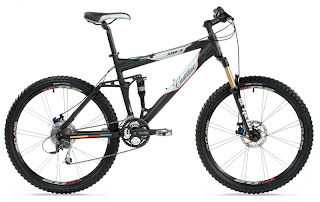
Yep: Cadillac bicycles.
I chuckled, and moved on to the next site. Then, on second thought, I took another look. After all, it’s not like General Motors is actually manufacturing the bicycle — they’re just branding someone else’s work. The 20 year old geek within me woke up and wondered: What sort of frame are we talking about? And who supplies the components?
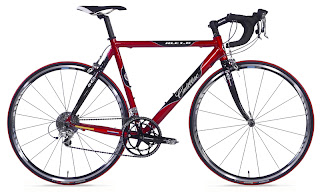
On closer inspection, the Cadillac bicycles appear to be reasonable “mid-list” bikes: they're being compared to the Schwinn bikes of old (the original “Cadillac of bicycles“), and that’s no small compliment: Schwinn bikes were sturdy, conservatively constructed bicycles that most people could buy and ride to the end of their days. Cadillac offers a similar package, with carbon frames and decent componentry that is priced in line with brand-name bikes offering similar fare.
So, is there a Cadillac in my future? Not likely. Frankly, the brand is a sharp disincentive. I live in a small town, and I’m not keen on being the guy whose car is a Toyota and whose bicycle is a Cadillac.
On some level, a Cadillac brand bicycle is counter-intuitive, particularly in contrast with, say, the Hummer bicycle. If you're the sort to buy a yellow H2 (or whatever number they've reached these days), you’re likely the sort to think a matching bicycle on the roof rack is a good thing. But even an off-road cyclist could be forgiven for being reassured by the brand. HumVees are (ostensibly) off-road vehicles; you needn’t own the car to be persuaded of the bicycle’s off-road merits. Which gets me wondering: who, exactly, was the Cadillac bicycle meant to appeal to?
Best guess: Cadillac SUV customers. If they get a thousand-dollar bike thrown in with the new Escalade, well, bonus! Except most Escalade customers are likely to turn their noses up at any bike that sells for a measly grand. So we’re left with GM assembly-line workers who can buy the bike at cost, or Costco customers caught in the throes of (as marketers like to say) an aspirational impulse.
No thanks. Unless Cadillac undercuts its immediate competition (Trek, Fisher, etc.) and drops another $300-$400 off its price tag, I believe I’ll go brave the bicycle salesmen instead.
Post-script: this guy points out that Cadillac bicycles are built by the same people who manufacture the Tonka and My Little Pony bicycles you find at Sears. “My Little Pony“ — now there's a brand I'd love to ride around this town!

A customer wearing bizarre, skin-tight clothes was paying an older man who was similarly attired. He wheeled his bicycle out the door, and took off. Then it was just the four of us, in a tiny shop with shiny new bicycles hanging from the ceiling. “Can I help you boys?”
Hm. British.
“Yeah. Why are your bikes so expensive?”
“Well,” said he, “these bicycles might cost a little more than what you’re accustomed to paying, but there are some appreciable differences between these models and the ones you’re riding.”
“Such as?” I can’t remember which of my friends said those magic words, but they opened up an entire afternoon to a tutorial on the finer pleasures of purchasing and riding a refined set of wheels. Chromoly frames; double-butted tubing; alloy rims; side-pull brakes, versus the gimpier center-pull ... am I missing anything? Oh yeah: the clothes. Sweat-wicking, less wind-resistance and whatnot. Sneakers vs. cycling shoes, the difference between hitting a sponge ball vs. hitting a cricket ... erm, baseball.
For the middle-aged gent who was lecturing us, this was simply the well-trod method of introducing three lads to a potential “Life Sport” (the lingo of the day). For three guys on the cusp of 20, this was stuff — cool, shiny, new stuff. Within a week, my friends were riding a couple of flashy, deceptively fragile-looking bicycles. I opted for a used motorcycle, but eventually traded that in for the mountain bike.
Having been informed that my current bike is cruising toward an expensive breakdown, and having been assured by my daughters that lengthy rides are soon to come, I’m slouching back to the bicycle store. My, how things have changed. My old bike, which cost nearly a grand 20 years ago, is a heavy monster compared to what’s currently on offer. And forget side-pull, center-pull, and them new-fangled cantilever brakes of mine: disc brakes are all the rage, apparently.
As with stereo stuff, I’m now disinclined to indulge a salesmen or do much by way of product research. My first impulse, when informed of my bicycle’s dire state, was to visit the Costco website to see if they didn’t have something I mightn’t pick up on my next shopping trip. I discovered, to my surprise, that Costco is selling Cadillacs.

Yep: Cadillac bicycles.
I chuckled, and moved on to the next site. Then, on second thought, I took another look. After all, it’s not like General Motors is actually manufacturing the bicycle — they’re just branding someone else’s work. The 20 year old geek within me woke up and wondered: What sort of frame are we talking about? And who supplies the components?

On closer inspection, the Cadillac bicycles appear to be reasonable “mid-list” bikes: they're being compared to the Schwinn bikes of old (the original “Cadillac of bicycles“), and that’s no small compliment: Schwinn bikes were sturdy, conservatively constructed bicycles that most people could buy and ride to the end of their days. Cadillac offers a similar package, with carbon frames and decent componentry that is priced in line with brand-name bikes offering similar fare.
So, is there a Cadillac in my future? Not likely. Frankly, the brand is a sharp disincentive. I live in a small town, and I’m not keen on being the guy whose car is a Toyota and whose bicycle is a Cadillac.
On some level, a Cadillac brand bicycle is counter-intuitive, particularly in contrast with, say, the Hummer bicycle. If you're the sort to buy a yellow H2 (or whatever number they've reached these days), you’re likely the sort to think a matching bicycle on the roof rack is a good thing. But even an off-road cyclist could be forgiven for being reassured by the brand. HumVees are (ostensibly) off-road vehicles; you needn’t own the car to be persuaded of the bicycle’s off-road merits. Which gets me wondering: who, exactly, was the Cadillac bicycle meant to appeal to?
Best guess: Cadillac SUV customers. If they get a thousand-dollar bike thrown in with the new Escalade, well, bonus! Except most Escalade customers are likely to turn their noses up at any bike that sells for a measly grand. So we’re left with GM assembly-line workers who can buy the bike at cost, or Costco customers caught in the throes of (as marketers like to say) an aspirational impulse.
No thanks. Unless Cadillac undercuts its immediate competition (Trek, Fisher, etc.) and drops another $300-$400 off its price tag, I believe I’ll go brave the bicycle salesmen instead.
Post-script: this guy points out that Cadillac bicycles are built by the same people who manufacture the Tonka and My Little Pony bicycles you find at Sears. “My Little Pony“ — now there's a brand I'd love to ride around this town!

Wednesday, April 25, 2007
My Bicycle
There she is: my 1987 Fisher Hoo-koo-e-koo.*

It's a wonder she's lasted 20 years. In the summer of 1988, after a full year of riding her the way a mountain bike is meant to be ridden, I decided the proper thing to do was give her a complete overhaul. I was unemployed, I'd read Zen & The Art of Motorcycle Maintenance and I figured, “How hard could this be?” I purchased a few specialty tools, then spent an afternoon taking her apart. Four hours later, the pieces were neatly arranged on my apartment floor, and I was carefully cleaning every last ballbearing with an old toothbrush dipped in kerosene.
Four hours after that, she was reassembled ... sort of. Everything was where it belonged, but it wasn't quite fitting together the way it should, particularly in the bottom bracket. I wasn't able to fully reinstall the two cups that held the bearings and crank axle — I experienced a great deal more resistance putting them back in than I had removing them. So I called my local bicycle shop and asked if they had any advice. “Better wheel her in,” said the gear-head.
I did, and explained the situation all over again to the guy who met me at the door. He listened to me without interrupting. When I was done, he cleared his throat and said, “Well, for starters, you've put the cups in the wrong mounts. If you reefed on 'em hard enough, you've probably stripped the threads in your bottom bracket.”
D'oh!
And that's been my history with this lovely bike: I'm a gentle rider who reserves his most abusive treatment for those down-times in the shop.
Two more photos, highlighting some of my accessories. Note the Kellogg's Rooster reflector — a bitter inspiration of covetousness for my daughters:

Still, my younger daughter saw fit to award me this nifty handlebar decoration three years ago:

With the arrival of spring, I decided it was time to replace my brake shoes. I purchased two pairs, came home and dismantled the brakes. Midway through reassembly, I realized I'd lost track of what went where. I collected everything, threw it into the trunk of our car and headed back to the shop — 20 years older, and none the wiser.
*I couldn't tell you what the name means, except that it was “borrowed” from Indian history, specifically a tribe that resided in Northern California.

It's a wonder she's lasted 20 years. In the summer of 1988, after a full year of riding her the way a mountain bike is meant to be ridden, I decided the proper thing to do was give her a complete overhaul. I was unemployed, I'd read Zen & The Art of Motorcycle Maintenance and I figured, “How hard could this be?” I purchased a few specialty tools, then spent an afternoon taking her apart. Four hours later, the pieces were neatly arranged on my apartment floor, and I was carefully cleaning every last ballbearing with an old toothbrush dipped in kerosene.
Four hours after that, she was reassembled ... sort of. Everything was where it belonged, but it wasn't quite fitting together the way it should, particularly in the bottom bracket. I wasn't able to fully reinstall the two cups that held the bearings and crank axle — I experienced a great deal more resistance putting them back in than I had removing them. So I called my local bicycle shop and asked if they had any advice. “Better wheel her in,” said the gear-head.
I did, and explained the situation all over again to the guy who met me at the door. He listened to me without interrupting. When I was done, he cleared his throat and said, “Well, for starters, you've put the cups in the wrong mounts. If you reefed on 'em hard enough, you've probably stripped the threads in your bottom bracket.”
D'oh!
And that's been my history with this lovely bike: I'm a gentle rider who reserves his most abusive treatment for those down-times in the shop.
Two more photos, highlighting some of my accessories. Note the Kellogg's Rooster reflector — a bitter inspiration of covetousness for my daughters:

Still, my younger daughter saw fit to award me this nifty handlebar decoration three years ago:

With the arrival of spring, I decided it was time to replace my brake shoes. I purchased two pairs, came home and dismantled the brakes. Midway through reassembly, I realized I'd lost track of what went where. I collected everything, threw it into the trunk of our car and headed back to the shop — 20 years older, and none the wiser.
*I couldn't tell you what the name means, except that it was “borrowed” from Indian history, specifically a tribe that resided in Northern California.
Tuesday, April 24, 2007
Bicycle Helmets
I came across the receipt for my bicycle. Hard to believe, but it's 20 years old. Coincidentally, so is my helmet.

If I listened to the gear-heads at the local bicycle shop, I'd have replaced my helmet fifteen years ago, and I'd have done it twice more in the interim. I'm skeptical about helmet safety claims, though. A friend of mine was killed on his bicycle, and he was wearing a helmet. Still, I make a point of wearing one whenever I ride: the only traffic accident I suffered on my bicycle happened the day I decided I didn't feel like wearing a helmet. Besides, I want to be a good example to my kids, who are required by law to wear one.
Anyway, my old helmet's perch was getting shakier and shakier as the foam became ever more compact, so I finally dropped $30 on a new helmet. It looks like this:

First impression: holy cow, my head is cold!! It seems ventilation science has made mighty strides in the last 20 years. Take another look at my old helmet. Boy, could that piece of Tupperware ever trap in the heat.
It also made me look like an incredible dork. The only "dork factor" my new helmet provides is by contrast. Here we have a sleek, new helmet sitting atop a not-so-sleek, not-so-new rider. Ah well. When it comes to aesthetics, I didn't care when I bought the first helmet and I'm not going to start caring now.
The gear-heads wagged their finger at my helmet, but pointedly admired the longevity of my bike. Tomorrow I'll post a picture of my vehicle of choice, and maybe do a little reminiscing.

If I listened to the gear-heads at the local bicycle shop, I'd have replaced my helmet fifteen years ago, and I'd have done it twice more in the interim. I'm skeptical about helmet safety claims, though. A friend of mine was killed on his bicycle, and he was wearing a helmet. Still, I make a point of wearing one whenever I ride: the only traffic accident I suffered on my bicycle happened the day I decided I didn't feel like wearing a helmet. Besides, I want to be a good example to my kids, who are required by law to wear one.
Anyway, my old helmet's perch was getting shakier and shakier as the foam became ever more compact, so I finally dropped $30 on a new helmet. It looks like this:

First impression: holy cow, my head is cold!! It seems ventilation science has made mighty strides in the last 20 years. Take another look at my old helmet. Boy, could that piece of Tupperware ever trap in the heat.
It also made me look like an incredible dork. The only "dork factor" my new helmet provides is by contrast. Here we have a sleek, new helmet sitting atop a not-so-sleek, not-so-new rider. Ah well. When it comes to aesthetics, I didn't care when I bought the first helmet and I'm not going to start caring now.
The gear-heads wagged their finger at my helmet, but pointedly admired the longevity of my bike. Tomorrow I'll post a picture of my vehicle of choice, and maybe do a little reminiscing.
Subscribe to:
Posts (Atom)