Showing posts with label Comic books. Show all posts

Friday, January 13, 2012

Walt Disney's Mickey Mouse, Floyd Gottfredson, and Fantagraphics Books

I've gushed about Gottfredson's Mickey before, focusing chiefly on the rodent's originally sympathetic character. But if there's one aspect to Gottfredson's work that Fantagraphics raises in high relief, it is his artwork. Fantagraphics' reproductions of the original strips are the cleanest and truest to date, bringing to the fore Gottfredson's mastery of pen and ink, shading, and melodramatic exaggeration. Contrast this strip, an 80s reproduction, with Fantagraphics' reproduction:


Fantagraphics' reproductions in these first two volumes of Gottfredson's Mickey Mouse are an endless source of wonder and revelation. In examples like this . . .


. . . we see the rough sort of cross-hatching and stippling that caught the eye and inspired Haight Street ne'er-do-wells like Robert Crumb and Vaughn Bodé — Fantagraphics' original meal-ticket.

Returning to the “Mickey Attempts Suicide” subplot, we also see the artist's pacing and perspective put to effective use. By the fourth panel, as our confused and dejected hero finally succumbs to despair, Gottfredson gives us only the back of Mickey's head . . .


. . . a self-consciously discreet point of view that filmmaker Martin Scorsese later exploited in Taxi Driver, when Travis Bickle gets dumped (via pay-phone) by his love interest.


When Mickey finally resolves to end it all, his vulnerability and lack of stature are grotesquely emphasized by the elements in his living room, including a framed picture that seems poised to fall on him:


These first two volumes are full of such stylistic discoveries, which seemed to occur to Gottfredson at a Pre-Cambrian rate. By the 40s, Gottfredson has all but traded in his pen for a sable brush, ditching the baroque cross-hatching and endowing the rodent with a more plastic environment, which readers no longer recognized as their own, but as exclusively Mickey's. Gottfredson's work was never again as affecting as the Depression-era stories.

I still hope Fantagraphics continues publishing the strips: Sky Island and World of Tomorrow are two later adventures I'd love to see receive the Fantagraphics treatment. As it stands, I've scanned and enlarged so many frames for contemplation, the current two volumes have extremely well-worked spines. Which gets me thinking: as much as I appreciate the devotion to scale, how much cooler would it be if these physical books were also sold with a DVD-ROM which could be explored for just such minutiae?

Ah, but copyright issues probably bar such a practical solution. Too bad! But don't let that be your excuse for not purchasing these fabulous volumes — now, while supplies last.


Fantagraphics Books
Amazon

Wednesday, November 23, 2011

... KISS Me Twice ...

My parents got home from Bible Study, and asked if everything was alright. I said, “Yeah,” and kept fiddling with my homework.

“So what's the air rifle doing next to the door?” asked my father.

“Oh,” I said. I'd actually tucked it beneath the coats on the rack, to keep it from being seen, a ploy that apparently failed if you were hanging one up. “Right. I meant to put that away.”

“So?”

“Ah . . . I got this weird phone call, kinda freaked me out a bit.”

“What'd they say?”

What, indeed? It was hard to explain, so I took it from the top: I was seated at the basement desk, toiling on my homework. The phone rang. In those primitive days before Call Display, if you wanted to know who was calling you, you picked up the receiver and answered the phone. In this case, my caller didn't identify himself. “How old are you?” he asked.

“Fifteen,” I said, guessing at the age of my caller and hoping to one-up him. In fact I was 12.

“Perfect. Who's the greatest rock band in the world?”

“Uh . . .” The truth was I'd only started listening to the radio, and couldn't name more than two, maybe three bands, tops. I was nervous, and lunged for the obvious answer. “The Beatles?”

“The Beatles? No, no. I'm talking about your favourite rock band, the one you listen to the most.”

“The Beatles,” I said, resorting again to the lie. I didn't yet have a favourite rock band, but would have chosen one with a “harder” sound to it than the Beatles.

“Seriously? The Beatles?”

“Yeah.”

“Oh.” He sounded disappointed. “Well . . . I was looking for KISS.” Then he hung up, and I retrieved my air rifle, lest some goon barge through the door to deal me the physical harm I had invited by giving the wrong answer to this improvised bit of polling.
With KISS you never knew. They were obviously tapping into something beyond the pale. The pancake makeup, the flash-pots. Breathing fire, spitting blood. The theatrics tended to inspire a similar degree of extremity in the fans. So far as I knew, none of my Mennonite friends listened to KISS, but there was a Ukrainian Catholic kid in my class who doodled the KISS logo on anything within reach. His locker was papered over with pictures of KISS concerts — a modest shrine compared to his bedroom back home, if you believed his claims (and I did). I wouldn't have classified my classmate as crazy, but I had read the story in the paper about the kid who took his father's shotgun to shop class and blew away another kid, later claiming he'd received direct orders from the band.

The fans called themselves an “Army” and I wasn't about to take any chances. Hence the air-rifle. Now that my father was home I figured I was safe enough. He could absorb the invasion's first salvo, while I crawled out the window and fled for my life.
That ain't workin'...
Thirty-five years later, there's a video of the band making a guest appearance on a sketch comedy show. They show up in regalia as a high-school girl's prom date. Her square parents are shocked and appalled. You can find it pretty quickly, but I'd advise against it. It's gratingly unfunny theatre, because it gets the social positioning completely ass-backwards. These days the scary, dangerous people from the fringe are Dad in his belly-cinched pants and Mom in her high-maintenance coif. The Munsters' high concept has been perfectly reversed, thanks in no small part to KISS.

Indeed the alleged “Knights In Satan's Service” aren't just identifiably human, they're struggling to keep the paint fresh on an increasingly bourgeois facade. Another round of memoirs, another season of Gene Simmons' meta-antics; costumes held together with duct-tape, an inveterate pussy-hound whose marriage is held together with the duct-tape of constructed celebrity drama.

There's the Wizard of Oz, and then there's the chap behind the curtain. Is there a curtain behind the curtain? Is there anything in the comic books that somehow peels back the vital layer and catches a glimpse of the edgy, conceptual power that once summoned an Army?

Tuesday, July 12, 2011

How To Draw Comics The Marvel Way by Stan Lee and John Buscema

While contemplating the aesthetic pleasures and rigors of Andrew Loomis, I couldn't help reflecting on some of the drawing instruction books of my youth. Foremost among them, to a degree that couldn't possibly be exaggerated, was How To Draw Comics The Marvel Way by Stan Lee and John Buscema. Even into early adulthood, this book was the final word on drawing anything.


So how does it stack up in comparison to Loomis? None too shabbily, in fact.

Wednesday, December 22, 2010

Pre-Christmas Grab-Bag of Links

Today's post is a grab-bag of links I had every intention of riffing off, but never quite mustered up the wherewithal to get the job done. Still, attention must be paid.
Family and friends know me as a quick mimic, with a tonal range that can catch people off-guard. In my experience, there aren't too many cartoon voices that can't be convincingly aped. Fred Flintstone, however, is entirely beyond my reach. This is a terrific homage to Alan Reed, the man who gave us the incomparable voice of Fred Flintstone.
During a recent malaise, I retreated to the comfort of a series of comic books I'd enjoyed in the late 80s: Andrew Helfer and Kyle Baker's tweaking of that hoary old hero of the pulps and radio, The Shadow. In the mid-80s DC Comics briefly dragged The Shadow of old into contemporary Manhattan, with the help of Howard Chaykin. Chaykin's approach wasn't that far removed from the one he used for American Flagg (it's never been far removed from Flagg, really); he does what he does and it pays the bills. When Helfer took over, though, readers got a young writer keen to take the scene into unexpected territory, and an artist — Bill Sienkewicz — who had the surrealistic flair to pull it off. But when Sienkewicz left and Kyle Baker took over, there was a perfect merging of visual-literary sensibility. Jason T. Miles does a terrific job (with the aid of some snazzy scans) of unpacking Helfer & Baker's deft touch with The Shadow. I would only add that by the series' conclusion Helfer & Baker were probably having too much fun: the final six issues detailed, among other things, the travails of the Shadow's sons as they dragged his corpse through one indignity after another en route to Shangri-La.

I don't quite “get” the veneration that significant writers have for the works of H.P. Lovecraft. His stuff strikes me as ornate and overwrought — he's too busy describing the horror his characters feel to bother dispensing any for the reader (this one, at any rate). I suspect, though, that my distance is more a product of having encountered him late in life, as opposed to in my adolescence (the ideal time to encounter any pulp fiction).

Having said that, I'm usually up for reading meditations on his work. Over at PopMatters, Dennis P. Quinn explores the rich ironies that abound among the personalities and subcultures that have taken (typically occult) religious inspiration from Lovecraft's fiction. Lovecraft the man was an avowed atheist who held all religions in contempt; he considered his Cthulu works, for example, an act of ridicule. Ah, but there are acolytes who beg to differ . . . .

Speaking of Cthulu, earlier this year Erik Davis took a close and careful look at the current “Cute Cthulu” meme and was decidedly not amused. I'll post the link in just a minute, but before I do: here is where I riffed off Davis' treatise on Led Zeppelin IV — the best of the 33 1/3 books I've read. On the strength of that I went ahead and purchased The Visionary State (A), Davis' encyclopedic account (with photographs by Michael Rauner) of the various religious expressions unique to modern California. The Visionary State proved to be breathtaking, so I ordered his latest book, Nomad Codes (A), which I'm looking forward to reading through the holidays.

Alright, on to the link. It is NSFW, thanks to a hentai illustration near the bottom of the piece. This might be regrettable to some people, but the truth is Davis could not get to the root of what makes this “Cute Cthulu” business so insidious without referring to hentai. So there it is, and here is the link (NSFW).

Friday, July 30, 2010

Harvey Pekar: October 8, 1939 – July 12, 2010


News of Harvey Pekar's recent death has not been easy for me to digest. Now that Pekar's seemingly incessant running commentary has in fact ceased, it feels like a significant amount of air has been let out of the white balloons floating over my own head.

Pekar was the first, best blogger. He sifted through anything and everything in his search for the poetry of human value. People say he “explored the mundane,” but that's wrong: he turned the mundane on its head until it was mundanity's exact antithesis. In this, his early attempts at stand-up served him very, very well. His shticks never began with, “What's the deal with airline food?”; they began with, “Ever since I was a kid it seemed I collected something.” The details continued in a matter-of-fact exposition that disarmed and entranced. Where the hell is he going with this? became Oh my God: that's me!

I first tuned in during the late 80s at the comic book store, where I opened American Splendor and encountered this short chapter about record collecting (excerpted from Ron Mann's neat-o doc Comic Book Confidential). At the time I was gripped in a collecting frenzy of my own: comic books. When I read Pekar's confession, something turned for me, too. I bought the Pekar/crumb work, and left the men in tights alone. It's funny how your mind sometimes works.

As in the above example, Pekar's gentler observations ended with a “How 'bout that?” tone, but he was also keen on the not-so-gentle observations. If he was pissed off about something — and he was always pissed off about something — he let everybody know. If he was wrong, he wasn't just quick to admit it — he reveled in the fact, before moving on to the next outrage.

I was never a Pekar completist, nor would I recommend that route to the innocent bystander. But you can't go wrong with The Best of American Splendor (A). The movie (with Paul Giamatti and Hope Davis, who are both brilliant) is a knowing, quick-witted abuse of Pekar and his material, and a lovely experience because of it. Our Cancer Year (A) is a good read, not just for cancer survivors, but anyone who's married. And The Quitter (A) is just out-and-out superb.

I rather doubt The Beats (A) will be Pekar's final work to receive printed notice, but it is a coda of sorts. For once Pekar is talking about someone besides himself, giving deft summaries of people who were bums and heels, who produced a lot of questionable work but also not a few artifacts of lasting value. If there is a “theme” that runs through Pekar's typically unblinking appraisal of this scene, it is the surprising depth of friendship that held each of these faulty and frequently cruel beings in good stead. I'd say that is the worthy epitaph for Pekar himself: a guy who could rally other people into helping him illustrate and bring to larger narrative life his own inglorious, and thoroughly American, splendor.

Thursday, March 11, 2010

The Comic Book Store

We had a ringette game in the city last Friday. En route to the arena I spotted a small comic book store I'd visited a few years earlier. I was astonished to see it was still open for business: I'd originally paid it a visit during the day, and was the sole customer. The guy who ran the place was approachable, and had a gentle enthusiasm for his product that wasn't too hard to take. At the time I noticed that nearly every major Marvel storyline was written by Ed Brubaker. I asked if this was a case of Brubaker really being that good, or the rest of Marvel's stable being pathetic. This opened the floodgates, but the short answer was, “Yes.” I left an hour later with a few choice collections, but wondered how much longer this place could survive.

One of my weekly blog-visits is Valerie D'Orazio's Occasional Superheroine (hat-tip to JS). When D'Orazio announced a forthcoming gig as writer for a Punisher one-off, I made a mental footnote to look into it. Now, here we were, with this store still very much in business. I asked my daughter if she'd mind stopping for a quick visit. She said no, so in we went.

With both of my daughters in adolescence stores now fall into two categories: 1) the kind where I find a chair while the girls dive in; 2) the kind where the daughters stick to their father's side like a pair of extra ribs, because the only subject of interest is When can we get out of here? Even though the girls can spend hours poring over comics at home, the comic book store fell decidedly into the latter category.

First of all, the place was packed.
Kinda like this.
People milled about the racks, the air was raucous with boisterous conversation, and the guy I'd originally met danced from clique to clique. “Hey, you're new!” He skipped over as we crossed the threshold. “If you have any questions about anything you see, just ask me. I read everything that comes in!” I thanked him, but he was already gone, keen to interject a personal observation into a discussion regarding the discrepancies between the novels and on-line dynamics of World of Warcraft. I forged through the crowds, with my daughter following close behind.

For all the talk of on-line gaming, there was a distinct absence of internet technology. I saw one Blackberry in use, but other than that, nothing. I noticed an open door revealing a plain white room illuminated by fluorescent lights, furnished with folding tables and chairs. I took a closer look, expecting to see laptops or computer monitors. Instead there were companies of guys playing an elaborate card game (Magic, from the looks of it). I moved back to the racks, found what I was looking for, then bought it and left.

When we reached a discreet distance from the shop, I said, “Did you notice anything about that place?”

My daughter shrugged. “Like what?”

“Like, you were the only girl there.”

“Well, I noticed that.”

“Did you notice anything about the guys in there?”

“Like what?”

I shook my head and sighed. “Your grandmother used to worry I'd take up permanent residency there.”

Punisher MAX: Butterfly, by Valerie D'Orazio, art by Laurence Campbell

John Updike, grousing about Don DeLillo, famously said, “The trouble with a tale where anything can happen is that somehow nothing happens.” Nowhere is this observation truer than in the field of comic books — surely a medium in which nearly anything could happen. It is disappointingly rare for a reader to encounter a genuinely playful intelligence at work; rarer still in the über-dreary Punisher franchise. What an astonishment, then, to encounter Butterfly, a one-shot written by Valerie D'Orazio, a short narrative so layered, twisted and personally invested it blows apart genre conventions and reassembles them in a way that opens the field to manifest possibilities.

“Butterfly” presents herself to a potential publisher as a “mob hit-woman” keen to expose all in her memoirs. On the face of it, she and her story bear more than a passing resemblance to The Punisher. But as the truths behind the story she's peddling unfold, then fold in again in increasingly complex patterns, his presence becomes increasingly ominous.

D'Orazio and her artist co-conspirator Laurence Campbell take on a number of modern comic tropes, including, particularly, Frank Miller's noir fabulism. But they don't just tweak and play off the genre's abundant ironies, they exploit them to spectacular effect. To choose just one non-spoiler example, after decades of establishing a “Movie Of The Month” approach to controversial subject matter, Butterfly marks the first time that the emotional effects of child abuse are trenchantly disclosed, in a way that is absolutely integral to the narrative engine of the book.

Nuff said — buy the book and discover its many pleasures for yourself. And here's hoping Butterfly ignites a much-needed revolution in a genre where so little seems to truly happen.

Wednesday, November 18, 2009

Asterios Polyp by David Mazzucchelli

The “novel of ideas” is highly feted by the smarty-pants set, but I’ve usually had trouble finishing one. Those few that I’ve read to completion fall considerably short of my “desert island” list. Paul Auster, whose Moon Palace still resides near the top of said list, failed to impress me with his New York Trilogy (A) — City Of Glass was, I thought, especially tedious and self-indulgent. Nevertheless, since I was still young and passionate enough to collect the complete works of a beloved author, I picked up David Mazzucchelli's adaptation of City (A).

This seemed a curious pairing of talents: prior to this I only knew Mazzucchelli as the artist who fleshed out Frank Miller’s Batman: Year One (A).


In retrospect, the pairing of Miller to Mazzucchelli was no less unusual. Miller’s aesthetic, while certainly the product of a virtuoso, remains resolutely moored to muscular guys/curvaceous babes. Where Miller habitually defies gravity, Mazzucchelli brought a sagging realism. Batman might be a superhero, but his outfit was a little baggy in spots; Commissioner Gordon had posture troubles, and Gotham seemed choked with grit and litter.

With City Of Glass, Mazzucchelli was relieved of industry parameters and the generic expectations of an adolescent, predominantly male, readership. This proved to provide a very a fertile canvas for Mazzucchelli. To my delight, the characters that had read as aloof abstractions in Auster’s hands were now transformed into emotionally compelling people.


Surprise, surprise: comic book artists can breathe life into the arid Novel Of Ideas.

This preamble is just about as much as I care to say about Mazzucchelli's Asterios Polyp (A). There are any number of dazzling abstractions set off with pyrotechnic flair in the course of this story — consider the panel below, where Asterios meets Hana, the love of his life:


The setting is a gallery party, populated by various fledgling artists. As Hana sits in solitude, feeling self-conscious and inferior, the others, including Asterios, mill about in their perfectly realized modalities. Once he starts talking to her, however, their own modalities merge to the point of nearly fleshing out — a gorgeous evocation of falling in love.

The rest of the novel's abundant pleasures should remain unspoiled for the new reader. It is fun, it is moving, and it begs to be read again and again: Asterios Polyp is a profound, emotionally resonant graphic novel — of ideas — that has landed on my desert island list.

Links:
this person is especially fond of what Mazzucchelli did with Batman.

Tuesday, September 01, 2009

Batman: Ego & Other Tails by Darwyn Cooke, with Paul Grist, Bill Wray & Tim Sale

This is a collection of stories in which the common thread, aside from the titular character, is Darwyn Cooke. Two of these stories (“Ego” and “Catwoman: Selina’s Big Score”) were written and drawn by Cooke; the four remaining have him claiming one or the other credit. Basically, what we have here is a journeyman’s book which traces Cooke’s development in the comic book biz.

In his introduction Cooke is circumspect about what he achieved in the Batman stories, which I think is appropriate. Cooke's transition from animated TV series storyboard artist to comic book sequential artist, while certainly impressive, is not always free from some unfortunately inert moments. Similarly, his aesthetic is also a work in progress — in “Ego” the shift away from the look of the TV series takes place very gradually, while much of “Selina’s Big Score” is splashed in bold brush-strokes that could be confused with early David Mazzucchelli.

“Selina's Big Score” has, in hindsight, some very obvious and entertaining indicators that Cooke's infatuation with Richard Stark's "Parker" is about to erupt into an all-consuming love affair. Having first encountered Cooke in The Hunter (A, wp) — the current height of Cooke's artistic prowess — I thought this collection made for some amusing, but hardly essential, reading. Instead, Batman: Ego suggests that Cooke is an artist with a nearly limitless capacity for developing aesthetic and narrative depth, moving relentlessly forward. Cooke's best, I do believe, is yet to come.

Wednesday, August 26, 2009

Darwyn Cooke at DC: The New Frontier JLA

My recent read of Darwyn Cooke’s The Hunter left me wanting more — a lot more — so I skipped over to Amazon and scrolled through his back catalog with DC Comics. Cooke is apparently one of the visionaries who has shaped the animated Batman series, as well as other DC franchises that have crossed over to television, including The Justice League of America. The JLA has never appealed to me — “action team” comics strike me as being especially superficial, in a medium that’s had trouble plumbing emotional depth at the best of times — but Cooke’s signature ’63 aesthetic splashed boldly across the book covers persuaded me to plonk down the cash. Even if the books’ pleasures were strictly visual, I figured it was probably money well spent.

In the end, the visuals were in fact the bulk of the books’ bounty. Cooke has cultivated and explored an aesthetic similar to television’s Mad Men. Looking for characters who wake up to a drink and a cigarette? Check. Drive shiny cars with fins? Check. Pursue buxom babes with bulletproof coifs? That’s a big checkeroo. In fact, some of the underlying narrative tensions — political, social, sexual — are similar enough to the critically lauded television series that it’s worth pointing out that Cooke got there first.


Cooke’s approach to the superhero “look” has a similar vintage charm: the juiced-up-gymnast physique is replaced with bods of varying shape and size — Wonder Woman has an especially muscular chunkiness to her (which I loved) while the Flash could almost be described as scrawny — and all the costumes fit with some room in them to allow for drapery folds and wrinkles.

I enjoyed the subplots involving characters I previously hadn’t given much consideration to, particularly the conflicted pacifist/military man, Hal Jordan/The Green Lantern. All the men seemed to want a purpose nobler than Danny Ocean’s insouciant pillaging, but were variously hobbled by limited, self-serving perspectives. This being a franchise book, the characters are pre-required to unite against a very large common enemy, which turned out to be the books’ least compelling aspect. The villain was vague, and driven by a remarkably impersonal motivation, so the final confrontation was a ho-hum by-the-numbers barn-burner. The fact that I was disappointed at all, however, is testament to Cooke’s ability as an explorer of comic book characters. The peril might have been a bore, but I'd grown keen to know more about the men and women who gathered to fight it.

Darn it, I’m back where I started: hungry for more of what Cooke’s been cookin’.

LINKS: The artwork above is Cooke's own (natch), and I cadged it all from this site. The work as rendered in the books is fabulously colored by Dave Stewart. There is a good sampling of it, as well as a typically candid Comics Journal interview with Cooke over here. And here are the Amazon links for DC: The New Frontier Vols 1 & 2.

Thursday, July 30, 2009

Richard Stark’s Parker: The Hunter, Adapted & Illustrated By Darwyn Cooke

Richard Stark’s Parker: The Hunter, Adapted & Illustrated By Darwyn Cooke (A) is one of the tastiest morsels of comic book confection to sit on my bedside table in a long, long time.
The Hunter (A) has been adapted into a movie twice: in 1967 by John Boorman and Lee Marvin (i), and in 1999 by Mel Gibson and Brian Helgeland (i). The latter is quickly taken over with Gibson’s bug-eyed antics, while Marvin’s performance (despite being somewhat uneven and occasionally overwhelmed by Boorman’s momentary fascination with the French New Wave) falls closer to what Donald Westlake laid down when he wrote as “Stark.” Now it has been adapted into a comic book* by Darwyn Cooke.

Cooke brings a whole lotta luscious luuuuv to the table. He renders the characters in bold strokes reminiscent of early Harvey Kurtzman (w) and moves the story in a smooth sequential flow that brings to mind Will Eisner (w), when he was at his unselfconscious best. Cooke is also resolutely faithful to the text, lifting not just dialogue but entire passages straight from the book. This is not, however, a text-heavy work: Cooke’s use of the silent panel is adroit and entirely beguiling in the best “A Picture Is Worth” tradition.

Cooke has a retro-stylistic savoir faire that won’t ever be confused with the rancid, sweaty, nicotine-stained prose that “Stark” employed — but that’s a good thing, as it makes this book a delicious pleasure unto itself. Highly recommended, not just for Parker fans, but for anyone who enjoys comic art at its pulpy, impish best.

*Quibblers who would rather call this a “graphic novel” should meditate a little longer on what Art Spiegelman has to say on the matter.

Link Love: Darwyn Cooke's blog; IDW's page; Michael Blowhard links to some Westlake love, including his own, here.

Thursday, October 02, 2008

Will Eisner's The Spirit

Drawn! links to these 12 fab splash pages illustrating (and explicating) some of the genius behind Will Eisner's The Spirit. Even though the posting is entitled 12 Splash Pages Will Convince You Frank Miller Shouldn't Adapt The Spirit, io9 graciously concludes, "The bar is set high, but it's always enjoyable to watch a confident director adapt deserving material." Comic book fans are usually the most hesitant when it comes to embracing silver-screen adaptations -- I have my own reservations about Miller -- but a property that is as nuanced as The Spirit poses particular challenges, as this person makes clear.

Monday, September 22, 2008

Frank Miller, Incubus of Depression-Era Comic Book Heroes

Funny how Frank Miller somehow manages to keep generating controversy with his irreverent treatment of DC characters. After I finished DK2 I sincerely hoped DC was finished with Miller -- DK2 read like a joyless exercise, was obvious in its execution, and worst of all looked, by Miller's standards, lazily penciled. But such trivialities didn't affect Miller's Midas touch, apparently. DC made money on the book, so he's back with a "script" for All-Star Batman & Robin. The controversy? Potty-mouth schoolyard trash talking, insufficiently blacked out by the publisher's censors -- some pages are here, for the morbidly curious.

Hard to say just what I think of the whole thing, really. This latest exercise strikes me as being about as controversial and subversive and entertaining as Paul Krassner's Disneyland Memorial Orgy -- which, to my eyes, fails on all three counts. But if that floats your boat, lay down your plastic and chortle to your bitter heart's content. Miller got the last laugh when he cashed yet another paycheque from DC for typing up a dreary retread of Marshal Law.

I think the more pertinent question now is, was Miller the right guy to write and direct The Spirit? The movie is still being referred to in some quarters as "Will Eisner's The Spirit" but that's about as accurate as calling DK2 "Bob Kane's 'The Batman.'" The movie is Miller's, and the keepers of Eisner's creative flame should probably brace themselves: as with Batman, it could well be Miller who takes complete ownership of The Spirit's identity.

Speaking of retreads: here is my public fan-letter (with reservations) to Miller; here is what I thought of the Sin City movie. My chief kvetch? "The flick was too talky. Always with the voice-over narrator, that let-me-Spillane-it-to-you prose, yak yak yak. Which can be Miller's weakness, as well -- though I usually credit him with a sense of humour he may or may not have toward his own material." Hm. Anyone want to take me to the movies this Christmas?

Finally, a tip o' the hat to Occasional Superheroine, whose post on the ASBAR controversy provoked 82 comments, and counting.

Thursday, November 22, 2007

Imagining Batman

When I was a child my father's rule re: the purchase and consumption of comic books was pretty straight-forward: so long as my age was still in the single digits, I was restricted to Uncle Scrooge and Archie. He was also fine with Christian comics (*shudder* — another post, perhaps) and had an abiding fondness for MAD magazine, which I devoured from cover to Jaffee-fold-in cover. So far as censorious edicts go, my father's ploy was subversively clever. By the time I was 10, I so well-versed in "the usual gang of idiots'" shtick that I had no desire to spend my hard-earned nickel on men in capes and tights (that all changed 10 years later when Frank Miller came on the scene).

However, when I was seven the siren-song of Neal Adams' Batman was still very compelling. I was particularly drawn to this issue:


Bear in mind that I was completely ignorant of the Batman's origins and non-existent super-powers. I glanced at the cover and let my imagination run wild in an attempt to fill the gaps of my knowledge. "The Demon Lives Again"? Was Batman the demon? He certainly looked dead on the cover. Of course, even a seven-year-old could see the sword was lodged in the sand, and not between Batman's ribs. I also knew Batman had to "live again" just to make it to the cover of next month's issue, so I figured that had to be it: Batman was a type of demigod, who through some horrid process had been reduced to the fate seen on the cover by the scary-looking old dude holding Bats' costume. And how exactly did that costume work, anyway? The cowl was still present, as were the shorts and long-johns, but he was shirtless. And here, too, Batman was a peculiarity: superheroes were always a muscular hairless bunch, but this guy didn't just have chest-hair — he had nipples, too.

And he was dead. Or beaten up badly enough to have his costume removed. The answers lay beneath this cover. Dad was still talking to the pharmacist. Maybe if I just quickly leafed to the pages in question ... there's a fight in the desert ... scorpion stings Batman on the ankle ... he's down ....

"Um ... son?"

The rest of the story is in the pages of this book. And while I do love the artwork, I've gotta say: the story that swirled in my seven-year-old noggin was a lot better than the one I eventually read to its conclusion.

Tuesday, December 13, 2005

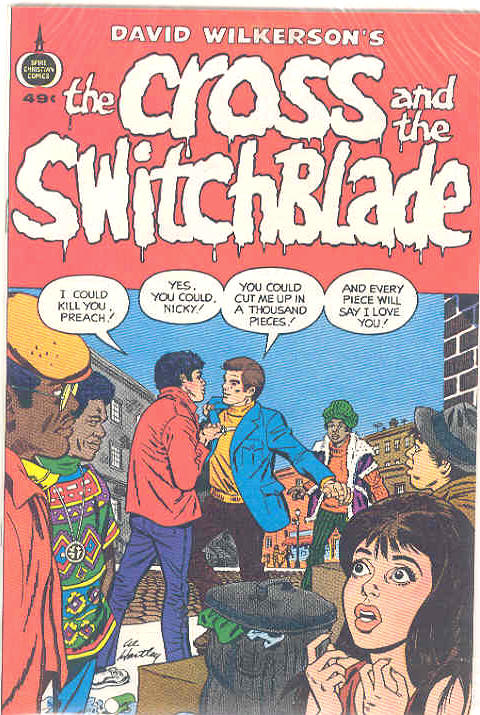
"You could cut me up in a thousand pieces! And every piece will say I love you!"

In my early-20s, I went camping in Florida with a couple of cobbers from my old Bible school for the usual harmless fun: cheap beer, quick tans, sunny conversation and ineffectual flirting.

But things took an ugly turn one morning after we'd crawled from our tents. We passed around the Wonder Bread. One of my mates asked for the peanut-butter knife. When he received it, he suddenly thrust it toward the chest of his friend and snarled, "I could cut-choo into a t'ousan pieces, mang!"

His friend looked at him with large, doe-like eyes and said, "And every piece would say I love you!" Giggles erupted, and we went on with our dopey day.

Nearly everyone admits there is a bounty of kitsch to be harvested from the history of comic books, but the vein is just that much richer in the all-but-unexplored field of Christian comic books - and this little exchange is just one delicious example. Young lads nurtured in the fold of 1970s Christendom could expect their collection of "secular" comics to be duly leavened by the work of Al Hartley, a former girly-artist divinely re-commissioned to chronicle the adventures of a born-again Archie. Not only was the Riverdale Gang subject to an Evangelical make-over, but many real-life sin-to-salvation autobiographies (we called these "testimonies"; our unsaved neighbors called them "human interest stories") were given the Hartley treatment as well: heroes with rugged good looks, and heroines with long straight hair (or a healthy afro), lush lips, and a rack that defied gravity.

One such testimony is David Wilkerson's The Cross & The Switchblade. I'd be curious to hear what Wilkerson made of this comic and the ham-fisted movie that followed (starring Pat Boone and Eric Estrada): the book they were based on remains an affecting first-person account of a young Pentecostal minister in the late 1950s called by God to preach salvation to the youth of the ghettos. My hunch is Wilkerson endorsed the spin-offs as sincere attempts to present the larger gospel message to as wide an audience as possible. Fair enough: Hartley possessed no lack of sincerity either, and hormonally-charged boys of every congregational stripe were the happy benefactors of the buxom Hartley Vixen that lay between their copies of Spider-Man and The Justice League of America.

Here, for your edification, is the Al Hartley cover of The Cross & The Switchblade, from which today's title is taken (as ever, click to enlarge):


If you find yourself wanting more, Kliph Nesteroff deconstructs the Hartley Template over here.

Friday, April 08, 2005

'Sin City' — It's Miller Time

It's interesting to locate the critical dividing line on the recent Frank Miller/Robert Rodriguez film, Sin City. The movie seems to elicit the same sadistic chuckles of approval or clucks of moral disappointment that The Good, The Bad And The Ugly did 30 years earlier. In the former libertarian camp we have Roger Ebert, whose critical mantra "It's not what a film is about, but how it goes about it" permits him to give Sin City precisely the same rave he gave The Passion Of The Christ. And among the latter blue-hairs in the back pews, we have Anthony Lane, whose sigh over Sin City's emotional and moral vacuity is but a weary echo of his outrage over Mel's Passion. Reading these guys, it sounds to me like the movie hews closely to the Frank Miller comics it's based on.

Having seen neither movie (yet), I'll go out on a limb and suggest that as film directors, Miller and Mel have quite a bit in common, beginning with a deleterious obsession with things Catholic. But where Mel is the ardent convert, an ultra-conservative late to the fold, wielding his aesthetic like a truncheon to brow-beat viewers into the Kingdom, Miller is the raving heretic, throwing open the windows of the sanitarium and coughing in the patients' faces — brow-beating viewers in the opposite direction. With precious few exceptions, Miller's comics depict Catholic priests as shrunken, dissipated connivers, and Catholic nuns as gargantuan, hate-driven viragos capable of inflicting terrible physical humiliation (somewhere in FM's childhood, the boy must have run afoul of Miss Clavel). In nearly all of Miller's work, but especially in the Sin City books, the heretic heroes pummel, blast and dismember a barrage of holy fathers and sisters — behavior seemingly made acceptable because his priests and nuns are presented as willing co-conspirators in an enormous, corrupt regime.
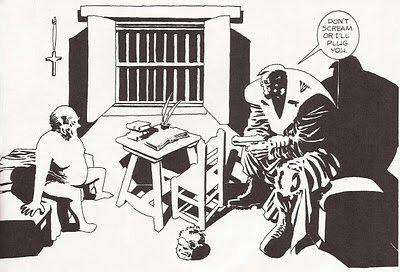
Catholic authority is but one of Miller's big obsessions: others include pneumatically enhanced women with cold, cold hearts, cynically manipulative conservatives, bleeding-heart liberals, a docile and easily-duped public, malicious flying imps (often in the form of automatons), drapey trench-coats and Chuck Taylor sneakers. Miller has become that uniquely American phenomenon: he turns a profit with his public self-indulgence. His worst material is like bad heavy metal, with its tedious excesses and a head-slapping lack of self-consciousness. Conversely, his best material is like good heavy metal: it knocks you on your ass.

Some 20 years ago, when Miller still had an editor to answer to, he delivered the work he will be best known for: Batman: The Dark Knight Returns. Dark Knight is tightly scripted, meticulously penciled and inked, has worthy literary pretensions, and is single-handedly responsible for the current deluge of comic books on the big screen. Corruption at the highest level, moral dis-ease, the tension between anarchy and fascist totalitarianism and the desperate heave to transcend all these mortal conditions are played out with a giddy ferocity. In tone and physicality, Batman resembles Clint Eastwood's avenging angel of death, William Munny, during Unforgiven's final act.
Until the final act of Dark Knight, however, Batman more closely resembles Eastwood's The Man With No Name during his feebler hours. Batman was a bit too eager to come out of retirement, it seems. He takes a physical beating that would kill a dozen men; toward the end of the saga's early chapters, he limps about with mashed lips, missing teeth, while clutching broken ribs or an abdominal wound in his sagging costume. The man has lessons to learn before the demi-urge within can tower over the bad guys (including a gormless Superman), and the chief lesson seems to be: if the world is unimaginably corrupt, your methods of subversion have to be unimaginably extreme.

The Dark Knight Returns was an incredible success, and vaulted Miller into rock star status. I dabbled in comics before Frank Miller; once I recognized him, I turned the corner and became a collector. I dug the way his figures swept out into open space — often the white space between panels — with an ethereal grace, or the way they'd bunch up like a clenched fist, ready to explode. His heroes were never merely challenged or tried: they were fed into the crucible, feet first. Torment, humiliation, agony, resurrection and violent triumph — the movies weren't delivering this stuff, not as deliciously as Miller was.

(Digression: Miller's kinetic aesthetic has proven extremely difficult to translate cinematically, because his movement either defies or exaggerates gravity. He borrows heavily from the Shangri-La films, but uses drape-like clothing to add to the drama of the printed page in a way that, until the advent of digital film-making, was impossible to capture. Think of the trench-coated Neo, dodging bullets in the Matrix. Or think of Mr. Incredible purposely leaping off a cliff and falling for half-a-mile before catching a palm tree that flings him gymnastically to the next level. Prior to this we had Rambo, impaling himself on a towering evergreen.)

As good as The Dark Knight Returns was, it was only the launching pad for his best, most controversial project — Elektra: Assassin. Miller took the unusual step of teaming up with artist Bill Sienkiewicz, a man whose conceptual approach was hallucinatory, borderless and garishly, oppressively colored. Collaborating board by board with Sienkiewicz, Miller cooked up a story that played like a Road Runner cartoon envisioned by Hieronymous Bosch. As with Road Runner, Elektra is the ostensible hero of the series, but she is something of a cipher, and the villain chasing her becomes the story's true moral center — which poses a serious problem. Garrett is a government operative, a certified psychopath employed only because he's been physically tinkered with: several limbs are artificial, giving him powers he is incapable of dealing with responsibly.

He chases after Elektra, brandishing bombs and guns and lethal Rube Goldberg devices, all of which boomerang on him. With every foiled plot, he loses more of his genuine self, until the only thing that isn't artificial is a portion of his head. With this compromised instrument, he is able to reach two crucial realizations: he has fallen hopelessly in love with his nemesis, a woman whose cruel streak exceeds his own by a grotesque margin; and she herself is chasing after bigger fish — in this case the Antichrist, a charismatic demon-possessed Democrat set to unleash nuclear annihilation once he gets into office.

If my summary sounds comic, the true effect of the book has to be experienced to be believed. At the time (Reagan's second term in office), it did a good job of rattling my cage, and a bunch of other people's, too. It fueled several loud calls for censorship, which Miller's publishers promptly used in their promotional materials. I suppose you could say Miller excelled at the "how" of what his material was about. Guess who's narrating here (Hint: it's not the guy holding the head):
And what was it about? Same old same old. The world is a scary place; the political and religious powers that be are corrupt beyond imagining and wildly out of control, tainting the well-intentioned when they aren't abusing them outright; and only extreme subversion can possibly curb their grim direction — momentarily. Elektra: Assassin is a tour de force that should not be read at too tender an age, or before going to sleep.

Following Elektra: Assassin, Frank Miller's Sin City books seem almost like an afterthought. By now his characters go through the paces. Everything has the Frank Miller look, which never gets boring, but it decorates the trademark Frank Miller plot we've come to expect. It amounts to maladjusted behavior in a shiny package, which at least has the courage of its thin convictions. Miller knows you didn't buy Sin City, or pay admission to see a movie like The Patriot, because you want to see a man find his soul: you spent the money to see some fucked-up shit, and he delivers. If it doesn't scare you the way Elektra: Assassin did, it's because Miller no longer needs to put everything on the line to get your money. Sin City is the equivalent of the last 12 albums by the Rolling Stones, or the last seven by AC/DC: the eleven herbs and spices are all there, but the nutritional foundation has been processed into near non-existence. It's junk-food for the soul — a little of it shouldn't hurt you, but you're arguably better off without it.

If that last declaration places me amongst the blue-hairs, so be it. Hey, I like junk-food, too, but I'm at the age where I have to limit my intake. And let's be honest: that age is any age. Youthful readers who wish to quibble should try this little exercise: hold your own Robert Rodriguez film festival, starting with El Mariachi, Desperado, the three Spy Kids movies, and concluding with Sin City. When it's over, step outside and take a long, deep breath. Look around you, or talk to your neighbor for a few minutes. Then return to your darkened TV set, and see if you don't feel — just a little — like Morgan Spurlock after eating a month's worth of McDonald's.