Monday, May 29, 2006

Keeee-raaash!!

Looks like my dumpster computer will be returning to its former home. Seems to happen with me at this time of year, doesn't it? Ah, well. My wife (this is her work computer I now type on) has encouraged me to forego my usual Menno thrift in favour of getting something pert-near state-of-the-art. Hopefully, the new rig will arrive at my doorstep in the next day or two.

Strangely enough, I'm going to miss the wheezy old jalopy -- thank you Kaz, for passing along the savings. And thank you Roar for jury-rigging Linux Red Hat when my BIOS was compromised. And finally, thank you Bro for the painless introduction to Ubuntu Linux -- the very first installation I'll be making when the new box is up and running.

Sunday, May 28, 2006

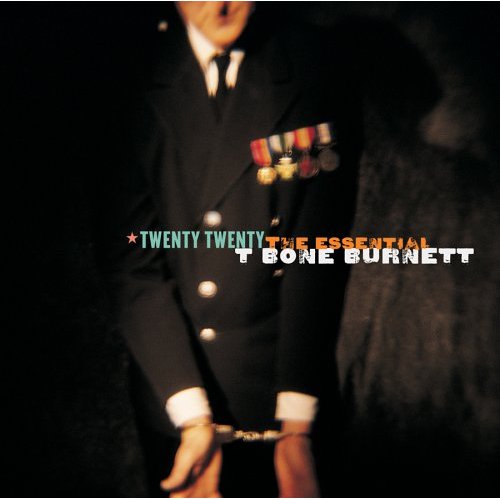
Twenty Twenty: The Essential T Bone Burnett

With the release of this "best of" collection, Mr. J. Henry Burnett finds himself in a spot where he can neither win nor lose. His fanbase has built slowly and steadily, primarily through word of mouth (or the lost art of the mixed tape). His creative output, sporadic right from the start, slowed to the point where his faithful listeners wondered if he'd maybe packed it in for good. But here we are, 13 years after his last CD: he's released The True False Identity to raves (including my own), and offered a two-disc selection of "essential" songs from his past.

Burnett's ouevre commands some the same critical reverence that Bob Dylan's does, while his output comes in at a tiny fraction of The Man's. Thus, T Bone fans -- let's call them "Bone-heads", shall we? -- have of necessity formed the habit of snapping up everything thrown their way, including a package of songs from albums they already own -- T Bone can't lose. However, thanks to this same paucity of output, there isn't a milisecond of recorded sound that Bone-heads haven't committed to intimate memory. Fudge with any of it -- and T Bone has -- and you can't possibly win.

Twenty Twenty was purchased by a number of fans still waiting for a CD reissue of Burnett's seminal 1983 album, Proof Through The Night. There are fans who consider this album a masterwork of collaborative genius -- Rolling Stone deemed it the best album of '83 (back in an era when its opinion of these things still mattered). My own reaction to Proof was and remains mixed -- I would have preferred more songs from the Trap Door EPs and fewer from Proof or Talking Animals, but nevermind. T Bone's perspective on his own music is naturally of interest to the attentive listener -- and we Bone-heads are nothing if not resolutely attentive. So let us insert the discs into our players, turn up the volume and attend.

The track listing is reminiscent of the same scattered consciousness that informed Dylan's three-disc Biography -- chronological order is eschewed in favour of something more aesthetic. The first offering from Proof -- "Fatally Beautiful" -- comes in at number four. When I first heard it, I wasn't sure if this was the original track from the album, with just a few minor tweaks, or if I was listening to something entirely new. I tabbed back and listened again, but the jury was still out.

After hearing all 40 songs, I'm fairly certain Burnett went back to the studio and re-recorded, right from scratch, every single one of the Proof selections. This can't help but stir up conflict for the listener: personally, I rather liked the re-jigging of the zany "Hula Hoop", a song that now has added sheen and bouyancy; but I disliked the changes to "When The Night Falls", which seems to have lost Ry Cooder's note-bending tension. The fact that Proof is the only album to receive this treatment makes me wonder if T Bone's rights to the source material aren't inextricably enmeshed. The heavyweights of the day showed up at the studio, back in '83 -- perhaps there's some legal complication involved in presenting the tracks as they once existed?

I'm not especially offended by this approach, but judging by the Amazon comments, there are listeners who are: "The re-recorded Proof Through The Night tracks are a crime" (one star); "That the originals were superior should be obvious to anyone: much of the bite and snarl, the snap and poetic power are just gone" (three stars); "The alternate versions on Twenty twenty just dont make it ... Too bad, this collection had great potential" (three stars); "Burnett has committed the unforgivable sin of re-recording the tracks from his best album ... BIG MISTAKE" (two stars) -- geez, you'd think we were talking about Star Wars!

My own take: I like the set. There's a spicy essay supplied by Bill Flanagan, and Burnett brings commentary to each and every song, some of it very enlightening indeed. Again, I think comparing it to Dylan's Biography is appropriate. It's a mixed and re-mixed bag of tricks. Played from beginning to end, it carries its own strange sense of narrative. And once you've ingested it a few times, you'll find yourself skipping over songs you were never crazy about to begin with; you'll also find yourself listening to others you once dismissed.

As for all this disappointed fan vitriol, I would think the easy corrective would be to re-release his entire catalogue. It's the Trap Door albums I'm after, but even so, I'd lay down money for Proof and Animals, too. Sony might not want to do this just yet, however. Burnett fans are too used to waiting a long, long time for what they want -- too much at once might ruin our sense of anticipation and interrupt our on-line conversation.

Tags:

Gratuitous Hockey Post

I couldn't help feeling some sense of deja vu in the final outcome of the Ducks/Oilers series. I wasn't cheering too hard for either team, but I did follow my father's habit of siding with the underdog, the appallingly-named "Mighty Ducks". The emotional cache was given some extra weight by coach Randy Carlisle, a former Winnipeg Jets defenseman.

The coach for the Edmonton Oilers is, of course, former Oiler centre Craig McTavish. Back when Winnipeg had an NHL team, there was no guarantee they'd make the play-offs, and when they did, fans became accustomed to watching their team get perfunctorily eliminated by one of the two Alberta teams. The fights with Calgary were sometimes close, but Edmonton was another story. So far as the Oilers were concerned, the Jets were little more than the scrawny workout partner who showed up to keep them in shape.

And so Carlisle's team has once again been dismissed by McTavish's: salt in the wounds. On the plus side, a series between Carolina (I can't imagine Buffalo rallying from its wounds) and Edmonton could be pretty intense. But once again, I'm not sure I can find it in me to cheer Edmonton. Funny how deeply these sport history resentments can run.

Thursday, May 25, 2006

"Summer" Reading

My summer reading doesn't differ substantively from the other three seasons, but I've enjoyed Slate's meditations on pulp fiction thrills so much, I caught some of their surfer dude spirit. I hereby commit myself to re-reading Dashiell Hammett.

The public declaration is a bit disingenuous of me; I was already set to give Hammett another peek, regardless. This is due to my current attempts at bedtime reading. You can see I've had trouble finishing Dennis Danvers' The Bright Spot -- two months "On The Floor", and counting. This is partially due to late-spring torpor, but chiefly due to the writing style. It's not a bad style, per se -- it just happens to be a style I've never enjoyed reading: specifically, Raymond Chandler's style.

There are Chandler-based movies I've enjoyed: the pal-mal confusion and sexual heat of Howard Hawks' The Big Sleep is still a thrill to see, and Robert Mitchum's turn in Farewell, My Lovely is softly evocative and has a boozy sweetness to it. But reading Chandler is another story -- he's always grated on me. There's too much of the wise-ass in his prose, and in my life I have been overly familiar with wise-asses. The fact that I once attempted to be one myself only makes the presence of wise-assery all the more unbearable. So, no thank you to Messieurs Chandler, Parker and now, uh, "Sydney".

Hammett, on the other hand, is a horse of a slightly different colour. Not so much the wise-ass as something colder -- or should I say "cooler"? It's been 20 years since I last read him, though, and my memory of the experience may be way off the actual mark. So stay tuned...

Update: although Michael Blowhard makes no mention of my flip dismissal of Chandler, he clearly disagrees with my prognosis. And I have to admit there is indeed an enviable and evocative economy to such lines as: "He looked like a bouncer who had come into some money."

But since I've already committed myself to flippancy, I might as well come out and say: I just don't get this recent revival of Georges Simonon. I've only read two Maigret novels, and I'm disinclined to try any more. When you take Raymond Carver's minimalism and knit it to the bones of a mystery novel, you don't necessarily produce entertaining ficiton. Non?

Wednesday, May 24, 2006

Reading WIRED and Fast Company

I have become a regular WIRED reader, and I'm not altogether sure why. I remain a technophobe (if not a Luddite), so the pages devoted to gadgets and computer innovations are mostly lost on me. I'm genetically predisposed to viewing anyone's optimism with outright distrust, and WIRED is resolutely optimistic. And WIRED's writing style inevitably makes me a little nuts -- here's one example, on a topic I've been musing over of late: DEVO.

"[DEVO] recently extended the brand, helping Disney launch Devo 2.0, an ensemble of 10-to 13-year-old kids who sing Devo classics. Is it evolution or devolution that a band once considered too odd for radio is the latest offering from one of the largest media companies on the planet?"

Waiting for the writer's prognosis? Final paragraph: "Devo 2.0 updates the idea for a new generation. 'It could be an interesting new way to look at Devo,' [DEVO frontman Mark Mothersbaugh] reflects. 'Or it could be really stupid.'" Judgement appears to be suspended, but the subject matter is portrayed with such cheerful brio that the inescapable conclusion for this reader is -- because Mothersbaugh's take on things is so ironic, Devo 2.0 is probably really stupid and "rilly kewl".

This sort of reportage represents an improvement of sorts on the earlier WIRED's billboard-style "The Revolution Is Here!" optimism. After retrieving a few 10-year-old issues from the basement and contrasting them with the current magazine, I have to say I miss the high-grade quality of paper, and the charming insertion of Marshall McLuhan's visage (and words) into the monthly masthead. The current WIRED is slimmer, void of McLuhan, and built to be read faster. It's probably the latter I enjoy most: a great deal of what WIRED gassed on about in the 90s was worth less than half the type & hype.

In tandem with WIRED is Fast Company, a magazine my wife subscribes to. FC serves to keep her company (heh), I think. The bulk of any given issue acknowledges the condition of North American life -- we work too long and too hard, for and with people who make us crazy -- then offers up tactical analysis and a bromide or two to keep the reader going. FC is, at heart, as optimistic as WIRED, but is a bit more even-tempered about it. WIRED and FC both make a point of rejoicing at those strange intersections where anarchy and the corporation meet. And they are both unabashadly "lite" about subjects that have at times mired me in the Slough of Despond.

I think I read both magazines in an effort to enhance some personal sense of possibility. For much of my 20s and 30s I read text-heavy monthlies of the What Is To Be Done? mindset. I supplemented this ideological diet with glossies -- Esquire and GQ were frequent purchases, and from 94-97 Details was something of a lifeline. Today all three of those magazines seem like they're being published by and for some alien species. I didn't complain when the cheesecake factor was gradually upped in the first two, and the gay slant of the new Details was a bit of a curiosity at first. But all three reached a tipping point at roughly the same time. Of course, maybe it was just me -- but I doubt it, because the focus on distraction seemed to intensify after 9/11, and after two or three months of looking at the same magazines, the same girls, cars, watches and suits and repeatedly asking myself, "Honestly: who the hell cares about this shit?" I stopped buying them. (Full disclosure: I still buy the occasional ish of British Esquire -- pretentiously literary (last December's all-star audience with Paul Auster was an enticing conceptual salad, lightly dressed with a tart vinaigrette) and unpretentiously laddy (I refer not just to the "birds", but to pieces like (again) last December's tribute to Led Zep thumper John Bonham), the magazine often embodies my notion of a truly guilty pleasure.)

As I alluded to earlier, so much of me and my way of thinking is heavy, that I genuinely enjoy a lighter approach to possibility and potential, wherever I end up finding it. Lately it's been in the pages of WIRED and Fast Company. If there are other (better?) resources that occur to you, tag the comments below: I'm all ears.

Friday, May 19, 2006

Superman Is A Dick

Just to prove to Cowtown Pattie that I'm not averse to theological controversy: Drawn! links to Superdickery, a site I've wasted time on before (thanks to Boing Boing). This is the cover that finally got me giggling. The word for Soop's body-language, I believe, is insouciant.


Unfortunately, there seems to be reams of irrefutable evidence that he's also a bad influence on my favorite super-hero, Batman:


Still not convinced? Go ahead and view all 191 examples.

Movies I Refuse To Watch

It's big, it's got buzz, everyone is seeing it and talking about it ... and that just makes me dig in my heels. I'm not going. Nope. Won't even rent it when it comes out. So there.

E.T. - The Extra-Terrestrial was the first such movie; The Passion of the Christ the most recent. Now we have The DaVinci Code. Oh, I was wavering for a bit. Several people at church have pressed me on the issue, saying I really should read the book (it's a United Church, and our chief concern is the comfort-level of our handbaskets). I've read enough of Dan Brown's prose to know I'd be frothing at the mouth by page 90 (reading bad prose to my kids is trial enough -- "'Oh, could we, Mother? Please?' asked Sophia excitedly." Argh). I figured I'd have an easier time digesting 90 minutes of Ron Howard's ham-fisted directing than I would the two or three hours of speed-reading Brown. But, wait: the movie is two and a half hours long! And it's crap.

Meh. I'd rather play Free-Cell.