Monday, April 20, 2020

10 albums 10 days, day 1: Can't Buy A Thrill, Steely Dan

Over at Facebook it's become de rigeur to find your name highlighted in a post that says: "I've been nominated by [friend's name] to choose ten albums that greatly influenced my taste in music. One album per day in ten consecutive days. No explanations, no reviews, just album covers. Today I nominate [friend's name]."

Hey, purty pitcher wordlessness is a blessed relief if you're hanging behind the blue-and-white velvet rope, where the teeming masses trade COVID conspiracies or lock-yerself-down-with-a-mask exhortations. Those are shoals I strive to clear, for the most part. And silence from SWMs of my vintage and older is definitely the better course of valour in this day and age.

BUT.

C'mon, we're dealing with albums, fer crying out loud! Words need to be spilled!

So over here you will get all the verbiage you're missing in Zuckerberg's algorithmic clinic.

Unfortunately, there's little that needs to be said about album cover #1 that I haven't said already — here, here, here etc.

Thursday, April 16, 2020

Rattling in my brain-pan

First, the lighter fare:
Alright, now to the meat and potatoes reading.
  • The Open Psychometrics Personality Test is getting some link-love for being more in-depth than your average Buzzfeed caper. Results can be a source of deep ennui, apparently. If you take it, share the top-five alignments, won’t you? Mine are Gandalf (85%), Lester Freamon (The Wire, 81%), Dr. Strange (80%), Dale Cooper (80%), and Norman Wilson (The Wire, 79%). Mostly flattering, but that last match is a touch disturbing...
  • “He who successfully claims power in an emergency suspends and can destroy rational evaluation. The insistence of the physician on his exclusive capacity to evaluate and solve individual crises moves him symbolically into the neighborhood of the White House.” — Ivan Illich. David Cayly takes effort to apply Illich to the seemingly unified response to the COVID pandemic. My own thoughts on the matter are a bit scattered. First of all, if my Facebook feed is any indication the response to the health crisis is anything but unified. I never thought I’d be nostalgic for the days of consensus reality, but that amber-hued wistfulness is surely MY reality, currently. Secondly, Illich will never be accused of pragmatism, which I have always thought the unfortunate Achilles heel in his critique.
  • Our Age Of Sincere Inauthenticity — Frank Bergon recalls Lionel Trilling and surveys the contemporary cultural land hell-scape we find ourselves in.
  • ‘Truisms are true, hold onto that!’ George Scialabba surveys Orwell and Rorty and a few others in a, perhaps somewhat Quixotic, effort to steer the Left aright.
  • “Years later, installed as an English professor at an even smaller Christian college, I’d recognize doppelgängers of my younger self and wonder if my own teachers had viewed me with the same mixture of distaste, pity, and affection.” In what might be the most thought-provoking read I have currently encountered this year, Michial Farmer considers the matter of failure, and two types of despair. Side-note, Farmer’s wife Victoria has been diagnosed positively for COVID-19 and is today entering that crucial fifth day of symptoms. If you would, please pray for them.

Thursday, April 09, 2020

Three albums by... John Prine

“Gary Shandling always said to me, ‘Don’t get mad, get funny.’ It changed my life.” — actor Rip Torn.
Somewhere in his life — quite early, I’d say — John Prine internalized the same strategy, and used it to profound effect.

Prine wrote and sang about gut-wrenching stuff — the sort of events that throw most people into a towering rage, for very good reasons. “Your Flag Decal Won’t Get You Into Heaven Anymore”; “Paradise”; “That’s The Way The World Goes ‘Round” — knee-jerk “Ready, aye-ready” military adventurism; conscience-less capitalist evisceration of small communities; addiction and domestic violence, respectively. Lou Reed would sing about this and leave a listener horrified, if morbidly captivated. John Prine sang about it, and threw in the sort of screwball observation only he could pen, nudging the listener into chuckles — and the tacit understanding that these horrors were more intimately familiar to us all than anyone was keen to acknowledge.

Wait, why am I smiling? Why am I laughing?

In concert Prine’s delivery was deceptively casual, often punctuated with a one-shoulder shrug, as if to say, Ah, it’s for other people to get mad about. I’m just a song-writer.

Not that Prine’s catalog is concerned solely with eat-your-spinach matters. A lot of what he wrote is just plain goofy. Some of it doesn’t make a lick of sense. Some of it is incredibly sad. And there are quite a number of songs that are all of the above.

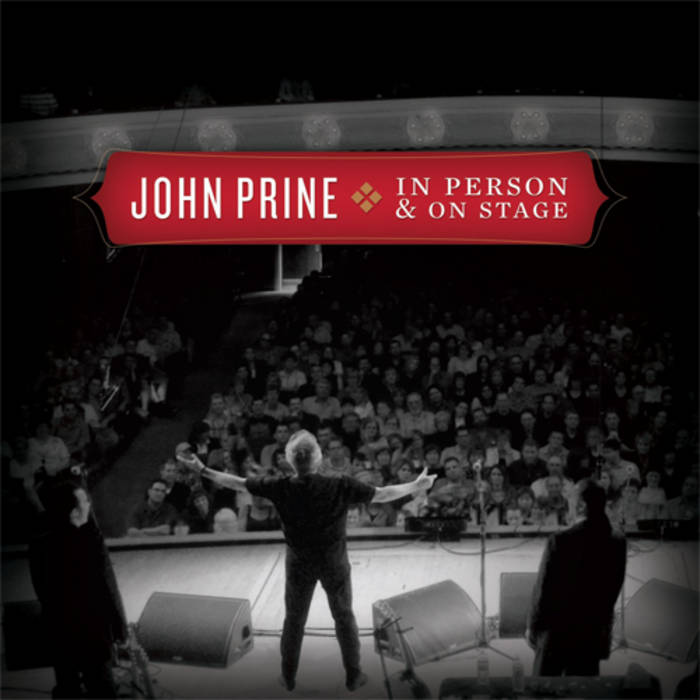
I have a bunch of his studio albums, most of them released on his own label. But his live albums have received more hours of my attention than all of the studio albums combined. That’d be John Prine: Live, Live On Tour, In Person & On Stage. 
The stories and anecdotes that accompany these songs are all a hoot, and several are epic — and certainly epic in length. Audacity is a helpful tool here, for those playlists that oughtn’t to get bogged down by verbosity, no matter how entertaining it might be.

To be honest, I don’t listen to the third all that often. The croak that intruded on Prine’s vocal delivery after his second fight with cancer was just too damn depressing.

But now that voice is silent, which is so much worse.

He seemed to be a man for whom self-care was a distant concern — until it became a central concern. That he should die of this stupid virus after clawing back from two harrowing rounds of cancer seems somehow appropo to these crazy times we are all struggling to endure. I expect he’d have something to say about that — and it’d probably make me laugh. Then cry.

Rest in peace, John.

Saturday, April 04, 2020

“End Times Anxiety”

“Did my Fundamentalist up-bringing prepare me for Coronavirus?” asks Sarah Jones.

Jones appears to be roughly three decades younger than Yours Truly — it looks like she came of age while the Left Behind books were all the rage, though she makes no mention of this.

I had my own youthful brush with apocalyptica, but I went straight to the source. After many, many long and drawn out conversations with my father (who never in my lifetime self-identified as a Fundamentalist) I came to some peace over potential apocalypses. Eventually it was impressed upon me that there’s stuff you can control, and there’s stuff you have absolutely NO control over. And the latter list is much larger than most people realize.

The first list is probably larger than most people realize also, and that is what the optimistic humanist hopes difficult conditions might reveal.

Back to the subject, Jones seems ambivalent about what youthful exposure to apocalyptic literature “prepares” a person for, and fair enough. Throw something potentially traumatizing at a kid and there’s no telling the direction that kid will run with this particular ball of memetic fever.

Over at The Christian Humanist Nathan Gilmour has a wonderful interview with Psychologist-in-training Dan Koch about “End Times Anxiety” that touches on some familiar themes for me. Koch has his own podcast. I’m not sure my curiosity vector matches up with his, by and large, but I will definitely look into his case studies of people whose End Times Anxiety affected the direction of their convictions and character.
In fact, the Apocalypse came and went some time ago.

Tuesday, March 31, 2020

When last I visited the record store...

On Saturday March 6 my wife and I met her brother in Belleville. He and his wife, plus another sister avec husband, gathered with the two of us for breakfast and caught up on events. My bro-in-law just received a diagnosis — the Big C. We’re all grateful, of course, for the astonishing advances in treatment. And we hope all things, don’t we? It was lovely to see each other and share a common meal — the last such occasion in what might be a very long time.

The day before, we’d stopped at the Quinte Mall. While my wife committed to her own shopping concerns, I stuck to mine — a visit to the last surviving Sam The Record Man. The place is a trip — seriously, check out this gallery.
I loaded my arms, but these two discs are the highlight of my cache from that day — Rory Gallagher’s Blues with Chess Records, and Life. Legacy. Music., a single disc retrospective of Streetheart.
Streetheart is a Canadian rock band whose heyday coincided with my adolescence. They headlined and filled arenas up here, and did not too badly in the US and Europe as well, opening for some mighty big names. Their sound is unique for a rock band, because the bulk of songs were clearly written by someone who learned music theory by way of piano — that’d be Daryl Gutheil. Guitarists had to be adaptable to play this stuff, and much of Streetheart’s earliest music, prior to that era when keyboard synthesizers and drum-machine beats became the mainstay, remains interesting to listen to.

Vocalist Kenny Shields died three years ago, but I gather the band is still doing its thing — or will return to doing its thing, once this pandemic gets in hand.

As for Rory Gallagher, I took note of the Chess collection when it was released, but figured I didn’t need any more RG. But there at Sam’s I saw it, held it, and realized I was feeling differently about it, so I bought it. And I’m glad I did. It’s not essential Rory Gallagher, but it is crazy good.

Not essential, but crazy good — seems a terrible distinction to make, somehow. It brings to mind my earlier theory that, for this listener at least, maximal artist absorption seems to peak at three albums. It’s a theory that still holds true for me. Given how difficult it is to mull over anything not plague related, it might be time to resume listing — I’m thinking a series of “Three albums by...” posts.

Do stay tuned.

Tuesday, March 24, 2020

Taking pause

Sundays used to be deadly boring, back in the 70s.

No, really...

Everything in the village was closed, except for the Grow Sir, and how much soft-serve ice cream could a kid actually consume in a given day? If you were bored enough, and you (ahem) permitted yourself access to the parental change cup, you found out — once.

Then it was back to normal. Which was boring.

Sunday afternoon television was programming brought to you from the Most Boring Pit of Hell. Of the four channels caught by the roof antenna, only two were commercial channels from the city. One played a long boring movie frequently interrupted by the same four local ads, the other offered sports with the exact same ads. The other two were the Canadian Broadcasting Corporation —  one delivered English Canadian content, the other French. The English had Hymn Sing, the French had something involving two or three fellows in bucket chairs talking excitedly over each other.

You could read a book for an hour, maybe two if you were a particularly nerdy kid. But sooner or later the walls closed in, and you had to go outside.

If it was winter, maybe you dragged the toboggan to the hill just west of town. Or maybe you and the neighborhood kids played Fox and Goose in someone’s pristinely snow-blanketed garden. Some kids played road hockey, but in the 70s nobody had money for a net. You used giant blocks of road snow for goal posts, and a sponge puck, which you chased down the street after someone “scored.”

If it was summer, you could ride your bike to a friend’s place and kill time there, reading his comic books for a change. Sporty types might play a little football, or if you had one of those small plastic footballs from the hardware store you could play “Aunty-Aunty-Over” for a few minutes — hucking the little ball over the roof of your house and hoping your friend on the other side wouldn’t catch it, race around the building and claim his due reward — a vicious punch to your shoulder.

Sundays were so freaking boring, church truly was a relief — even Sunday night service. For an hour or two you could quell the dread you felt over your freakishly changing body by contemplating the wondrous transformations taking place amongst the others. And if your youth pastor was hip you put together musicals and puppet shows.

You learned songs you probably still sing to yourself, forty years on.

*****

Flash-forward to 1990. I was in Toronto, the Centre Of The Universe, and the 70s were LONG gone.

And yet Sundays were still boring. The only stores open were mom-and-pop corner stores, everything else was closed. A Dairy Queen was just down the hill. And in theory you had 57 channels, but with the exception of Much Music (how long you stayed tuned depended on how many repetitions of C+C Music Factory you could endure) the content hadn’t really changed. If you were in your 20s the best you could do was ride your bike to a buddy’s to see if he had any beer in his fridge. Plus ça change.

And Bob Rae — the guy I didn’t just vote, but actually campaigned, for — was he seriously hoping to enforce a “common pause day” in Ontario? A day I could better spend pinballing from one record store to the next, when I wasn’t ensconcing myself in the World’s Biggest Bookstore? Ex-squeeze me? Now-Premier Rae’s idea truly was just that self-evidently, spectacularly BAD.

Give the people what they want, Bob.
*****

Flash-forward to 2020. A friend owns and operates the local hardware store. It’s been a seven-days-a-week affair since '92. “We closed one day for my mother’s funeral,” he tells me. “It took just over two weeks for the numbers to get back up to the daily norm.” He, too, remembers — rather wistfully — when Sundays were boring.

Now I’m doing a little basic math. Most years have 52 Sundays — multiply that by 28 and you get a total of 1,456 24-hour units we collectively fed through the consumption machine. Factor in Leap Years and round up just a tad, and that’s four years we’re talking about.

If that’s how many common pause days are now required of us, I sure hope there is a merciful God — because we’re gonna need help.

"Come, let us sing..."

Tuesday, March 17, 2020

Party Of Shine

I am having such a blast listening to this band/album/group of songs — Party Of Shine.
Social media flagged them for me. Jeff Johnson, formerly of this band, is the driving force of said Party. Tommy Womack wrote copy for their debut, and I cannot in any way improve on anything he said, so do check it out. With Tommy I will affirm elements of Crazy Horse, MC5 and early Stooges, and make personal note of just a soupçon of Nick Cave in the mix. It’s chunky growl and howl delivered in a hearty sauce of clatter and fuzz — good fer what ails ya.
Direct quote: "We sound like Duran Duran ... in Hell!"
Party Of Shine is streaming at all the usual locations. It’s a fact that Apple pays better than most, but it’s still pennies-per-glass, so please just hit “buy all” and give the boys another mittful of change to keep the Party going.

Party Of Shine: homepage, Facebook page.
Another shot of Whisky: Tommy Womack.