Monday, December 15, 2014

“I obviously knew what tape sounded like when you played it backwards”: Missing vs. Getting The Point With Jimmy Page

For starters: presenting the above quote as the lede = “Missing The Point.”

"Don't get it all backwards."
I've taken deep sonic enjoyment from Page's recent tweaked re-releases of the first five Led Zeppelin albums. So, apparently, have the MSM. Sometimes things align that way.

Page has agreed to a number of interviews, and his guarded chin-wag with Chuck Klosterman for GQ is getting a lot of link-love. I'm frankly baffled by the adulation. The central defining element in the profile is Klosterman's determined obtuseness — it's a more telling profile of Klosterman than it is of Page.

Hey, I'd love to hear Page wax on at length about The Freaky Shit. But he's not going to indulge that  — will, in fact, get very prickly very quickly when an interviewer attempts to broach the subject of the occult, or drugs, or bad behaviour on the road. And a reader of Page doesn't need to delve all that deeply to understand why he's sensitive about any potentially sensational matter — anything peripheral to the music, the sound, which he considers the defining element of his life, is a distraction.

Every few years, when Tony Bennett gets asked about somebody like Amy Winehouse, he'll refer to his own struggles with addiction, and say he received a moment of clarity when Lenny Bruce's former manager said, “He [Bruce] sinned against his own talent.”

I imagine Page experienced a similar moment, probably around '79-'80.

Keep the focus on talent, and Page happily opens up. Luke Turner shows us how it's done.

Friday, December 12, 2014

Catching Up With Sean Stewart: The Jane Austen of Magic Realism

When the daily clicks fail to engage, a little Google game of “Where are they now?” usually does the trick. Yesterday I wondered whatever had happened to novelist Sean Stewart.


Stewart was a Canadian resident — Edmonton, Alberta, in fact — for a stretch of years, and I considered him one of “our” finest writers. He'd been introduced to me in the pages of the now-defunct Saturday Night Magazine, sometime in the mid-90s. There's nothing on the interweb to help me, so I'm relying on memory here, but I seem to recall the profiler vaunting Stewart's unique genre as the equivalent of “Jane Austen writing magical realism.”

And if the lamentably forgotten profiler didn't say those words, I'll say 'em myself and take the credit — because it's true.

“Sean Stewart's unique genre reads as the equivalent of Jane Austen writing magical realism” - Whisky Prajer


The last thing of his I'd picked up was Galveston (2000 - description, author's notes), which I've been toying with giving a re-read.


My initial encounter was nearly 15 years ago. I thought it a weird and wonderful book, not a little disturbing. A hurricane figures prominently in the action, as hurricanes do to the actual locale, with increasing frequency. Is there anything waiting to be (re)discovered in this book, post-Katrina?

And, geez: we're talking 15 years since I'd last read Stewart. What's he done since then? Where is he now?

Second question first: Stewart is Creative Director at Xbox Entertainment Studios, in Santa Monica, CA. I'm tempted to quip, “Nice work if you can get it,” but I don't begrudge him one bit. Stewart is one of those unique talents — an exuberant innovator who nevertheless reveres our human yearning for cogent linearity.

Checking his LinkedIn profile, I see he and his various teams have been responsible for some of the funkier narrative textures in the HALO games. Also, there's the Cathy's Book series — which predates the similarly-themed J.J. Abrams/Doug Dorst prestige-publishing extravaganza, S., by at least seven years. If there's someone who deserves Creative Director more than Stewart, please introduce us.

Alas, it seems Stewart's AI activities have slowed his words-on-page output — he doesn't even bother with his Twitter-feed anymore. Not that I've any cause for complaint: there are at least a half-dozen titles I need to catch up with, including an entry to the Star Wars franchise(!), Yoda: Dark Rendezvous.


I've never been a Yoda fan — his puppety introduction in The Empire Strikes Back triggered my first “Oh, brother!” response to Lucas's saga. But if anyone can turn that around for me, Stewart can, particularly with a working title like The Sith Who Came In From The Cold (Stewart's writer's notes on the project are an amusing read, here). Depending on how quickly I get my mitts on this book, it might take momentary precedence over Galveston.

Curious Newcomer, if Star Wars is at all your scene, I'll go ahead and recommend the Yoda book, sight unseen. Otherwise, start with either Galveston, Resurrection Man or Clouds End. Actually, Perfect Circle is looking mighty enticing as well.

Alright: you're on your own.

Friday, December 05, 2014

Post-Card From A Mosh Pit

Devin Townsend Project, Animals As Leaders, Monuments at The Phoenix Concert Theatre, Toronto, November 30 2014

Hey, P___ — greetings from the mosh pit.

And, at 49-years-of-age, I've gotta say: it's looking like my final visit.
"This used to be fun!"
I know, I know: “Never say 'Never.'” But honestly, P___, the whole evening's been dishing out more punishment than a half-century-old bod has the wherewithal to absorb.

Nor is it the moshing that's at issue, not for me at any rate. Gave that a wide berth, thank you. Wouldn't want to scare the kids.

No, it's the standing that kills.

I'm told sitting is the new smoking, but I don't buy it for a minute. I've been standing for the last five hours, and couldn't feel worse if I'd hot-boxed a carton of Gauloises. While the kids lunge and pogo and stage-dive, yours truly is staying put, hands in pockets, slowly champing his feet like an old horse to keep the numbness from setting in, and to extend what mercy he can to his suffering pelvic-girdle.

“Pelvic girdle” — there's a topic you won't hear kids discussing, unless mistaken for fetish wear.

But enough about age — what about the acts?

Things have changed since we were kids, bouncing around to Black Flag, Killing Joke, etc. The musicianship, for one thing — today it's off-the-charts accomplished, with very little margin for error in the performance (when someone goofs, you see immediate, stricken recognition in the band's faces). Tonight it's Monuments, Animals As Leaders and Devin Townsend Project, all three of whom take King Crimson as their acknowledged starting point — then ricochet away from there in their own peculiar directions.

It's all Metal, of course — we get the expected contrapuntal poundings. But these guys have absolutely no fear about introducing earlier icons of genre to the proceedings. Surprisingly catholic, in a way. Take Monuments, for example: wasn't familiar with them, and thought at the outset, “Okay — Bad Brains meets King Crimson. It works, it works.”
But near the end of their set, the lead singer (Chris Barretto) picked up an alto sax and played, as an intro, John Coltrane's intro to A Love Supreme — note for note.

P___, my jaw hit the floor. I whooped and did my own little hobble-hop, glancing to see if any of the kids were getting this. If they did, they chose to acknowledge it with reverent silence, waiting instead for the double-bass to kick the mosh back into motion. Which it promptly did.

The all-important double-bass. So long as the drummer is working it, the kids are happy.

And, to my astonishment, the kids seemed very happy through the duration of Animals As Leaders.
Prior to the show, I thought the group a slightly odd fit to Townsend's Penny-Rock-Opera antics, though I could certainly see their appeal to Townsend. One of their shirts at the merch booth reads, “Odds are we are better musicians than you.” Indeed. Of the three Prog Crimsonites, this trio is pushing the “Progressive” edge of things the furthest.

I watched guitarists Tosin Obasi (founder) and Javier Reyes do the technical push-me-pull-you with each other, while drummer Matt Garstka . . . well, geez, what did he do? What didn't he do? I mean, he set the foundation and kept the kids jumping (no stranger to the double-bass, he). But he often had a push-me-pull-you routine entirely his own, with the sort of brocaded jazz flourishes that put me in mind of Max Roach.

I was mesmerized, if not smitten. Then, shortly past the midway point, Garstka and Reyes triggered some sort of feedback loop — a deep, pulsating BWOOOMMBP-BWOOOOOOMMBP — that I found extremely unpleasant. Did they mean to do this? Was it accidental? Were they kettling us toward the exits? I stared at them to try to discern; they struck me as somewhat baffled by the noise.

My latent agoraphobia, which I'd managed (with the help of a barley sandwich on an empty stomach) to keep down to a shadow-child nudging me in the ribs, now blossomed into a nine-foot behemoth intent on hugging my face.

I'd done the groundwork for this eventuality, positioning myself between two exits and making sure I kept my car keys on my person and not in my jacket at the coat-check. I now positioned myself outside the crowd, closer to the nearest exit.

Nobody else seemed to be panicking. The kettling noise eventually stopped, and music once again took over. I endured the rest of the set, standing next to a father with his seven-year-old son, who was dressed in Ziltoid regalia — clearly anxious, like I was, for Devin Townsend to take the stage.

Which Townsend and Project finally did, some 40 minutes later.
They performed to spec, I thought — though Townsend attested vigorously and at length to just how out-of-sorts he was. “Twenty-five years of this! Forty-two years old! And I know nothing! Twenty-five years ago I knew everything! I'd figured out the patchwork quilt of the universe! Now every night is an existential surprise, and I'm wondering, 'Why am I acting like such a jackass?' Or: 'Maybe I should be acting like more of a jackass?' Not tonight. Tonight I'm just running off at the mouth. But that's what you paid to see — isn't it?” [Raucous cheer from crowd, etc.]

The crowd ate it up, and if Townsend, a Vancouver resident of long-standing, begrudged the Hogtown locale, he gave no evidence of it. In fact he appended the opening bars of RUSH's YYZ to the closing bars of Ziltoidian Empire, which finally roused me out of my beaten torpor.

And there's the sad truth of it: by the time they took stage I was too used-up to take much pleasure in the act I'd come to see.

Also, something else was niggling at me. I couldn't get over the corporate reliance on computer-loops to fill in the missing sonic gaps. All three acts used the tech, but AAL did it the least conspicuously, chiefly because their music is a constant recalibration of syncopation — against each other, and against the computer. The other two acts used the computer to bring in female background vocals and the like, which, every time I caught it, distracted me from the actual performances.

Now, I do understand that performing in coordination with digital-loops is terrifically challenging. At one point, with a band I won't name, there was a moment when I thought, “Something's out-of-sync here.” Then the drummer did this massive “THWOP!” and everything seemed to click back in gear. So props are due to any band who manages the feat, night after night.

And my sensitivity to it was likely highlighted by the sound-filters in my ears, but I really was astonished at the degree these performers were willing to let a previous recording inform the delivery of the here-and-now. It couldn't help but bring to mind all those Sunday mornings in church, when a girl would climb up behind the pulpit and start singing along to a tape.
"Who needs an orchestra?"
That “But is the music genuine” issue is my generational baggage, however, and seems not at all pertinent to the kids around me, who are all having a hoot and bouncing around like so many neutrinos in a lead cup. For them, I suspect, adherence to a recorded sound they've committed to memory might be the higher value.

Interesting times, no? Wup — looks like Townsend's done shaking hands with the fans. Here comes the encore.

Wish you were here — D___

P.S. 1:00 a.m., back home. Spent the ride wondering if the Garstka/Reyes feedback-loop wasn't intentional. Recalling Tom Araya's observation that, once you get the taste of metal, it's like a drug: you want it as heavy as you can get it. AAL were definitely the heaviest act tonight. I kinda regret not getting a shirt. In fact, I'm wondering when's the next time they'll be in town?


But then, I've given all that up — haven't I?

Friday, November 28, 2014

Monkeying With 12 Monkeys

We watched 12 Monkeys the other night, one of Terry Gilliam's more successful entertainments, in which Bruce Willis time-travels back to current (1990) Manhattan to head off a triggered apocalypse. In the process he has to persuade an overworked hospital psychiatrist (Madeleine Stowe) that he is who he says he is.

It's been a while, but I've seen the movie two or three times before. Once my memory of it started tracking I switched to Thought Experiment Mode and did a little time-travelling of my own, getting Willis and Stowe to switch roles, just for kicks.

"Wait, are you sure about this?"
To my surprise, with only very little tweaking, the experiment was a success — a smashing one, even. I say “surprised” for a couple of reasons. First of all, I'm not the Gender-Neutral sort — a similar experiment with Gone With The Wind proved to be a laughable disaster. But secondly, and more significantly, I can't think of another filmmaker who's applied his energies and intelligence more doggedly to carrying Joseph Campbell's torch than Terry Gilliam. Gilliam's entire ouevre is devoted to The Hero's Journey, and while the hero may have a thousand faces, 99% of those are masculine.

Not only that, but the feminine occupies a definitive space in Gilliam's work as muse and liege, in the Romantic tradition — again, very much in line with Campbell's narrative apparatus. But where other Hollywood filmmakers take a Cliff's Notes approach to these sorts of women's roles, reducing the gals to eye-candy or emasculating harpies, Gilliam's is more nuanced and mischievous. His women are frequently more actualized than his hapless masculine heroes. In Brazil, Sam Lowry's muse Jill is a trash collector who is physically stronger and more adept than the scrawny, balding protagonist. Or think of Mercedes Ruehl in The Fisher King, portraying a long-suffering woman who can no longer wait for her “boy”friend to become a man.

For Gilliam, non-actualized women are girls who voluntarily fall in line with the expectations of a stunted/immature masculine perspective.


Gilliam's is, I think, a shrewd POV that performs a necessary mischief. Currently there is justified hue and cry over what an infantilized masculine sausage-factory Hollywood has become. The now-famous Bechdel Test highlights the problem, but too much critical energy is devoted to changing the numbers. Sure, a Disney blockbuster meets the numbers (and rakes in the $$$), but really it only passes the Bechdel Test by 51%. There remains an untouched, very rich vein of narrative ore sitting right in front of our faces, just waiting to mined.

For a glimpse of that glitter, a writer could do a lot worse than monkey with one of Gilliam's scripts. Lemme tell you, the version of 12 Monkeys I “watched” the other night is one hell of a show.

Friday, November 21, 2014

“How About Reviewing Some Actual BOOKS, Prajer?”

A friend asks me why it’s been so long since I posted a book review that didn’t involve talking ducks. Have I stopped reading novels, biographies, etc?

Answer: I am indeed still reading novels, biographies, etc. Not as ravenously as I used to, mind you. For most of my life I was a sucker for the midlist. Now I find it difficult to work up much interest in that material. I’d rather skirt toward the marginal, which is easier to mull over. Unfortunately, giving the marginal its proper due takes more effort than breezily opining on the stuff everybody is already yakkin’ about.

Also: I think the internet has really changed the way books ought to be reviewed. I’m all for the “Deep Read” — I still take pleasure in long essays, and am keen to contribute what I can to the craft — but is that what we log on to read? An innovative site like Wink has me wondering.

Anyway, I’ve got further thoughts on the matter, which I hope to explore a bit. I’ve also got a ringette tournament in St. Catharines, so . . . you know where my priorities are at.

Not one talking duck in sight.

Friday, November 14, 2014

“Make Me A Real, Live Boy”: Artificial Gravity In WOLFENSTEIN: The New Order

When last we — well, I, at any rate — saw William B.J. “Blaz” Blazkovicz, he looked like this:
Blaz was the “P” a player FPSed through Castle Wolfenstein 3D, stabbing/shooting/Gatling down pixelated Nazis and their dogs by the hundreds, before getting to this guy:
"Und I am not ee-fen za vurst you vill faaace!"
Castle Wolfenstein 3D was goofy, violent, and very satisfying fun — a completely addictive time-waster and a godsend to a single guy in his mid-20s who'd finally outgrown the video arcade (although the original cabinet Simpsons game still enticed on occasion). Wolfenstein was the gateway to video games as we now know them. It capitalizes on A) a player's curiosity to see what unpleasant surprises lie beyond the next corner, B) the innate fun of innocently shootin' up bad guys real good, C) the darkly ironic sense of humour that ought to attend both those impulses.

When iD announced a 20-years-later reprise of Blaz and Castle Wolfenstein, I was juiced. Globally victorious Nazis taking over the fizzy pop zeitgeist of the '60s? Blaz to the rescue? Count me in!

I'd missed subsequent additions to Blaz's epic of pixelated blood-letting, so I had no idea what to expect from this latest chapter. Boy oh boy, was I in for a shock: Blaz has an emotional life.
And he looks like this -- all the time.
What does the emotional life of a man who's personally perforated thousands of Nazis, including a cyborged Fuhrer, look like? Why, nothing so much as that of your run-of-the-mill aggrieved heterosexual adolescent male, who thinks the mere fact of his existence entitles him to the sexual affections of the dishiest dame in the room.

This complicates a (seemingly) mature man's enjoyment of the game, to say the least. Taking Blaz seriously is seriously wrong — it requires the player to take Nazis seriously, an even greater story-board miscalculation. The entire exercise is akin to sending Indiana Jones to give Oskar Schindler a little help. And outfitting the camp commandant with some Robocops, just to make things interesting.

Which is not to say I abandoned the game in a state of high moral dudgeon. It's a short game, finally, with some amusing elements. Rocketing Blaz to the moon captured perfectly the deranged goofiness of the original game. For a moment I was surprised and delighted to see the game's physics replaced by the physics one expects on the lunar surface. Of course the physics revert the second Blaz steps through an air-lock — I guess the Nazis invented artificial gravity.

But then this entire game is built on artificial gravity. I can't imagine Blaz's “poor me/what a crazy, mixed-up woyeld” mutterings tugging at anyone's heartstrings, but I could be wrong — when I see the lads attempting to catch the attention of my daughters, I'm continually struck by the distance of perspective I have on my own adolescence.

If nothing else, iD's missteps highlight for me what I generally expect from a game. Diversion, first and foremost. Secondly, emotional bonds that are light and exclusive to the world as rendered in the game — evocative, but not too evocative, of actual reality.

And really, by now the bottom line for game developers couldn't be clearer: aggrieved adolescent hetero males — no matter what their age — don't want to be reminded of their miserable plight. Easy-peasy . . . right?

Elsewhere: AV Club asks, Is it okay for Wolfenstein to turn Nazis into cartoons?

Friday, November 07, 2014

Super Duper Alice Cooper

I finally caught up with Sam Dunn's Super Duper Alice Cooper, a project I was very much looking forward to.
"Me three, pal!"
I had a renewed romance with Coop some years back, enjoying his snarly clowning around in recent offerings like Dirty Diamonds and Brutal Planet.

As for Dunn, I've followed him ever since he glued together Metal: A Headbanger's Journey. Dunn's fresh-out-of-college shuck proved surprisingly effective in disarming his subjects, from drooling fans to long-in-the-tooth rock 'n' roll survivors. “I'm an anthropologist, looking into the anthropology of the Heavy Metal scene.” Sure, kid. Whatever you told the National Film Board to get your funding works for me, too.

Since then, Dunn's movies have traded on his unabashed joy for the genre and its artists, producing jolly, affirmational behind-the-scenes extravaganzas like Iron Maiden: Flight 666 and RUSH: Beyond The Lighted Stage. His enthusiasm is remarkably infectious: even the notoriously reticent Neal Peart chuckles and opens up to Dunn's camera. Super Duper offers Dunn, in conversation with Alice, while the cameras roll. Could this agreeable fanboy filmmaker entice new revelations and insights from the Coop's thin lips?

Short answer: beyond copping to a cocaine addiction in the '80s, no.

I should point out this is something of a departure for Dunn: it's a narrative doc, with no footage of Dunn-yacking-with-the-subject. But the film starts promisingly enough, with Vincent Furnier and the other original members of Alice Cooper narrating the sequence of the band's origins, while home movies and animated photos play out against a pastiche of vintage horror flicks, with particular emphasis on Dr. Jeckyl & Mr Hyde. Stylistically, Dunn is borrowing heavily from Julian Temple's The Filth & The Fury: A Sex Pistols Film — a commendable, if dangerous choice. Commendable because Temple's film is rousing entertainment; dangerous because comparisons quickly reveal the weaknesses in Dunn's movie.

Super Duper isn't the story of a band, it is the story of one man, Vincent Furnier, and how he survived a near half-century in showbiz. Consequently, though Dunn brings in a chorus of other voices to round out the narrative, the predominant voice is Furnier-Cooper's — he determines the framing of the narrative, and the others (including ex-bandmates) pretty much fall in line with it.
"And that's what really happened -- just ask anyone in this room."
Makes sense, really. It's the formula to success that manager Shep Gordon spotted and quckly honed to a razor's edge and weilded in his own self-interest: “Alice Cooper” The Persona is the meal-ticket; fence that off, and everything else becomes negotiable.

Now that would be an interesting angle to explore. But Alice Cooper is also Dunn's meal-ticket, so we get the expected narrative of addiction and recovery — or more accurately, the pernicious All-American Narrative Of Addiction And Recovery, which extolls the virtues of the Nuclear Family closing ranks behind The Rugged Individualist, cleaning him up and sending him back into the fray, to prove himself (and by extension them) Victorious Conqueror Of The Scene At Large. If Coop's version doesn't grab you, go watch Johnny Cash. Same story, different costumes.

I don't want to come down too hard on Dunn: these films take a heap of work, and the film I really want to watch is an almost impossible challenge, if only because Furnier and his handlers are too vigilant to allow it. But I'm hoping Dunn rediscovers some of his anthropology texts soon.

What were the social conditions that made Alice Cooper such a smash hit? Furnier says he owes his success to being the only one doing what he was doing when he was doing it — he saw a gap and filled it, basically. Even if we accept that claim at face value (and I don't) why was America ready to make this guy a superstar? When was America ready to make him a superstar?

Answer: 1973, with the landslide re-election of Richard Nixon coinciding with the release of Billion Dollar Babies, Alice Cooper's first album to go gold, and eventually platinum.
"Oh, I'm just warming up."
At the time, parents (like my own) saw clips of Alice Cooper's outrageous stage antics and thought this was the behaviour of a man in fact possessed by demons — a curious claim at a curious time. If an anthropologist were to do a little trawling through the counter-cultural penny-press of that era, focusing on the publications devoted to the occult and esoterica, he'd quickly discover that the long-haired kids saw clips of the president their parents had re-elected and believed this, too, was the behaviour of a man in fact possessed by demons. Now consider how the Babies show concluded with a roadie in a Nixon mask being beaten to an inch of his life by the band — and an increasingly frenzied audience — and you have a better grasp of the when behind the why.*

That's just one of many other more interesting stories swirling in the wake of this Addiction Recovery Success narrative, but you'll have to read books to find 'em — starting with What You Want Is In The Limo: On The Road With Led Zeppelin, Alice Cooper & The Who In 1973, The Year The 60s Died & The Modern Rock Star Was Born by Michael Walker (A). Pair that up with Nixonland by Rick Perlstein (A) and you'll be clutching your blankets and calling for mommy faster than you can say, “Welcome to my nightmare.”

In the meantime you can take or leave Dunn's flick for what it is: a reverent tribute to a showbiz veteran, a nostalgic diversion.
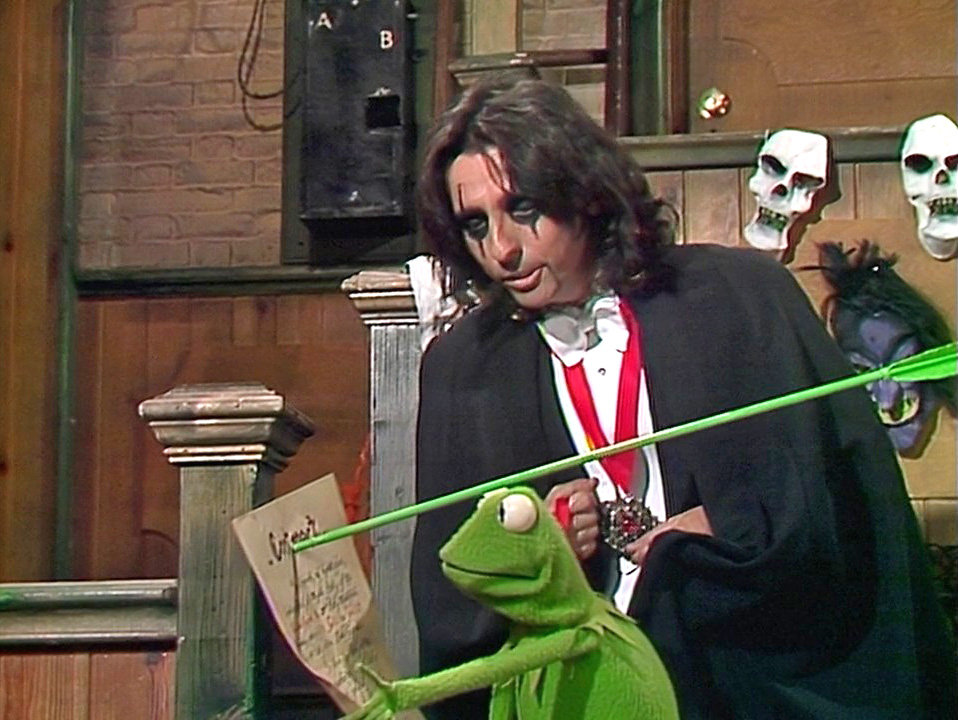
No Muppets were harmed in the making of this production.
 *Another when question worth asking: when did Alice cease to be frightening?