Friday, March 18, 2011

Marginalia

Whenever I had a university paper due, the library books I reached for were the ones that had been re-bound. The books were uniformly ugly: the re-binding was frequently lime green. The information within was often dated, the pages were leathery from overuse, and it was clear the next step for these resource materials was going to be the pulper. So why the preference? One word: marginalia.

Man, with some of those old books, the essays practically wrote themselves! Key texts were underlined (sometimes highlighted, which annoyed me with its visually jarring colors), and arguments for and against were outlined in the formerly white spaces on either side of the print, often with reference to other works I could look up and include. The feckless and inexperienced preferred newer books to these stinky old things. But at the end or early dawning of the day, who needed Cliff's Notes or even an essay-writing service when these troves were so freely available?

My own contributions to marginalia, on the other hand, should be ignored. Inspired by what I saw, I tried my hand at commentary. After a year or so, when I reread what I'd scrawled (in pen!) I was shamed in realizing what a pretentious twit I'd become. The marginalia promptly stopped.

Anyhow, teh interwebz is abuzz with the seemingly endangered art of marginalia. Will digital deprive us of this pleasure, this artform? Kevin Charles Redmon compiles a number of links exploring the issue, and contributes a few thoughts of his own. But so far, my favorite essay comes from Victor LaValle, who brings a ballsy disregard for the book as totem, over here. Perhaps the time to again uncap my pen has finally arrived.


Marginalia, David Foster Wallace-style.

Thursday, March 17, 2011

Two Stars? Really?

Allen Barra beats the drum for the written work of Barry Gifford, over here. Barra begs readers not to associate Gifford too closely with the films of David Lynch (although the two clearly enjoy collaborating). Matt Dillon's City Of Ghosts (IMDB) is probably closer to Gifford's literary mark, if you'd rather see a movie than read a book.

Some years back I read Port Tropique (A), and loved it. I reached next for The Sinaloa Story (A), and when I finished that I figured I'd about finished with Gifford, too. Some of the "snapshots" within those pages failed to catch my interest; others beguiled, and begged for further exposure, which Gifford resolutely denied. I would call the first book "accomplished" and the second "experimental" -- a judgment Barra strains to refute. Barra is also keen on The Cavalry Charges, so I figured I'd give Gifford another chance.

My review of it is here. Two stars strikes me as a bit harsh, but the javascript prompt for three stars is "I liked it" while two indicates "It was okay," which is pretty much what I thought when I'd finished the book. If nothing else, The Cavalry Charges served to remind me that the real excitement in a writer's life, even one as internationally fêted as Gifford, occurs on the page.

Another D&D Link

By Grabthar's hammer, there must be something in the water. I hesitate to introduce D&D to my daughters, although I'm not at all sure of my reasons. I suspect it's mostly because, La-Z-Boy dad that I am, I couldn't be bothered to help them sort out the intricacies of gameplay. Besides, gameplay is the sort of thing they ought to be dishing out, and not some basement-bound fella on the far end of the spectrum.

Thursday, March 10, 2011

The Financial Lives Of The Poets by Jess Walter

The big-picture decline of my newspaper is no different than the decline of newspapers in most towns. Specifically, the time line looks like this:

1950s: TV arrives and it turns out that most people prefer having their news delivered by a guy on TV with molded plastic hair, smoking a cigarette.

1960s: Evolution and improved diet cause the first father in history to give up reading the paper on the toilet . . . much like the first fish that walked on land.

1970s: Literacy and newspapers reach their peak just as, ironically, actual reading begins to decline. (Side note: the guy reading the TV news quits smoking on air.)

1980s: Cable TV arrives and steals ad dollars from newspapers; soon entire channels are devoted to 24-hours-a-day news with three main components: (1) stories about celebrities, (2) police chases filmed from helicopters and (3) angry political hacks yelling at one another.

1990s: The Internet arrives, stealing even more advertising and compelling the last reader under forty to cancel his daily newspaper subscription so he can devote more time to masturbating to online porn.

2000s: eBay and craigslist combine to kill off classified advertising and car and house listings, which turn out to have been the financial backbone of newspapers. The recession crushes display advertisers, coolly finishing the job.

Present: After a long period of newspaper panic, publishers do increasingly stupid things to drive away what readers they once had, speeding up their impending death, which is now estimated to be somewhere around 2015.


Snippet from The Financial Lives Of The Poets, by Jess Walter. My review can be read here.

Wednesday, March 09, 2011

You Can Draw -- And Probably Better Than Roger Ebert Can

"I began to haunt art supply stores, as if somehow one could purchase what one needed to be an artist. I loved the smell of the paints and papers, the chalks and wooden easels."

Here is an Ebert post I've been mulling over. It brought to mind the first time I joined my wife on one of her working trips to Europe. The first morning in Germany I took my coffee and journal out onto the balcony of our apartment, which offered a spectacular view of the Black Forest. There was no way I could write about it, so I took my black Uni-Ball pen and sketched what I saw. Because I've always preferred blank paper to lined, the page practically invited the activity.

I liked ... no, I'll be honest: I loved what I drew. It was rudimentary, and certainly wouldn't win me any awards. But just looking at those jagged lines immediately evoked a much larger sense of what I was taking in than any of the subsequent photos I snapped. For the rest of the trip I kept the journal close, taking it out at cafes and pretty much following the advice Annette Goodheart gave to Roger: draw in ink, don't erase.

If I ever get a scanner, I'll underwhelm you with some examples. In the meantime, I believe I'll reapply Ms. Goodheart's advice to my life and start sketching again. You should, too. It's what we've been hardwired to do.

Dungeons & Dragons, Part The Second

Although I'm bitter at being scooped by Ethan Gilsdorf, it behooves me to link to his piece on mid-life campaigners. He admits that nostalgia is a crucial motivating factor, but uncovers a few others that hadn't occurred to me, including:

"Gamers are married, making babies. They are encouraging their kids to discard their Xbox consoles in favor of the communal storytelling experience that is the cornerstone of D&D."

More anon.

Wednesday, March 02, 2011

Dungeons & Dragons, Part The First

“We’ve got a campaign going on in Ty’s* basement. Care to join us?”

Thus began, in the summer of ’80, my exceedingly brief history with Dungeons & Dragons. I was 15 years old, and getting ready to spend a few weeks at my aunt and uncle’s farm, where my activities would be chiefly devoted to practical concerns. A summer afternoon in a friend’s basement playing this game with the weird name seemed like a good stepping-off point.

Ron, the friend who made the invite, was a Tolkien buff who made my enthusiasm for Lord Of The Rings look like the superficial acquaintance it was. The basement “campaign room” was standard-issue 70s rec room: ceiling-mounted flourescent lighting, inexpensive paneling on the walls, shag rug, a beaten-up couch set and a stocked bar we were too mindful to abuse. Ty was “Dungeon Master” and spread his charts and sheets on the coffee table, which he sequestered to himself so that we couldn’t cheat.

As the graph paper and bizarrely-shaped die were produced, Ty explained the temporary character I was going to play. He might as well have spoken Japanese — or Elvish — the way he droned on. “You’ll catch on as you play,” he said.

It took a while. Ron showed me the map he'd drawn of the dungeon we were in. There seemed to be a lot of white space. “This is as far as we've got,” he said, pointing to a square. Earlier in the campaign he and some others had encountered and fought orcs, a gang of bandits, and some goblins. “Right now we're in a large room where the only item of consequence is a large tapestry hanging on the eastern wall.” He looked at Ty. “Can we remove the tapestry? Roll it up and take it with us?”

Ty shook his head. “You cannot.”

Ron asked about a few other techniques, including casting a spell of some sort. Ty wasn't budging on the tapestry. Ron huffed. “Alright, try this: with my lance, I gently lift the southeast corner of the tapestry and peer behind it.”

“You see a brick wall.”

“Is there a door, or some hidden panel?”

“All you see is a brick wall.”

“Ahm . . . have I got enough magic left to check for enchantments?”

“Yep.”

“Okay, then.”

“Still a brick wall.”

“Are you serious? What happens if I scratch the tapestry with the point of my lance?”

“Sorry, did you say you slash the tapestry?”

Ron's eyes lit up. “Is this a prompt?”

Ty retreated. “Clarification. I'm just asking.”

Ron leaned forward. “I slash the tapestry!” He made a sweeping motion with his hands.

Ty snickered. “A green, viscous ooze pours out of the slash, covering you and your party and killing you. Your campaign is over.”

This was when the many-sided die finally came into play, to be thrown at Ty the Dungeon Master, who quickly retreated behind the bar.

When tempers finally cooled, another campaign was initiated. The first thing our fictional band encountered was a group of traveling merchants. Once again, the lengthy Q&A. Once again, we might as well have encountered another brick wall. The way I understood it, Ty was a would-be novelist, hoping we'd suss out the plot as we snooped around his setting. To my mind, the obvious encounters in which a central or even secondary character might gain illumination were nothing more than cruel cyphers designed to frustrate players. I said so to my friend as we walked home for supper.

“Well, Ty is a particularly opaque Dungeon Master,” he said. “Ideally we'd have someone a little more generous with his detailing and characterization, like Kent.” Alas, Kent's summer with the Air Cadets had already begun, so the D&D bug never took hold of me.

Alright, now take a look at this:
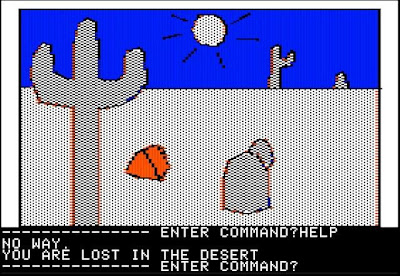


That is a screen from “Wizard & Princess,” one of the earliest Graphic Adventure Games. See the command prompt, and the game response? That's just one example of the moribund stasis these games frequently lapsed into. If you weren't part of a discussion group — which, in this the early age of the telephone modem, would physically gather at the vendors that rented out these games — the odds that you'd ever see these games through to their designed completion were stacked against you. Although I finished one or two of the later, more user-friendly (read: “so simple an addled chimp could do it”) games, I never had the prerequisite patience to engage in the larger, ostensibly more rewarding graphic adventure games.**

No surprise, really, that these games were more robustly enjoyed by my friends who had devoted themselves to the intricacies of D&D. After all, there was something of value in that tapestry, or behind it, or somehow or other related to it. If we'd only had the patience and the persistence and the correct variation of inquiry we might have discovered just what that was . . . .

Richard Moss entertainingly unspools the quarter-century history of the graphic adventure game, which he reckons has all but concluded — or evolved to a superior format, depending on your point of view — with the advent of episodic games.

*All names have been changed, to protect the guilty.
**Including, most recently, Grim Fandango.