Sunday, October 29, 2006
The Spirit of '76
The flashes snapped in earnest now, deluging him. This was it, he realized. Front-page news. He had aspired his whole life to maintain a Gary Cooper sort of levelheadedness, but no-one would ever confuse Tom Raith with Coop after this. Now he was Crazed Father of Killer Teen...
Saturday, October 28, 2006
Footnote To A Bread Recipe
It was a lousy year for farmers and a great year for lawyers. We took to sleeping on the living room floor, just to catch whatever breeze the night could muster. And she was quick to tell me: sweat from sitting around didn’t taste near as good as sweat from honest work.
Friday, October 27, 2006
Sound the Trumpets -- Pagination Solved
Immediate digression: I just dropped the younger off at her karate class. As I returned home, I walked past an old car, an 80s-era GM clunker. A father was trying to hustle his boys out of the back seat, the back door wide open. We nodded to each other, and I caught a whiff of the car's interior -- that old car upholstery smell -- and it was like I'd been thrown into the back seat of the family car of my youth (my grandfather's old Cutlass Supreme). Memories, emotional associations ... whoah.
Alright: everyone using Mac Write or MS Word legitimately wonders, "What's the big hairy deal with this guy and pagination?" Well, I did use Word at first, but after experiencing less-than-stellar results in layout, I decided it might be a good time to learn the fine points of Open Office Writer -- the Open Source word processor preferred by most Linux users.
I didn't think pagination would be one of those fine points, but that was just my own naivete. Are you a Word user, accustomed to just click - and - pasting your page numbers? If so, are you curious to see how the other "half" lives? This is probably the most straight-forward tutorial on Writer pagination. I read it and took a stab at it. I repeated the process. And did it again. And again. It took me several hours and some gentle clarification from senior members at the Open Office Forum, but by golly, I finally got it.
I can now see exactly what the "problem" was: I was searching for Microsoft answers. I thought, Page numbers -- how hard can that be? The difficulty with OOo Writer is that it's not simply a matter of inserting page numbers: as with most Linux ware, it's a matter of configuring your initial template the most efficient way possible. For a newbie like me, this meant I had to bone up on OOo Writer structure and start from the beginning.
Not so MS Word. MS allows you to dive right in, follow your whims and throw a page number wherever you please. Middle of the page? Go ahead! Top left on the next page? We can do that too!! If the result is a document cluttered with code, some of it conflicting, well ... that's what the 1-800 number is for.
ANYWAY, if I get a little time tomorrow afternoon to work on the doc, I do believe it will be ready for public consumption. In the meantime, in anticipation of the blessed event, I'll post a story title and a snippet of prose in the days leading up to release.
Thursday, October 26, 2006
Review of the Day

Or, "Again with the iPod!" Here is a quick look at Steven Levy's The Perfect Thing: How The iPod Shuffles Commerce, Cultures, And Coolness. My favourite quote from reviewer Alan Jacobs:
This tendency — mon iPod, c'est moi — is irrational, perhaps, but irresistible: having just noted the last ten songs played randomly by my own iPod, I am deeply disappointed to see one of U2's most famous songs there, and even a little annoyed that the Beck song it pulled up is one of his more accessible. I would feel much cooler if it had pulled out something by the Dirty Three, or Charlie Patton, or Yo La Tengo. But as things stand I feel ordinary. This little electronic gadget, like a pocket-sized Freudian analyst, has somehow revealed — worse, allowed me to reveal — my inauthenticity, as though its famously fingerprint-attracting polished metal back had lifted itself before my appalled face and cried, Behold!
Well, when you start talking french to your iPod (just don't call it "ee-POD"), you can be sure your reflection will come back looking a little grubby. Still, curiosity got the better of me. I might be telling tales out of school by revealing this list of ten randomly shuffled songs from my wife's iPod, but bear in mind I'm the guy who put them there:
Steely Dan, "Black Friday"
Sting, "The Lazarus Heart"
Carolyn Arends, "Travelers"
Lisa Stansfield, "Soul Deep"
Steely Dan, "Everyone's Gone To The Movies"
Los Lobos, "Kiko & The Lavender Moon"
Shelby Lynne, "Why Can't You Be"
Bonnie Raitt, "Nobody's Girl"
Talking Heads, "Cross-eyed & Painless"
Erasure, "Breath of Life"
Emmylou Harris, "O Little Town of Bethlehem"
Bruce Cockburn, "Call It Democracy"
Eurythmics, "Sisters Are Doing It For Themselves"
Lisa Stansfield, "Tenderly"
Steve Bell, "The Lord's Prayer"
Hey, that's not 10 -- whoops! That "shuffle" feature is more entrancing than the paper's daily horoscope. Apparently Levy is convinced the iPod is wired to give Steely Dan top billing, which the casual reader might think is borne out by this random list of mine ... or rather, "my wife's". But the Dan happens to be one of my wife's favourite groups (and, quite coincidentally, my all-time personal fave), so I went ahead and ripped and uploaded their whole darn ouevre. That's a lot of songs, so the real surprise is seeing two from Lisa Stansfield in such a short span -- there's only one album by her in this little gizmo.
Maybe when I've taken a break from numbering pages, I'll see if I can't somehow generate a random selection of my music on the PC (in the interests of fair representation).
Over at Slate: iPod, Schmypod "Levy, a senior editor at Newsweek, is a prime example of the boomers who think the iPod is revolutionary. But really, they're grateful, because it's made them feel cool again" - Michael Agger
Formatting A Book Vs. Solving The Rubik's Cube
I was probably 14 when I saw my first Rubik's Cube. I was with my family, visiting another family whose kids were the right ages for my younger siblings, but the wrong ages for me.
Here was this messed-up cube. Here was bored little me.
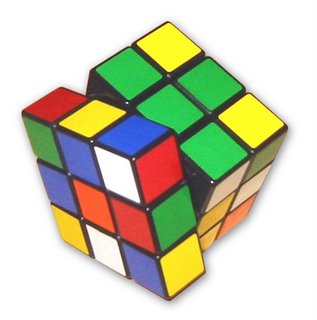
Over the next hour and a half I solved exactly one layer. Try as I might, I could not get beyond that. But I couldn't stop. One unusual shuffle of these little blocks, and ... hey, that's new! Am I closer?
Of course, then my brother's playmate showed up, grabbed the thing from my hands and had it done in two minutes. "It's easy," he said. "You've just got to remember where the center pieces are."
Oh yeah. Sure.
So here I am, nearly 30 years later, tweaking this and that on my book format, pulling out my hair when faced with a change I could never have predicted. But I can't stop. My most recent hang-up? I spent most of yesterday and am beginning today with headers, footers and pagination.
Ah, well. Be assured the colours are slowly being shuffled into their correct order. The final layer is just about there.
Here was this messed-up cube. Here was bored little me.
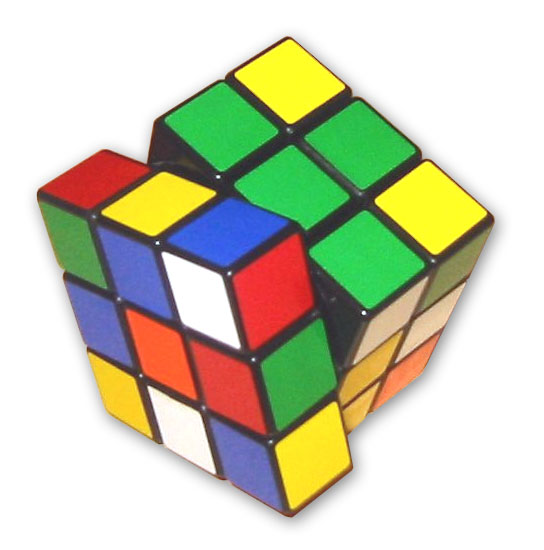
Over the next hour and a half I solved exactly one layer. Try as I might, I could not get beyond that. But I couldn't stop. One unusual shuffle of these little blocks, and ... hey, that's new! Am I closer?
Of course, then my brother's playmate showed up, grabbed the thing from my hands and had it done in two minutes. "It's easy," he said. "You've just got to remember where the center pieces are."
Oh yeah. Sure.
So here I am, nearly 30 years later, tweaking this and that on my book format, pulling out my hair when faced with a change I could never have predicted. But I can't stop. My most recent hang-up? I spent most of yesterday and am beginning today with headers, footers and pagination.
Ah, well. Be assured the colours are slowly being shuffled into their correct order. The final layer is just about there.
Wednesday, October 25, 2006
Review of the Day
Man, oh man: no-one reviews a book like Martin Amis. He writes each one as if he's been storing up everything in his life for just this occasion. Here he is on Bob Woodward's latest. Link from ALD.
Tuesday, October 24, 2006
Movies And Remembering
I'm one of those pissants who can't decide if I've deep-sixed a cautious admiration for Clint Eastwood out of envy, or if I'm legitimately peeved with the man (ditto Steven Spielberg). This morning I was all set to commit to the latter position, but then I read Cowtown Pattie's review of Flags Of Our Fathers. She closes with this:
When I saw Saving Private Ryan, I had to take a quick exit mid-movie to the ladies room. In the dark hallway outside, I came upon two older Vets standing off to the side. The old soldiers were sobbing quietly and consoling one another. I was embarrassed to be, albeit innocently, intruding into their private grief. It is these experiences I will remember more so than the actual films.
Well ... now me, too. There is something about watching these films get made, then putting on my cap and jacket and paying money to see them, that niggles at me. Isn't it just a bit tawdry of me to watch this stuff from the safety of my theatre seat, and expect to feel anything (thrills! chills! spills!) other than profound shame? And how should we judge the artistic intentions and moral obligations of Eastwood and Spielberg? Or are "moral obligations" a nettlesome subject that is only applied to the money-paying movie goer?
Back when Saving Private Ryan and The Thin Red Line were in theatres, my mother asked my great-uncle, a veteran who served the complete European tour from Juno Beach to Berlin, if he was at all inclined to see these movies. "Nope. Not at all." How about returning to Europe, and re-visiting some of the places he'd seen as a young man?
He was quiet for a bit, then he said that back when the surviving members of his regiment were on the boat leaving Europe, they all watched as the shoreline receded into the gray water. One of them wondered aloud if he mightn't someday return to the place. Someone else piped up and said, "Why? To look for your conscience?"
And that was all my great-uncle was going to say about that.
Elsewhere: Eastwood's FOOF gets a "meh" from Reelfanatic.
Subscribe to:
Posts (Atom)