Slate begins its Fall Fiction Week here. At first glimpse, The Novel, 2.0 seemed like a promising riff off some of my own thoughts, but upon closer examination I'm doubtful. Let's start with the proposition: "What is the role of fiction in the age of the Internet?"
Oh! Oh! I know the answer!! Pick me, pick me!!
"Yes? 'Whisky'?"
Um ... to tell a story?
"*bzzzt* WRONG! Submitted answer is not esoteric enough to be given serious consideration. The correct answer will seek to determine why there hasn't been a Great American Novel since DeLillo's Underworld, and attempt to provide helpful clues that might point the way forward for po-mo literatis confined to a limited range of sleight-of-hand parlour tricks."
Right, then. Say, have I mentioned how much I enjoyed James Lee Burke's penultimate Dave Robicheaux novel? Nothing happens in Crusader's Cross that regular readers haven't come to expect from Burke -- Robicheaux remembers a painful episode from his impoverished past, digs around a bit in the corridors of power, snaps and loses it big-time, struggles to regain his equilibrium while everything around him gets thrown off-balance, etc. The eleven herbs and spices are all there, in other words, but Burke tweaks 'em just enough to sustain my interest (I note, with gratitude, that Clete Purcell doesn't perform the usual "break the logjam" function here as he does in other novels).
I love the white heat of Robicheaux's (and, I assume, Burke's) moral outrage. I love how they have to choke it down while struggling with common grace. I love how much it bugs Robicheaux to spot a virtue within an otherwise damnable cretin. And I love how the cretin always suffers before he takes the Three-Day Journey. Love it, love it, love it. Next to A Stained White Radiance, this is my favourite Robicheaux novel.
As for Whither American Letters, I'd say the problem is there aren't any ex-pats. Or if there are, the publishing machine is geared to ignore them. Even with the world-wide charms of the Internet, without exile and cunning, well ... good luck finding and promoting the American Joyce (or Kundera or Milosz).
Wednesday, October 11, 2006
Monday, October 09, 2006
Thanksgiving
This it is to testify, to speak out what the heart holds true. If the tongue and the heart are at odds, you are reciting, not testifying. Augustine, Childhood.
Canadians are eating the bird, today. For those of us who believe in an interested Deity, and make timid attempts to work out our faith in fear and trembling, Giving Thanks is one of the big priorities. It isn't just a matter of saying what you're thankful for before you grab your fork and knife -- you're required to do something, to serve and be gracious. And despite Augustine's assertion, it isn't even a matter of feeling grateful -- and thank God for that, because I sure don't "feel" thankful.
The human capacity to fuck things up on a monstrous scale cannot be denied -- not in 1945, and certainly not this morning when we woke up to the news. The people of Darfur know it. The people of North Korea know it. The people of New Orleans and one or two of our nation's finest "Reservations" know it, too. We live between the headlines, hoping for some transcendant gift while wondering if, in fact, we aren't still captive to the bloodthirsty gods of old.
And who, I ask again, really needs the headlines to aid our daily lamentation? Do we not have enough to lament in our own small circles? One friend from my past has died, two are in marriages that are foundering (or "transitioning", on their better days), one is experiencing a volatile career-shift, another is waiting for news of his second down-sizing.
There is no conclusion, here -- just a droning recital that hopes for a bit of life to blow through it, to lift the bones in some strange testifying dance.
Friday, October 06, 2006
Public Service Announcement
My brother has been taking note of the latest hacker news. The big "story" suggesting that Firefox was critically flawed in a way that could not be patched appears to have been a hoax. But we are, in fact, witnessing some surprising manipulations of javascript (more here and here, for starters). Sites that have been carriers of javascript infections include google, msn, yahoo, aol, wordpress powered blogs, myspace, etc.
In other words, the javascript issue will only get bigger. So far, it's a fairly easy problem to navigate around: you just disable javascript in your browser. This does result in a significant reduction of the Internet's Distraction (or, "Entertainment", if you prefer) Factor. Also, most on-line banking requires use of javascript. But if, after you've been surfing about, you have the need to do some banking (or exchange other critical information), you can typically shake the javascript piggy-backers by closing your browser. Open it up again, and you are more or less off to a fresh start.
That's my understanding of it, thus far -- which is, I admit, pretty sketchy. You are, as always, invited to enlighten me in the comments.
Tuesday, October 03, 2006
Tracking Identity and the Jewish Diaspora: Roth's American Pastoral & Lebrecht's The Song of Names
I like bookstores that encourage their employees to write little “recommended” tags for titles they love. They're basically personal book reviews on a post-it note. Our bookstore did that, and we sold some unusual items that way (my own “off-the-beaten-track” favorite was this book).
When Philip Roth came out with American Pastoral, a co-worker (and friend) tagged it thusly: “This is the masterpiece that Mordecai Richler's book should have been.” You non-Canuckle-heads will just have to take it on faith that Richler's final novel, Barney's Version, was a Big Event in our country. It won several awards — including the upstart, glitzy Giller — and had no trouble nationally out-pacing Roth's efforts when it came to book sales.
Also, at that time the advent of Roth's stellar re-ascension was almost unimaginable. He had spent the previous 20 years writing increasingly self-indulgent stuff, hall-of-mirrors metafictional riddles that earned him hearty claps on the back from Esquire and The New Yorker, while the public grew weary and picked up something else — his ex-wife's memoirs, for starters. They painted the picture of a man whose sexual proclivities weren't far removed from those of his self-despising (and self-abusing) characters. The possibility that this adolescent slouch could return to form and write emotionally compelling fiction that was topical seemed beyond consideration.
Then came American Pastoral, with its singular prose and heart-rending story of a father who watches helplessly as his daughter sinks into the lurid, furious underground of the 60s counter-culture. It could have been parlour-fiction; Roth gathered all the standard narrative expectations and slowly drove a stake through the reader's heart — again, and again, and again. But there was no denying the dizzying breadth and subtlety of Roth's observations. When I finished it, I thought my friend's comparison to Richler may have been unfair, but her appreciation for the novel was entirely merited.
I admired American Pastoral, and was completely drawn in to “Swede” Levov's heartbreaking love for his wayward daughter. Watching the adolescent fury slowly boil within her, her terrible expression of it and her resulting disappearance grew to be an all-consuming pursuit for me as a reader (how could it not be?). That this was also the story of a time in America when an immigrant could, by force of will and attention to method, build an economic empire that duly provided for his family and the larger community around him only added to its emotional import. More than a few landed Mennonites would consider this a similar backdrop to their own story.
But Roth ties a larger concern to what would otherwise receive glib classification as his generation's final coming-of-age story. American Pastoral could have simply been “Man loses daughter and wonders what the hell went wrong with his family and his country.” But Roth's enterprise is more particular, more keenly focused: he is at pains to give a full account of the terrible toll exacted when the Jewish Diaspora fully embraces American secular liberalism. Roth seems to suggest that another famous Jew's rhetorical question — ”For what shall it profit a man, if he shall gain the whole world, and lose his own soul?” — isn't Jewish enough in its extremity of vision.
“Swede” doesn't just barter away a soul he didn't know he had — he loses the world as well. Lest we miss the moral of the story, by book's end “Swede's” beloved daughter gives up all aspect of her personality, ethnicity and individuality and joins a cult, his beautiful goya wife willingly subjects herself to a neighbor's groping, and the neighbor's drunken wife plunges a fork into “Swede's” father. Like the old man, I sure got the point, but I wanted to protest: Is it really as bad as all that?
Roth followed this up with The Plot Against America, an “alternate history” in which the United States is a willing partner in Hitler's Final Solution. In other words, “Sonny — you have no idea.”
Well, maybe I don't. Still, there are more pleasurable ways to acquaint oneself with the subtleties of tension and torment within the Jewish Diaspora, and I am happy to report that Norman Lebrecht's The Song of Names delivers the goods on every level. It is a mystery story of a friend's disappearance, narrated with a wry wit that appreciates the ironies of genius and the unsavory appetites of the public. Much of it is set during the London Blitz, and the terrible silence that grows within Continental Europe. From this silence comes The Song of Names, as poignant a demonstration of Judaism's irresistable staying power as you are likely to find in any post-Holocaust novel.
The Song Of Names, in other words, is the masterpiece that Roth's novel should have been. Buy it here.
Never Mind The Bibles: A Theology of Punk!
It looks like Andrew -- published author, former journalist, aging punk wannabe -- is awake and raving with his latest manifesto, Never Mind The Bibles: A Theology of Punk, a free-for-all interactive read via Blogspot (hold the loogies, though. They're murder on keyboards).
Theology? Punk?!? Well, if such things make you nervous, then huh huh huh! -- tough titters for you.
But, hey -- enough of my yakkin'. Let's rock and roll.

Theology? Punk?!? Well, if such things make you nervous, then huh huh huh! -- tough titters for you.
But, hey -- enough of my yakkin'. Let's rock and roll.
Monday, October 02, 2006
Lovesick Lake
I'm told this was our 18th gathering. I never thought I'd lose track of such things, but then I never imagined our get-togethers would extend into 18 years -- at the same location, no less. I'm guessing the location could change soon. I will miss the place (even as I look forward to a more comfortable mattress).

Photo courtesy of Tom.

Photo courtesy of Tom.
Friday, September 29, 2006
Reconvening With The Monks of Fall
I'm off to the Kawarthas to meet with my mates and slurp single malts. It's been 18 years and counting with this crew. The day someone scraped together the lucre for a bottle of Lagavulin was quite the revelation. Up to that point we'd been scruffy beer drinkers, who occasionally dipped into bourbon or blended whiskies that had a nose reminiscent of unleaded petrol.
But Lag! Oh! Oh my!!
I have cooled on Lag, since then. There's just too much contained in that tiny little glass. And it's bloody expensive. A bottle of Laphroaig is less than half the price, and its remove from Lag is not significant enough (to this aging palate, at least) to merit the expense. Last year our hurtin' Albertan introduced us to Bowmore Darkest, which was the hands-down highlight of the weekend. Not that different in price from Lag, but its pleasures were so much more nuanced than Lag's punch-in-the-gut.
But I ramble. I ramble because this year I have nothing to read to these jokers. I ramble because I have nothing more to say. So here's a picture of what I did on my summer vacation:
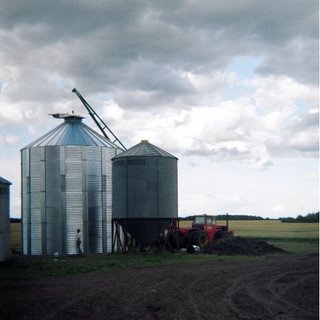
That's me, up in Northern Alberta. I pitched in with my brother in law and his friends to assemble a grain bin. The scene wasn't exactly raising the barn for Kelly McGillis (but then I'm not Harrison Ford -- and thank God for that!), but it was an incredibly satisfying day.
Alright, back on Monday. (Hey, Pattie -- we call ourselves The Nick Adams Society!)
But Lag! Oh! Oh my!!
I have cooled on Lag, since then. There's just too much contained in that tiny little glass. And it's bloody expensive. A bottle of Laphroaig is less than half the price, and its remove from Lag is not significant enough (to this aging palate, at least) to merit the expense. Last year our hurtin' Albertan introduced us to Bowmore Darkest, which was the hands-down highlight of the weekend. Not that different in price from Lag, but its pleasures were so much more nuanced than Lag's punch-in-the-gut.
But I ramble. I ramble because this year I have nothing to read to these jokers. I ramble because I have nothing more to say. So here's a picture of what I did on my summer vacation:

That's me, up in Northern Alberta. I pitched in with my brother in law and his friends to assemble a grain bin. The scene wasn't exactly raising the barn for Kelly McGillis (but then I'm not Harrison Ford -- and thank God for that!), but it was an incredibly satisfying day.
Alright, back on Monday. (Hey, Pattie -- we call ourselves The Nick Adams Society!)
Subscribe to:
Posts (Atom)