Heartbreaker #8: A River For Him by Emmylou Harris, on Bluebird.
Ms. Harris is acutely capable of locating the heartbreak in other people's songs, and has constructed a handsome career from this art. But she penned this one herself, and it's as lonely a song as you could hope to find this side of Hank Williams (lyrics here).
A friend asked me if I mightn't choose her cover of Steve Earle's Goodbye, from Wrecking Ball. I'm among the legion of fans who think Wrecking Ball is just about as good as she and Daniel Lanois get, individually or as a duo. And Goodbye definitely gives me the shivers and puts me in a minor key. It just doesn't get the tears flowing. This is because it is so obviously a sentiment voiced by a recovering addict: Was I just off somewhere or maybe just too high / But I can't remember if we said goodbye. That's chilling and deeply depressing, and quite sad for the person it's addressed to, but it does not come across to me as a "sad" song per se, if you see what I mean. It's too calculated. A River For Him, on the other hand, is messy with recognition of what's been lost forever.
But speaking of Steve Earle... Heartbreaker #7
Tuesday, February 14, 2006
"Amsterdam was always good for grieving"
Heartbreaker #7: Ft. Worth Blues, Steve Earle's ode to Townes Van Zandt at the close of El Corazón.
Heartbreaker #6
Heartbreaker #6
Monday, February 13, 2006
"Gone from mystery into mystery. Gone from daylight into night."
Heartbreaker #9: Closer To The Light by Bruce Cockburn, from Dart To The Heart. Also One Tree Hill by U2, from The Joshua Tree.
Most of my selections will pertain to our mortal condition, which makes grim sense, I think: we shed our hottest tears over death -- if we're especially fortunate, we get to shed a few over our own.
Before I get too gloomy, though, I'll get noisy. There's baggage for me to lose, and it can be stowed under the rubric of "lamentable rock snob": I'm one of those self-inflated prigs that thinks U2's best days as an artistic unit are long behind them. I'd have been personally gratified if they'd closed their Zooropa tour by shaking hands, clapping each other on the back, and bidding their mammoth audience farewell, allowing each other to trundle off to their respective careers as solo artists and debt-relief activists. Of course, millions of still-gratified U2 fans (and the entire continent of Africa) can flip me the bird on this point: it's a case of what the market will bear, and as a consumer I'm left with the happy option of keeping my change in my pocket and ignoring (to the extent that I can) their post-Zooropa output.
U2's breakthrough album, The Joshua Tree, was released while I was still in the habit of attending my childhood church. We had an old saint there -- a widower -- who could be relied upon to bless the elements and serve Communion. In the whispery remains of his former baritone, he'd proclaim, "The stars gonna fall from the sky -- and I'll see My Honey again!"
The stars gonna fall from the sky. This prophetic metaphor is from The Revelation of St. John the Divine, the final book in the biblical canon and a very personal thorn in my psyche. It takes an unusual consciousness to garner comfort from apocalyptic imagery, like the moon turning blood red and stars falling from the sky. I can't do it, but the old man could. And so could U2: I'll see you again when the stars fall from the sky / And the moon has turned red over One Tree Hill.
I don't know anything about the conditions that spawned One Tree Hill, except for what's provided in the liner notes, which is precious little: a funeral in New Zealand for "Greg Carroll, 1960-1986." Bono seems to rail not just against the untimely death of his friend, but against every wretched horror and injustice that humanity inflicts on itself. I think it is indicative of U2's collective genius that they were able to summon from their grief a depth of outrage that could only be addressed within an apocalyptic form. In any case, it got the waterworks flowing for me in 1986 -- a year of funerals for me. Twenty years later, the song still has the power to speak to me (and I still have the sensitivity to hear it).
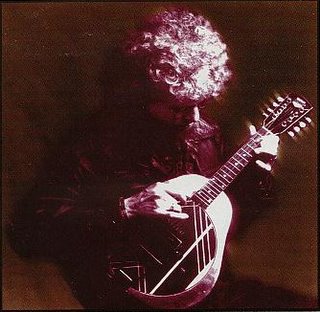
I know a little more about the inspiration to Bruce Cockburn's song, Closer To The Light. Mark Heard was a medium-built guy with a comically puffy head (made all the moreso by his unruly curls). When I was a youth, he showed up at different "coffee houses" held in our church basements: he played his guitar and sang his songs while we drank generic pop and snaked our hands toward our would-be girlfriends. At some point I registerd that this guy was singing about some pretty heavy stuff -- heavy enough for me to lose track of the blonde that just vacated the seat beside me. "My heart's taking a beating / Existence is bleeding me dry you know ...." Whoa, dude -- this is not what we typically get in a coffee house!
Fittingly enough, I last saw him perform in 1986. It was the same setting -- a church basement -- but I was older, standing at the back. Mark slouched in, glowered at the floor while the emcee introduced him, then shuffled onstage and fiddled with his guitar and the mics for a few minutes. He seemed to get a little more comfortable, and launched into a song. A few songs later, his eyes were closed and he was singing as if he was the only one in the room. And what he sang was weirdly and incredibly encouraging. This was a man who couldn't stand how awful such a sweet world could be, who almost seemed to want a different God than the one he had, but who sang to this God anyway because he didn't seem to have any choice...
"Maybe those inclined towards the arts are so spiritually retarded to a degree that we must go through the whole process of cathartic expression just to discover how we really feel... Maybe I'm just a selfish maniac who is wasting his time trying to transfer feelings which perhaps no one cares about onto a fretboard and a piece of magnetic tape. Maybe it's the modern petroglyph, or the modern way to write on the wall of your cave: 'I was here.' Maybe it is a cry to God about how much I hate the bad things and how much I love the good things." (Mark Heard's journal, circa 1990)
Ah, but the kids hardly knew what to do with him -- heck, he didn't really know what to do with himself. He kind of dropped from sight for a couple of years after that. Then I got word from a friend of mine that Heard had re-emerged from the wilderness to form his own record label. The man was his own distributor, had developed a bit of a freak-on for the electric mandolin, and was putting out his best music yet.
He'd become a father, which seemed to raise his appreciation of love and happiness as being more pervasive and encompassing than he had previously thought. It also spoke directly to his darkest fears, particularly being orphaned -- physically and emotionally. He was at the top of his game, doing his thing, playing for Sam Philips, opening for Bruce Cockburn.
And then he was gone. Heart attack. Coma. Death. Followed by a monstrous hospital bill for his wife and daughter to shoulder in his absence.
From my perspective (and I think Cockburn's too), his death created an irreplaceable gap in the choir -- the only voice to sing what some of us desperately needed to hear.
Lyrics for Closer to the Light are here. Mark Heard's music can be bought here, or legally downloaded at eMusic. High Noon is a good value and an excellent overview of his very best music, culled exclusively from his last three albums. The journal excerpt is from Matthew Dickerson's 2003 biography of Mark Heard. This is a touching tribute page to MH. And in a lovely fit of synchronicity, I was told today that Steve Bell, one of my favourite Winnipeg-based performers, will be releasing a CD of Bruce Cockburn covers later this month, including Closer to the Light.
Heartbreaker #8
Most of my selections will pertain to our mortal condition, which makes grim sense, I think: we shed our hottest tears over death -- if we're especially fortunate, we get to shed a few over our own.
Before I get too gloomy, though, I'll get noisy. There's baggage for me to lose, and it can be stowed under the rubric of "lamentable rock snob": I'm one of those self-inflated prigs that thinks U2's best days as an artistic unit are long behind them. I'd have been personally gratified if they'd closed their Zooropa tour by shaking hands, clapping each other on the back, and bidding their mammoth audience farewell, allowing each other to trundle off to their respective careers as solo artists and debt-relief activists. Of course, millions of still-gratified U2 fans (and the entire continent of Africa) can flip me the bird on this point: it's a case of what the market will bear, and as a consumer I'm left with the happy option of keeping my change in my pocket and ignoring (to the extent that I can) their post-Zooropa output.
U2's breakthrough album, The Joshua Tree, was released while I was still in the habit of attending my childhood church. We had an old saint there -- a widower -- who could be relied upon to bless the elements and serve Communion. In the whispery remains of his former baritone, he'd proclaim, "The stars gonna fall from the sky -- and I'll see My Honey again!"
The stars gonna fall from the sky. This prophetic metaphor is from The Revelation of St. John the Divine, the final book in the biblical canon and a very personal thorn in my psyche. It takes an unusual consciousness to garner comfort from apocalyptic imagery, like the moon turning blood red and stars falling from the sky. I can't do it, but the old man could. And so could U2: I'll see you again when the stars fall from the sky / And the moon has turned red over One Tree Hill.
I don't know anything about the conditions that spawned One Tree Hill, except for what's provided in the liner notes, which is precious little: a funeral in New Zealand for "Greg Carroll, 1960-1986." Bono seems to rail not just against the untimely death of his friend, but against every wretched horror and injustice that humanity inflicts on itself. I think it is indicative of U2's collective genius that they were able to summon from their grief a depth of outrage that could only be addressed within an apocalyptic form. In any case, it got the waterworks flowing for me in 1986 -- a year of funerals for me. Twenty years later, the song still has the power to speak to me (and I still have the sensitivity to hear it).
I know a little more about the inspiration to Bruce Cockburn's song, Closer To The Light. Mark Heard was a medium-built guy with a comically puffy head (made all the moreso by his unruly curls). When I was a youth, he showed up at different "coffee houses" held in our church basements: he played his guitar and sang his songs while we drank generic pop and snaked our hands toward our would-be girlfriends. At some point I registerd that this guy was singing about some pretty heavy stuff -- heavy enough for me to lose track of the blonde that just vacated the seat beside me. "My heart's taking a beating / Existence is bleeding me dry you know ...." Whoa, dude -- this is not what we typically get in a coffee house!
Fittingly enough, I last saw him perform in 1986. It was the same setting -- a church basement -- but I was older, standing at the back. Mark slouched in, glowered at the floor while the emcee introduced him, then shuffled onstage and fiddled with his guitar and the mics for a few minutes. He seemed to get a little more comfortable, and launched into a song. A few songs later, his eyes were closed and he was singing as if he was the only one in the room. And what he sang was weirdly and incredibly encouraging. This was a man who couldn't stand how awful such a sweet world could be, who almost seemed to want a different God than the one he had, but who sang to this God anyway because he didn't seem to have any choice...
"Maybe those inclined towards the arts are so spiritually retarded to a degree that we must go through the whole process of cathartic expression just to discover how we really feel... Maybe I'm just a selfish maniac who is wasting his time trying to transfer feelings which perhaps no one cares about onto a fretboard and a piece of magnetic tape. Maybe it's the modern petroglyph, or the modern way to write on the wall of your cave: 'I was here.' Maybe it is a cry to God about how much I hate the bad things and how much I love the good things." (Mark Heard's journal, circa 1990)
Ah, but the kids hardly knew what to do with him -- heck, he didn't really know what to do with himself. He kind of dropped from sight for a couple of years after that. Then I got word from a friend of mine that Heard had re-emerged from the wilderness to form his own record label. The man was his own distributor, had developed a bit of a freak-on for the electric mandolin, and was putting out his best music yet.
He'd become a father, which seemed to raise his appreciation of love and happiness as being more pervasive and encompassing than he had previously thought. It also spoke directly to his darkest fears, particularly being orphaned -- physically and emotionally. He was at the top of his game, doing his thing, playing for Sam Philips, opening for Bruce Cockburn.
And then he was gone. Heart attack. Coma. Death. Followed by a monstrous hospital bill for his wife and daughter to shoulder in his absence.
From my perspective (and I think Cockburn's too), his death created an irreplaceable gap in the choir -- the only voice to sing what some of us desperately needed to hear.
Lyrics for Closer to the Light are here. Mark Heard's music can be bought here, or legally downloaded at eMusic. High Noon is a good value and an excellent overview of his very best music, culled exclusively from his last three albums. The journal excerpt is from Matthew Dickerson's 2003 biography of Mark Heard. This is a touching tribute page to MH. And in a lovely fit of synchronicity, I was told today that Steve Bell, one of my favourite Winnipeg-based performers, will be releasing a CD of Bruce Cockburn covers later this month, including Closer to the Light.

Heartbreaker #8
Sunday, February 12, 2006
"Even with you near me, I still feel so all alone"
Heartbreaker #10: Tony y Maria by Los Lobos (my wife's favourite song, from her favourite band) found on Good Morning Aztlán
One hundred and fifty miles from Mexico to L.A.
doesn't seem that far but it's still a world away
So begins the story of Tony and Maria -- an immigrant story, etched with clean, precise lines. Tony arrives at el Norte in advance, figuring to secure a job and living quarters -- and opportunity -- for his family. He toils alone for a few years, cobbling together less than he imagined. Desperately lonely, he begs his wife Maria to come join him.
Tony longs for Maria. Maria arrives, and longs for her babies. For me, this song's chorus with its subtle variations is a stake that slowly drives closer to the heart of the vows we make in intimacy:
We promised that we'd care for one another
said his wife
now and for the rest of our lives
Lyrics here.
Heartbreaker #9
One hundred and fifty miles from Mexico to L.A.
doesn't seem that far but it's still a world away
So begins the story of Tony and Maria -- an immigrant story, etched with clean, precise lines. Tony arrives at el Norte in advance, figuring to secure a job and living quarters -- and opportunity -- for his family. He toils alone for a few years, cobbling together less than he imagined. Desperately lonely, he begs his wife Maria to come join him.
Tony longs for Maria. Maria arrives, and longs for her babies. For me, this song's chorus with its subtle variations is a stake that slowly drives closer to the heart of the vows we make in intimacy:
We promised that we'd care for one another
said his wife
now and for the rest of our lives
Lyrics here.
Heartbreaker #9
Friday, February 10, 2006
Musical Heartbreakers
I recently read someone's list of top 20 albums from 1985. This was on a discussion list I subscribe to (scroll down if you need a clue as to its subject matter). The list-maker claimed 1985 was an especially verdant year for rock music, and said this list of 20 had been a tough exercise for him because he had to cull it from a list of 80.
Full stop.
A list of 80.
I was 20 at the time, and a late bloomer when it came to musical taste, so I still had some distance to go before I reached my zenith as a full-blown musically-obsessive freak. But even when I finally reached that nerdy pinnacle, I never had a list of the year's favourite albums that exceeded 20, nevermind 50. There were years when I bought all manner of professionally recommended strangeness, but even then I don't think I purchased as many as 50 CDs in 365 days. I'm not proud of that fact -- had I been flush, the tally would likely have been higher. As it was, half my paycheque went to rent, and half of what was left went to pay off my student loans. The rest went to beer and peanuts. But still: 80 albums that rocked my world in one single year?! It never happened.
I guess you could say I've been humbled. I've also come to the realization that my musical passions tend to be a bit feral. I'll sink my teeth into a particular performer for a few years, then discard the body when it's finally been drained of all signs of life. When critics were still in the business of wiping my nose for me, I used to think this was an indication of a band's frailties: "I can't listen to the Rolling Stones, anymore. They used to be so dangerous, and now they're just a joke" -- the larger implication being that I, as a listener, was receiving the brunt of the punchline. No mere witless consumer, I! I was a connoisseur, the personal arbiter of my own taste.
But, you know, somewhere in the last few years I came to the miserable realization that when it comes to music, I'm just a huge, needy sponge. I reach for CDs the way a self-pitying lush reaches for his fish-monger wife. "Gives us a bit of love, ducks?" At this point, whether or not a song connects with me has more to do with my state of mind than it does with the performer's abilities.
I wonder, sometimes, if I'm not on the verge of discovering a "new" favourite musical genre. There was a time when I shut off rock music altogether, and discovered jazz. I was courting my future wife at the time, but the path to love did not run smoothly, and we finally reached a point where we decided enough was enough, and parted ways. For two years, there wasn't a single CD in my collection that I could listen to without feeling absolutely miserable, so I limped down to the local library and took out some jazz records. Viola -- problem solved. (The two-year break-up addressed the other issues, to my everlasting gratitude.)
Alright, I'll leave it at that -- you would-be shrinks out there, if you've got any pertinent questions to ask me, now's the time to do it. In the meantime, since this is the time of year when I cobble together some sort of top-ten list, this year's list will be my Top Ten Musical Heartbreakers. That's right: ten songs (or groups of songs) that force me to retrieve my hanky and dab at my eyes. Stay tuned!
Heartbreaker #10
Full stop.
A list of 80.
I was 20 at the time, and a late bloomer when it came to musical taste, so I still had some distance to go before I reached my zenith as a full-blown musically-obsessive freak. But even when I finally reached that nerdy pinnacle, I never had a list of the year's favourite albums that exceeded 20, nevermind 50. There were years when I bought all manner of professionally recommended strangeness, but even then I don't think I purchased as many as 50 CDs in 365 days. I'm not proud of that fact -- had I been flush, the tally would likely have been higher. As it was, half my paycheque went to rent, and half of what was left went to pay off my student loans. The rest went to beer and peanuts. But still: 80 albums that rocked my world in one single year?! It never happened.
I guess you could say I've been humbled. I've also come to the realization that my musical passions tend to be a bit feral. I'll sink my teeth into a particular performer for a few years, then discard the body when it's finally been drained of all signs of life. When critics were still in the business of wiping my nose for me, I used to think this was an indication of a band's frailties: "I can't listen to the Rolling Stones, anymore. They used to be so dangerous, and now they're just a joke" -- the larger implication being that I, as a listener, was receiving the brunt of the punchline. No mere witless consumer, I! I was a connoisseur, the personal arbiter of my own taste.
But, you know, somewhere in the last few years I came to the miserable realization that when it comes to music, I'm just a huge, needy sponge. I reach for CDs the way a self-pitying lush reaches for his fish-monger wife. "Gives us a bit of love, ducks?" At this point, whether or not a song connects with me has more to do with my state of mind than it does with the performer's abilities.
I wonder, sometimes, if I'm not on the verge of discovering a "new" favourite musical genre. There was a time when I shut off rock music altogether, and discovered jazz. I was courting my future wife at the time, but the path to love did not run smoothly, and we finally reached a point where we decided enough was enough, and parted ways. For two years, there wasn't a single CD in my collection that I could listen to without feeling absolutely miserable, so I limped down to the local library and took out some jazz records. Viola -- problem solved. (The two-year break-up addressed the other issues, to my everlasting gratitude.)
Alright, I'll leave it at that -- you would-be shrinks out there, if you've got any pertinent questions to ask me, now's the time to do it. In the meantime, since this is the time of year when I cobble together some sort of top-ten list, this year's list will be my Top Ten Musical Heartbreakers. That's right: ten songs (or groups of songs) that force me to retrieve my hanky and dab at my eyes. Stay tuned!
Heartbreaker #10
Thursday, February 09, 2006
"And this also has been one of the dark places of the earth." Regaining Perspective in Joseph Boyden's Three Day Road
A man sits at the prow of the boat, talking. Twilight sets, and his listener must at first exercise patience: from the outset it appears the man's story is going to be long and tortuous, but as with any horror story, it is darkly compelling.
He talks about leaving home, and boarding a ship that takes him to a land of unimaginable savagery, where the natives know no restraint. He witnesses and partakes in acts of brutality and unmoored sexuality that shake his very identity, and threaten to completely undo him. Through this narrative comes a portrait of another man -- a companion and a cipher who has shed his civilization's integral values of restraint and wisdom, to completely embrace the horrid excesses that surround him in this alien landscape. The narrator watches this man, identifying with him, yet also drawing back with revulsion and horror. This man cannot be allowed to live; how this man dies, and how the narrator attempts to put events into perspective, is the story the listener (and the listener's reader) must come to grips with.
This is, of course, the unmistakable architecture of Joseph Conrad's Heart of Darkness. This time, however, there is a breathtaking difference: the year is 1919, and the narrator is an Oji-Cree soldier who has returned, wounded, from the trench warfare in France. Never has the Heart of Darkness been more appropriately relocated.
Like Conrad before him, Joseph Boyden's Three Day Road plays with perspective so brilliantly, with such a seemingly apparent straight-forwardness, that the reader is left with a wealth of literary pleasures to consider by the novel's conclusion. Where Conrad's story stirs profound doubt as to where its "truth" is located (we are, after all, hearing a story that is filtered through not one but two unreliable narrators who don't seem to have fully grasped the significance of the larger narrative), Boyden exercises a nearly-unheard of faith in the (aboriginal?) concept of The Many Stories bringing us closer to The One Story. Xavier Bird, the soldier, tells his story with care; so, too, does his listener -- his aunt Niska, the last Oji-Cree medicine woman to live off the land. Through Niska and Xavier (two well-wrought and distinct voices -- an increasingly rare feat for contemporary authors) we gradually get a third voice and a third story: that of Elijah Whiskeyjack, the tragic Kurtz-figure. But where Conrad's Kurtz teeters precipitously on the verge of charicature, Boyden's Elijah is nuanced, compelling and persuasively tragic. When Elijah's fate is sealed, as it must be, it raises profound questions for the reader, and (I daresay) Western Civilization.
This is the sort of book that makes a noisy reader. I brought it with us to San Diego, and when my wife finally asked me why I was gasping, clucking my tongue and shaking my head, I said, "This is incredible: the book reads like a thriller." After giving my knee-jerk response a little more thought, I've concluded differently: Boyden's book reads the way thrillers ought to read. It pulls the reader in without any of the linguistic pyrotechnics we've come to expect from our literary writers, and it speaks directly to the concerns of the human heart.
One final note: I'm disappointed, if not especially surprised, to see this novel completely shut out of CanLit's big prizes. In their wisdom, Boyden's peers probably decided CanLit had exhausted Vimy Ridge as a setting with literary and emotional cache. This is not just Boyden's loss, but our own. Take my word for it when I say this novel has an appeal that transcends this country's literary regionalism. Three Day Road is an incredible book, transcendant on every level.
Tags: Joseph Boyden Three Day Road
He talks about leaving home, and boarding a ship that takes him to a land of unimaginable savagery, where the natives know no restraint. He witnesses and partakes in acts of brutality and unmoored sexuality that shake his very identity, and threaten to completely undo him. Through this narrative comes a portrait of another man -- a companion and a cipher who has shed his civilization's integral values of restraint and wisdom, to completely embrace the horrid excesses that surround him in this alien landscape. The narrator watches this man, identifying with him, yet also drawing back with revulsion and horror. This man cannot be allowed to live; how this man dies, and how the narrator attempts to put events into perspective, is the story the listener (and the listener's reader) must come to grips with.
This is, of course, the unmistakable architecture of Joseph Conrad's Heart of Darkness. This time, however, there is a breathtaking difference: the year is 1919, and the narrator is an Oji-Cree soldier who has returned, wounded, from the trench warfare in France. Never has the Heart of Darkness been more appropriately relocated.
Like Conrad before him, Joseph Boyden's Three Day Road plays with perspective so brilliantly, with such a seemingly apparent straight-forwardness, that the reader is left with a wealth of literary pleasures to consider by the novel's conclusion. Where Conrad's story stirs profound doubt as to where its "truth" is located (we are, after all, hearing a story that is filtered through not one but two unreliable narrators who don't seem to have fully grasped the significance of the larger narrative), Boyden exercises a nearly-unheard of faith in the (aboriginal?) concept of The Many Stories bringing us closer to The One Story. Xavier Bird, the soldier, tells his story with care; so, too, does his listener -- his aunt Niska, the last Oji-Cree medicine woman to live off the land. Through Niska and Xavier (two well-wrought and distinct voices -- an increasingly rare feat for contemporary authors) we gradually get a third voice and a third story: that of Elijah Whiskeyjack, the tragic Kurtz-figure. But where Conrad's Kurtz teeters precipitously on the verge of charicature, Boyden's Elijah is nuanced, compelling and persuasively tragic. When Elijah's fate is sealed, as it must be, it raises profound questions for the reader, and (I daresay) Western Civilization.
This is the sort of book that makes a noisy reader. I brought it with us to San Diego, and when my wife finally asked me why I was gasping, clucking my tongue and shaking my head, I said, "This is incredible: the book reads like a thriller." After giving my knee-jerk response a little more thought, I've concluded differently: Boyden's book reads the way thrillers ought to read. It pulls the reader in without any of the linguistic pyrotechnics we've come to expect from our literary writers, and it speaks directly to the concerns of the human heart.
One final note: I'm disappointed, if not especially surprised, to see this novel completely shut out of CanLit's big prizes. In their wisdom, Boyden's peers probably decided CanLit had exhausted Vimy Ridge as a setting with literary and emotional cache. This is not just Boyden's loss, but our own. Take my word for it when I say this novel has an appeal that transcends this country's literary regionalism. Three Day Road is an incredible book, transcendant on every level.
Tags: Joseph Boyden Three Day Road
Friday, February 03, 2006
"Whoppers", Take 2: An Optimistic Wrap-Up And A Proposed New Genre
I decided it was time to go at him. "Did you expect them to believe that cock-and-bull story? Don't you underestimate them?"
He was not disconcerted. "I expect them to believe the spirit of the story," he said, "and I know from experience what kind of story they like. You educated people, you have a craze for what you call truth, by which you mean police-court facts. These people get their noses rubbed in such facts all day and every day, and they don't want to hear them from me."
"So you provide romance," I said.
"I provide something that strengthens faith, Mr. Ramsay, as well as I can. I am not a gifted speaker or a man of education, and often my stories come out thin and old, and I suppose unbelievable to a man like you. These people don't hold me on oath, and they aren't stupid either. They know my poor try at a parable from hard fact. And I won't deceive you: there is something about this kind of work [soup kitchen] and the kind of lives these people live that knocks the hard edge off fact. If you think I'm a liar -- and you do -- you should hear some of the confessions that come out in this place on a big night. Awful whoppers, that just pop into the heads of people who have found joy in faith but haven't got past wanting to be important in the world. So they blow up their sins like balloons. Better people than them want to seem worse than they are. We come to God in little steps, not in a leap, and that love of police-court truth you think so much of comes very late on the way, if it comes at all. What is truth? as Pilate asked; I've never pretended that I could have told him. I'm just glad when a boozer sobers up, or a man stops beating his woman, or a crooked lad tries to go straight. If it makes him boast a bit, that's not the worst harm it can do. You unbelieving people apply cruel, hard standards to us who believe."
Fifth Business, by Robertson Davies (note how the man uses a semi-colon to better effect than I do).
This passage has been rattling in my brain for the last few weeks (Davies' "awful whoppers" was the inspiration for my previous entry). Reading it for the first time, one might almost hear Davies encouraging leniancy toward poor James Frey. But smarty-pants readers know this is not Davies speaking; it is one of his secondary characters, addressing Davies' protagonist, Dunstan Ramsay, an affirmed Modern quixotically seeking to establish the sainthood of a woman he once knew. i.e., it is a fictional character, speaking with authority within the constraints of a novel.
It's probably a mercy Frey never encountered this passage: he might have been tempted to recite it verbatim to Ms. Winfrey, and add plagiarism to his list of petty crimes. And no matter how you parse apart the quote, Davies had enough presence of mind to classify Fifth Business as a novel.
Davies' Deptford Trilogy remains one of the most subversive and life-affirming literary encounters I've had. I think he surprised everybody with these books -- he may even have surprised himself (his follow-up material never approached quite the same lofty heights). An interviewer once asked why it took him so long to come up with fiction of this quality (Davies was over 50 years old). Davies shifted uncomfortably and said, "Well, certain people were still alive, you see."
I don't think novelists need to be cagey about what is fact and what is phant'sy in their work, and if readers want to separate the police-court facts from the whoppers, they're welcome to that approach. Sometimes that's the only approach a reader can muster. This summer I overheard a friend from my former small town -- and I might as well "out" myself, here: we're talking about Steinbach, Manitoba -- being asked if he'd read Miriam Toews's A Complicated Kindness. He said, "You know, most of us saw what was going on between Miriam and her boyfriend at the time. We don't much feel like we need to read a novel about it." Miriam obviously needed to write about it (so did the former boyfriend), and readers who weren't around to see "what was going on" are apparently deeply gratified that she did so.
In my earlier post I proposed a preliminary "wink" before launching a whopper. On that score, I think Ms. Toews makes artful use of both "memoir" and "novel". ACK is presented as a novel, but is baldly structured around people and events her former classmates can't help but recognize. By book's end her protagonist, Nomi (as in, "No-Me" or "No(t)Mi(riam)") asserts a sentiment similar to Davies' character: stories are what matter most, and this one has been contrived for very personal reasons (you'll have to read the book to figure out what those are). Toews' previous book, Swing Low, is presented as "A Memoir". The wink, however, is immediately apparent on the first page: the narrative we read is her father's, in her father's words -- and the man has died at his own hand. In both cases the reader must immediately acknowledge and suspend disbelief, or stop reading altogether. Don't expect police-court facts, and you'll be okay.*
Getting back to Frey, there are many aspects of the spectacle that peeve me, but chief among them is the platform Frey built to launch himself into the stratosphere. Delivering the whopper while staring down the reader is an invitation to disaster, as is building up your own profile by slagging a would-be peer (speaking of which, I owe someone an apology. Remind me if I forget). Go ahead and call David Eggers a hack, but at least he had the decency to title his memoir A Heartbreaking Work of Staggering Genius -- as clear and broad a wink as any reader could hope for before tucking into a memoir.
Not having read Eggers, I'll just let that particular sleeping dog lie. I have read his buddy Rick Moody, however, and I've got to say his recovery memoir is starting to look better all the time (I still think if he'd eschewed italics and cut the whole thing down to a Harper's-sized essay, it would have been a terrific stick of dynamite). But I'm starting to feel more and more uneasy about their mutual friend, Michael Chabon.
Chabon found himself in lukewarm-verging-on-hot water last spring, when he opened his dog-and-pony show with the words, "Since this is a memoir, I will be truthful." What followed was mostly police-court facts, spiced into oblivion by some ill-advised whoppers -- to wit: "a childhood friendship with C.B. Colby, the author of Strangely Enough! and similar works of paranormal hokum, and also (Chabon says) the author of a Holocaust memoir called The Book of Hell, published under his real name, Joseph Adler. Only that, too, was a pseudonym. In fact, 'Adler' was Viktor Fischer – a Nazi journalist who, after the war, concealed his identity, even to the extent of having a concentration-camp serial number tattooed on his arm."
The above quote comes from Scott McLemee, because the original Bookforum article (by Paul Maliszewski) which blew the whistle on Chabon is no longer on-line. Again, McLemee's summary: "Maliszewski, who heard Chabon give the lecture a few times, reports that the audience listened with fascination and horror. 'The only problem was,' he writes, 'the personal story Chabon was telling, while he may have presented it as an authentic portrait of the artist, just wasn’t true. There was no Adler; and no Fischer either, for that matter. Nor does there exist a Holocaust memoir called The Book of Hell, nor an investigation by The Washington Post. There is a young-adult book titled Strangely Enough!, which is pretty much as Chabon describes it; and it is written by a man named Colby -- though he wasn’t, it must be said, a Nazi journalist who disguised himself as a Jewish survivor and holed up in the Maryland suburbs, but rather a real author, based in New York City and residing in Westchester County, who served in the US Air Force Auxiliary after World War II.'"
McLemee notes that Chabon supporters adamantly insist the man had broadcast unmistakable winks to his audience, but Maliszewski (who knows a thing or two about literary hoaxes) says otherwise. So far as I know, Chabon's only response to Maliszewski's pertinent questioning has been an insouciant shrug of the shoulders. Mike Warnke, move over -- we've got a new Frey-Guy!
Chabon and Frey and Warnke: is it possible these guys "inflate" because they haven't got past wanting to be important in the world? I find Chabon's resort to bullshit particularly lamentable because a man who wins a Pulitzer ought to be confident enough of his craft to know better. While I'm not an unabashed fan of The Amazing Adventures of Kavalier and Clay, I was duly impressed by how deftly he made the fantastic seem ordinary, and the ordinary seem exquisite. The novel's plotlines rely on sleight-of-hand, and Chabon pulls off enough of them to enchant and inform. Following this act with a roadshow of awful whoppers is, I would say, shamefully beneath the man.
Bloggers have been wondering what we should call this "new" genre of fictional memoirs: someone (a Blowhard? Bookslut?) proposed "fictoir" or "auto-lie-ography". I'd humbly submit "memwhopper". When it comes to Michael Chabon's memwhopper, I think Maliszewski has it right: "It seemed to me that buried in the lecture is a story about Chabon's life, and that it got lost. It's a story about his growing up in Columbia, Maryland, about his parents' divorce and his father's embellishments and lies, and about Chabon's attempts to escape that world into alternative universes imagined by mystery, science–fiction, and fantasy writers. To me, that sounds like a great story. It's a quieter story, for sure, and harder to tell in some ways, more difficult to imagine as a writer, because, in some of its details, it might appear just plain or even average American, but still, I'd love to read it. But that story -- that true story -- is obscured when Chabon inserts his fictional brush with a fake Holocaust survivor. In fact, letting the Holocaust into the story of his life has the effect of dwarfing everything else."
Similarly Frey: wouldn't the story of an upper-middle-class boy who comes to terms with the fact that he's nobody special just because he got derailed by drugs be more intrinsically interesting than a shabby Frank Miller rehash? Considering how, after Oprah's "confrontation", Frey's Amazon status climbed from number five to number four, you might say I have my answer. Our culture is doomed!
Alright: apology time. Earlier this summer, in a fit of pique, I none-too-subtley accused Robert Wiersema of conspiring to prop up John Irving as Canadian literary icon. Mr. Wiersema contacted me and with good humour gently set me straight -- I was wrong. Here is an end-of-the-year recap of the 150-plus(!!!) books Wiersema read and reviewed. You will see that despite my flaming, RW stands by his Irving rave. Wiersema is the real deal, and the summary of his forthcoming novel looks very much like something I'll enjoy reading. Godspeed, RW!
*Another Steinbach friend tells me she was approached by a concerned mother whose daughter was about to marry a Steinbach boy and move there. My friend assured the woman that the town was not quite as bleak an environment as Ms. Toews had, for her particular purposes, painted.
Robertson Davies Fifth Business James Frey Michael Chabon Miriam Toews
He was not disconcerted. "I expect them to believe the spirit of the story," he said, "and I know from experience what kind of story they like. You educated people, you have a craze for what you call truth, by which you mean police-court facts. These people get their noses rubbed in such facts all day and every day, and they don't want to hear them from me."
"So you provide romance," I said.
"I provide something that strengthens faith, Mr. Ramsay, as well as I can. I am not a gifted speaker or a man of education, and often my stories come out thin and old, and I suppose unbelievable to a man like you. These people don't hold me on oath, and they aren't stupid either. They know my poor try at a parable from hard fact. And I won't deceive you: there is something about this kind of work [soup kitchen] and the kind of lives these people live that knocks the hard edge off fact. If you think I'm a liar -- and you do -- you should hear some of the confessions that come out in this place on a big night. Awful whoppers, that just pop into the heads of people who have found joy in faith but haven't got past wanting to be important in the world. So they blow up their sins like balloons. Better people than them want to seem worse than they are. We come to God in little steps, not in a leap, and that love of police-court truth you think so much of comes very late on the way, if it comes at all. What is truth? as Pilate asked; I've never pretended that I could have told him. I'm just glad when a boozer sobers up, or a man stops beating his woman, or a crooked lad tries to go straight. If it makes him boast a bit, that's not the worst harm it can do. You unbelieving people apply cruel, hard standards to us who believe."
Fifth Business, by Robertson Davies (note how the man uses a semi-colon to better effect than I do).
 |
| "Honestly, it's the 'Fake Reviews' that bother me most." |
It's probably a mercy Frey never encountered this passage: he might have been tempted to recite it verbatim to Ms. Winfrey, and add plagiarism to his list of petty crimes. And no matter how you parse apart the quote, Davies had enough presence of mind to classify Fifth Business as a novel.
Davies' Deptford Trilogy remains one of the most subversive and life-affirming literary encounters I've had. I think he surprised everybody with these books -- he may even have surprised himself (his follow-up material never approached quite the same lofty heights). An interviewer once asked why it took him so long to come up with fiction of this quality (Davies was over 50 years old). Davies shifted uncomfortably and said, "Well, certain people were still alive, you see."
I don't think novelists need to be cagey about what is fact and what is phant'sy in their work, and if readers want to separate the police-court facts from the whoppers, they're welcome to that approach. Sometimes that's the only approach a reader can muster. This summer I overheard a friend from my former small town -- and I might as well "out" myself, here: we're talking about Steinbach, Manitoba -- being asked if he'd read Miriam Toews's A Complicated Kindness. He said, "You know, most of us saw what was going on between Miriam and her boyfriend at the time. We don't much feel like we need to read a novel about it." Miriam obviously needed to write about it (so did the former boyfriend), and readers who weren't around to see "what was going on" are apparently deeply gratified that she did so.
In my earlier post I proposed a preliminary "wink" before launching a whopper. On that score, I think Ms. Toews makes artful use of both "memoir" and "novel". ACK is presented as a novel, but is baldly structured around people and events her former classmates can't help but recognize. By book's end her protagonist, Nomi (as in, "No-Me" or "No(t)Mi(riam)") asserts a sentiment similar to Davies' character: stories are what matter most, and this one has been contrived for very personal reasons (you'll have to read the book to figure out what those are). Toews' previous book, Swing Low, is presented as "A Memoir". The wink, however, is immediately apparent on the first page: the narrative we read is her father's, in her father's words -- and the man has died at his own hand. In both cases the reader must immediately acknowledge and suspend disbelief, or stop reading altogether. Don't expect police-court facts, and you'll be okay.*
Getting back to Frey, there are many aspects of the spectacle that peeve me, but chief among them is the platform Frey built to launch himself into the stratosphere. Delivering the whopper while staring down the reader is an invitation to disaster, as is building up your own profile by slagging a would-be peer (speaking of which, I owe someone an apology. Remind me if I forget). Go ahead and call David Eggers a hack, but at least he had the decency to title his memoir A Heartbreaking Work of Staggering Genius -- as clear and broad a wink as any reader could hope for before tucking into a memoir.
Not having read Eggers, I'll just let that particular sleeping dog lie. I have read his buddy Rick Moody, however, and I've got to say his recovery memoir is starting to look better all the time (I still think if he'd eschewed italics and cut the whole thing down to a Harper's-sized essay, it would have been a terrific stick of dynamite). But I'm starting to feel more and more uneasy about their mutual friend, Michael Chabon.
Chabon found himself in lukewarm-verging-on-hot water last spring, when he opened his dog-and-pony show with the words, "Since this is a memoir, I will be truthful." What followed was mostly police-court facts, spiced into oblivion by some ill-advised whoppers -- to wit: "a childhood friendship with C.B. Colby, the author of Strangely Enough! and similar works of paranormal hokum, and also (Chabon says) the author of a Holocaust memoir called The Book of Hell, published under his real name, Joseph Adler. Only that, too, was a pseudonym. In fact, 'Adler' was Viktor Fischer – a Nazi journalist who, after the war, concealed his identity, even to the extent of having a concentration-camp serial number tattooed on his arm."
The above quote comes from Scott McLemee, because the original Bookforum article (by Paul Maliszewski) which blew the whistle on Chabon is no longer on-line. Again, McLemee's summary: "Maliszewski, who heard Chabon give the lecture a few times, reports that the audience listened with fascination and horror. 'The only problem was,' he writes, 'the personal story Chabon was telling, while he may have presented it as an authentic portrait of the artist, just wasn’t true. There was no Adler; and no Fischer either, for that matter. Nor does there exist a Holocaust memoir called The Book of Hell, nor an investigation by The Washington Post. There is a young-adult book titled Strangely Enough!, which is pretty much as Chabon describes it; and it is written by a man named Colby -- though he wasn’t, it must be said, a Nazi journalist who disguised himself as a Jewish survivor and holed up in the Maryland suburbs, but rather a real author, based in New York City and residing in Westchester County, who served in the US Air Force Auxiliary after World War II.'"
McLemee notes that Chabon supporters adamantly insist the man had broadcast unmistakable winks to his audience, but Maliszewski (who knows a thing or two about literary hoaxes) says otherwise. So far as I know, Chabon's only response to Maliszewski's pertinent questioning has been an insouciant shrug of the shoulders. Mike Warnke, move over -- we've got a new Frey-Guy!
Chabon and Frey and Warnke: is it possible these guys "inflate" because they haven't got past wanting to be important in the world? I find Chabon's resort to bullshit particularly lamentable because a man who wins a Pulitzer ought to be confident enough of his craft to know better. While I'm not an unabashed fan of The Amazing Adventures of Kavalier and Clay, I was duly impressed by how deftly he made the fantastic seem ordinary, and the ordinary seem exquisite. The novel's plotlines rely on sleight-of-hand, and Chabon pulls off enough of them to enchant and inform. Following this act with a roadshow of awful whoppers is, I would say, shamefully beneath the man.
Bloggers have been wondering what we should call this "new" genre of fictional memoirs: someone (a Blowhard? Bookslut?) proposed "fictoir" or "auto-lie-ography". I'd humbly submit "memwhopper". When it comes to Michael Chabon's memwhopper, I think Maliszewski has it right: "It seemed to me that buried in the lecture is a story about Chabon's life, and that it got lost. It's a story about his growing up in Columbia, Maryland, about his parents' divorce and his father's embellishments and lies, and about Chabon's attempts to escape that world into alternative universes imagined by mystery, science–fiction, and fantasy writers. To me, that sounds like a great story. It's a quieter story, for sure, and harder to tell in some ways, more difficult to imagine as a writer, because, in some of its details, it might appear just plain or even average American, but still, I'd love to read it. But that story -- that true story -- is obscured when Chabon inserts his fictional brush with a fake Holocaust survivor. In fact, letting the Holocaust into the story of his life has the effect of dwarfing everything else."
Similarly Frey: wouldn't the story of an upper-middle-class boy who comes to terms with the fact that he's nobody special just because he got derailed by drugs be more intrinsically interesting than a shabby Frank Miller rehash? Considering how, after Oprah's "confrontation", Frey's Amazon status climbed from number five to number four, you might say I have my answer. Our culture is doomed!
Alright: apology time. Earlier this summer, in a fit of pique, I none-too-subtley accused Robert Wiersema of conspiring to prop up John Irving as Canadian literary icon. Mr. Wiersema contacted me and with good humour gently set me straight -- I was wrong. Here is an end-of-the-year recap of the 150-plus(!!!) books Wiersema read and reviewed. You will see that despite my flaming, RW stands by his Irving rave. Wiersema is the real deal, and the summary of his forthcoming novel looks very much like something I'll enjoy reading. Godspeed, RW!
*Another Steinbach friend tells me she was approached by a concerned mother whose daughter was about to marry a Steinbach boy and move there. My friend assured the woman that the town was not quite as bleak an environment as Ms. Toews had, for her particular purposes, painted.
Robertson Davies Fifth Business James Frey Michael Chabon Miriam Toews
Subscribe to:
Posts (Atom)