Thursday, December 22, 2005

Penn & Teller's Magic & Mystery Tour

It was either my sixth or my seventh Christmas, when my aunt introduced our family to her new husband. He was a friendly guy with a warm smile, but his immediate task was to endear himself to my brother and me. This he did by reaching into my brother's mouth and fetching a quarter (which he gave back, telling the little duffer not to keep his money there).

Suddenly I knew what I wanted to be when I grew up: a magician!

Over the next few years I received several magic kits to aid me in my professional quest. I took a stab at deciphering the enclosed written instructions, and tried out a few tricks on my mother (who made a show of being impressed) and my siblings (who made a show of being unimpressed). The difficult truth I finally had to face was when it came to sleight-of-hand, I was all thumbs.
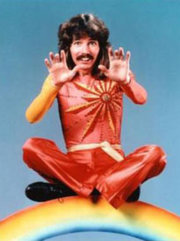
This certainly put a damper on my initial sense of calling. Adding to that was the CBC's annual habit of televising a Doug Henning show. I was originally very impressed with the man's mastery of illusion. That cat did the strangest stuff. He made a show of sawing not just one, but two women in half. Then he shuffled their pieces and put them back together again, so that when he finally released the gals from their cabinets, their lower halves were clothed in the other's slacks and shoes (the cabinets were also slim-line, and propped on gurneys, so the audience could see Henning's legs and feet the entire time).

After prolonged exposure, however, I lost interest. Henning may have been a master, but he was also creepy -- and not in an entertaining way, either. This elfin character seemed unnaturally energetic, as if his efforts to persuade by visual trickery were slowing him down and testing his own patience.

I believe that's the universal curse of professional magicians (or "illusionists"): their unpleasant personalities. This deficit of character makes sense, in a way: these guys (and this is a field still dominated by men) make their living by fooling slack-jawed audiences. In fact, any stage-show is invariably just a minor tweaking of some very basic tricks that have been around for a very long time. The conjuror knows this -- if the audience can't figure it out, he walks home with a pocket full of money he's made off their willful ignorance.

This is why I love Penn & Teller. These guys are meta-illusionists. They show you how the trick is done, then they do it in a way that defies the explanation you've just swallowed. They're consummate professionals. They established the parameters of their shtick early in the game (the diminutive and sly Teller doesn't speak, while Penn is verbose and overbearing), and they have never strayed from it. Why should they? It works, and shows no signs of creaky overuse!

Alas, they seem to have permanently de-camped to Vegas -- the only act that could possibly draw me there. So no more road shows for them. And until they release a DVD of their Vegas show (c'mon, you guys: Cirque du Soleil seems to come up with a television special every time they change their leotards -- surely you can throw us one lousy, chewed-over bone!), I'll just have to content myself with the delightful Penn & Teller's Magic & Mystery Tour.
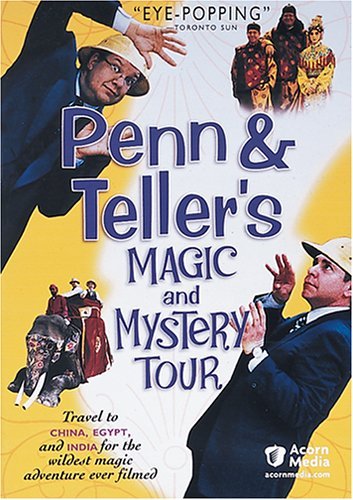
P&TM&MT is a jolly documentary following these two entertainers as they seek out the sources of the world's oldest illusions, and the still-devout keeprs of that flame. It's a terrifically entertaining education that gives the audience the inside scoop, while retaining some of the mystery that the true masters of the art still engender (there is one act -- a Chinese dance of masks -- that flummoxes the two, even after they replay the videotape in slow-motion). Between destinations, we're treated to quiet moments when the duo try to retain their western perspective (at one point, Teller suffers a genuinely hysterical meltdown as he faces his umpteenth supper of canned tuna and bottled water).

I made this wish too late to see it stuffed in any stocking, but no matter: I'll likely pick it up on my own recognizance. It's my recommendation to you, though, for your holiday viewing pleasure.

Post-Script: their TV series Bullshit! is worthy viewing, too, but not one I'll be watching in the next few weeks. As ever, during this season the Canadian airwaves are filled with the verbal parry-and-thrust of people earnestly inflating and deflating each other's mythology. It's noisy, unpleasant, and it distracts me from the things that matter, so I'm taking a temporary break from the whole "dialogue".
Tuesday, December 20, 2005

Uninspired


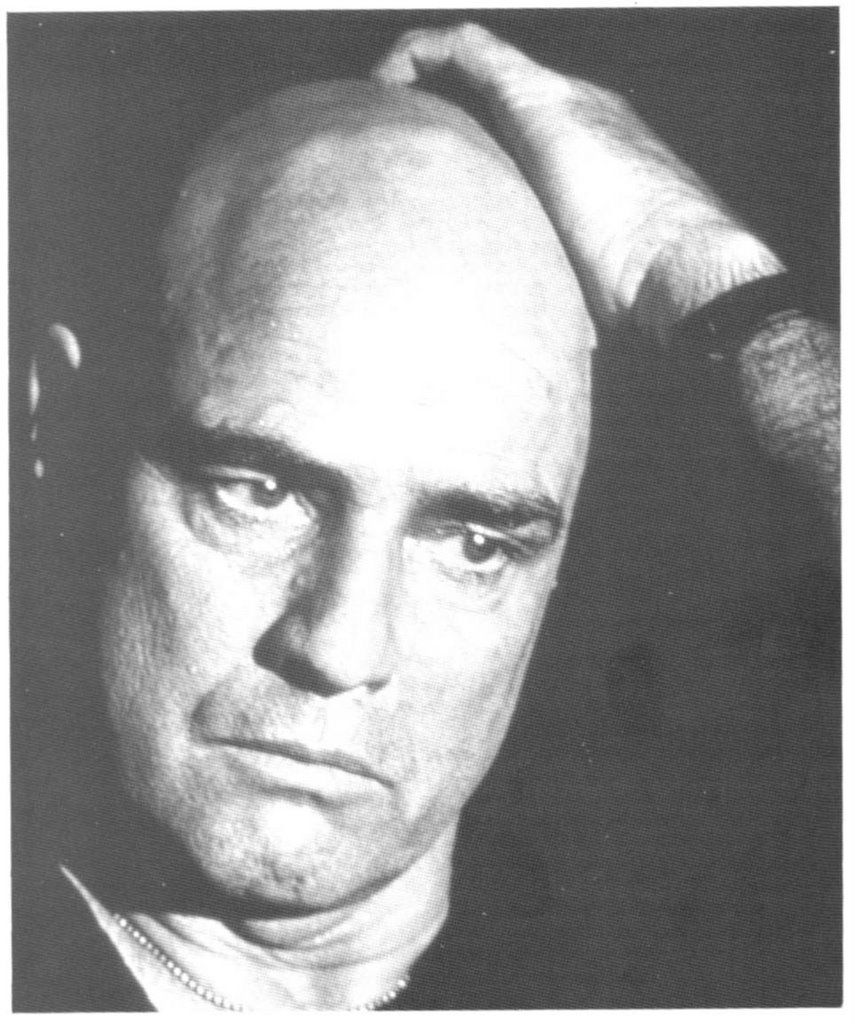
When my friend was working on his master's thesis, he hung a postcard of Brando-as-Kurtz on his dorm-room door. The first vocal balloon he pinned to "Kurtz" read, "The torpor! The torpor!"

I'm feeling some of that, right now. I suspect it's just my unconscious way of assuming the T'ai Chi "first position" and bracing myself for the onslaught of the holidays, but I'm bothered by it nonetheless. I'd rather be a flurry of inspired activity. In fact, inspired escapist activity is exactly what the doctor is ordering.

Inspiration, however, is proving difficult to find. The closest I'm coming to it right now is perusing the pages of The Atlas of Literature, edited by Malcolm Bradbury. It's a prettily rendered, and frequently impressive atlas that does a tidy job of summing up geographical and historical conditions behind some of literature's great moments. We start with Dante's Worlds and Chaucer's England, and gradually move to Kafka's Prague and James Joyce's Dublin, before timidly concluding with the Fantasywallas of Bombay and the Glascow of Gray and Kelman. There's plenty of juicy stuff in between: right now I'm savoring Mark Twain's Mississippi.

Still and all, I'd rather be penning bohemian rhapsodies of my own. I'm a considerate, if not open-minded fellow. If you've got a reliable source of inspiration (preferably one that doesn't land you in rehab), let's hear it.

Saturday, December 17, 2005

Drop Your Cel-Phone In The Shredder

Last December our family gathered in San Jose for one last California Christmas. When it came to highway travel, we were a large enough group to qualify for two cars. Our first trip involved a drive to Santa Cruz.

The inevitable happened: we got separated. We agreed to meet at a particular spot at a particular time.

The car I was in arrived. We got out and waited. The wind blew. We froze. The entire time I silently cursed: neither party had a cel-phone. It could have been so easy! I call, they pick up, we laugh and meet at Santa Cruz Bookstore cafe.

The wind kept blowing, and our party kept looking helpless. I thought about it some more, and the more I thought about it, the less I liked cel-phones. Why should we be dependent on instant communication? What gets taken away when we are so dependent?

Well ... spontaneity, for one thing. A capacity to live in the moment, and come up with creative solutions for another. When I could suck it up enough to discuss real options, we cooked up a perfectly good plan to salvage what we actually had before us: a blank slate, waiting for our designs. The rest of the afternoon was a treat, but as we drove back to the homestead I was troubled by my knee-jerk reaction. Allowing myself to be so hampered -- emotionally and conditionally -- by what I always thought was a convenience: I was embarrassed, if not ashamed.

My wife visited Uganda a couple of years ago. One of her hosts owned a large brewery. They sat down for a lovely meal, but the host admitted times were surprisingly tough for him: people weren't buying beer the way they used to, and it was all because of the cel-phone. Walking around, and answering your cel is an affordable status symbol. And if it's a choice between beer and a cel-phone, well ....

Far be it from me to discourage temperance, but I'm still alarmed at the sort of status cel-phones (and their dependant companies) confer. My wife has a business cel, which we use on occasion. I'd rather not, for all of the above reasons. But here's another good reason to destroy your cel: terrorists love 'em -- and so long as you foot the entire bill, your cel-phone company doesn't care.

It's The Most Wonderful Time Of The Year!

A fabulous day, yesterday. I persuaded my wife to quit work early so we could get our Christmas shopping done (while her parents picked up the girlies from school - heh!). This we did, without exceeding our budget, (we saved on the baby-sitting fees, of course) leaving us just enough coin and time to scramble into the multiplex for a last-minute movie: Syriana. I'm happy to report George Clooney's acting chops are something of a revelation in this flick. I knew he had range -- heart-throb in scrubs in ER, loud-mouthed, penniless fop in O Brother, Where Art Thou, cynical bounty (and booty) hunter in Three Kings. Those roles, however, relied to no small degree on the man's considerable charm and good looks.

This time, he's reached into The Actor's Studio bag of tricks -- or donuts. Clooney has packed on the pounds and grown a grotty beard that could retain soup-drippings for weeks. His shoulders are slumped, and his every step groans not just from the extra lard around his belt, but from the weight of several lives' worth of guilt. He is convincingly pathetic and dangerous at the same time.

Of course, Clooney's performance is not the only stand-out feature in this movie; the other is writer-director Stephen Gaghan's insistence that his audience pay attention. The effect is a bit jarring at first -- Yuh mean I gotta work while I watch?! -- but when the shock of the new wears off, the pleasure sets in. And the viewer is duly rewarded for the effort, though perhaps not quite to the degree hoped for. Syriana is, however, a measurable improvement on Traffic (another Gaghan writing credit, directed by Soderbergh (who takes his writers seriously)), which took a similar multiple storyline approach to a similar topic of geopolitical complexity. We had a good time, and I'm looking forward to the next big thing from this guy.

So yes: all this, and a crokinole board, too! "Knipps-spratt" as we called it in the mother-tongue. Nothing but fun, you'd be justified in thinking -- especially once the Sugo al Burro e Pomodoro was prepared and the bottle of red uncorked.

Fun, indeed. Until the TV got turned on, and the once-happy couple tuned in to the "Leaders" Debate. Short response: I was grateful for the wine, though it (or possibly the debate) left me with a foggy brain this morning. When it comes to the three national leaders (four, if you live in Quebec), the Canadian voter faces a truly sorry lot. Even so, I'd like to see Martin's Liberals removed. I opined to my wife (and certainly the wine had some influence in my thinking) that were Harper to get a minority, I could envision him and Layton doing good work together. Alas, they don't work so well in the debate format, either together or alone, and Martin carried himself with a confidence that didn't reek of arrogance. This doesn't look good for the others. But then, my wife and I were two of ... what? ... possibly eight people watching?

Wednesday, December 14, 2005

The Canadian Political Circus (continued)

We've all seen that "inconceivable" segment in The Princess Bride: the bad guy squares off with the good guy, and reasons that the good guy must be prepared for this, so the bad guy cooks up a clever counter-preparation, then reasons that the good guy must have thought of this, too, etc. etc. This sort of quadruple-think is the only reason I can grasp to explain what North America's politicians are up to.

Yes, I said "North American". I'm not just scratching my head over the Conservative's decision to leave their Central Ontarian brethren twisting in the wind with little to no national (read: "Albertan") support, all but conceding Toronto and environs to an uncontested Liberal stronghold. I'm not merely perplexed at Jack Layton's inability to retreat to an informed war-room, so's he can come back out with a pair of newly-grown balls, let union boss Buzz Hargrove have it with both barrels, and claim the middle-ground as the sole domain of the New Democrats. The Liberals are doing what everyone expected them to, so why hasn't someone -- Right or Left -- come up with some obvious flanking attacks?

Big puzzle, that. But then I have to wonder if Bush and his bunch aren't desperately hoping to see the Liberals return to power. How else could you explain this? Look, right now even American Republicans are dissing their president and his administration: how do you think a tart "straighten up and fly right" (or, "fly Right") is going to play abroad? I cannot -- I refuse -- to believe this hasn't been said for a very specific effect: to not just re-elect Paul Martin's Liberal government, but to give him an uncontested majority. It's Reverse Psychology 101.

But if that were the case, perhaps they've underestimated the Canadian voter. The Bush administration wasn't banking on the Canadian voter doing the opposite of the opposite it was asked to do, and actualy voting in a different government! Or maybe they have, and we just don't realize it. In which case we should really be voting the opposite of the opposite of the....

Or we could just stay home and watch the hockey game.

Tuesday, December 13, 2005

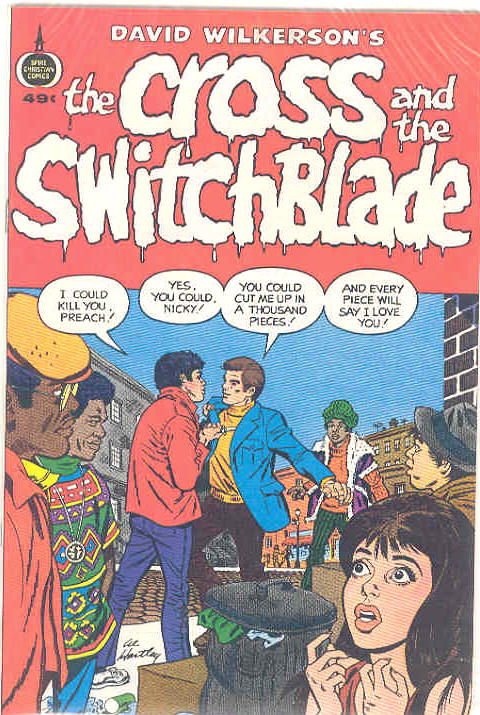
"You could cut me up in a thousand pieces! And every piece will say I love you!"

In my early-20s, I went camping in Florida with a couple of cobbers from my old Bible school for the usual harmless fun: cheap beer, quick tans, sunny conversation and ineffectual flirting.

But things took an ugly turn one morning after we'd crawled from our tents. We passed around the Wonder Bread. One of my mates asked for the peanut-butter knife. When he received it, he suddenly thrust it toward the chest of his friend and snarled, "I could cut-choo into a t'ousan pieces, mang!"

His friend looked at him with large, doe-like eyes and said, "And every piece would say I love you!" Giggles erupted, and we went on with our dopey day.

Nearly everyone admits there is a bounty of kitsch to be harvested from the history of comic books, but the vein is just that much richer in the all-but-unexplored field of Christian comic books - and this little exchange is just one delicious example. Young lads nurtured in the fold of 1970s Christendom could expect their collection of "secular" comics to be duly leavened by the work of Al Hartley, a former girly-artist divinely re-commissioned to chronicle the adventures of a born-again Archie. Not only was the Riverdale Gang subject to an Evangelical make-over, but many real-life sin-to-salvation autobiographies (we called these "testimonies"; our unsaved neighbors called them "human interest stories") were given the Hartley treatment as well: heroes with rugged good looks, and heroines with long straight hair (or a healthy afro), lush lips, and a rack that defied gravity.

One such testimony is David Wilkerson's The Cross & The Switchblade. I'd be curious to hear what Wilkerson made of this comic and the ham-fisted movie that followed (starring Pat Boone and Eric Estrada): the book they were based on remains an affecting first-person account of a young Pentecostal minister in the late 1950s called by God to preach salvation to the youth of the ghettos. My hunch is Wilkerson endorsed the spin-offs as sincere attempts to present the larger gospel message to as wide an audience as possible. Fair enough: Hartley possessed no lack of sincerity either, and hormonally-charged boys of every congregational stripe were the happy benefactors of the buxom Hartley Vixen that lay between their copies of Spider-Man and The Justice League of America.

Here, for your edification, is the Al Hartley cover of The Cross & The Switchblade, from which today's title is taken (as ever, click to enlarge):


If you find yourself wanting more, Kliph Nesteroff deconstructs the Hartley Template over here.

Sunday, December 11, 2005

DVD Extras

When I first hooked up our DVD player, I was giddy with anticipation. I'd purchased The Filth & The Fury: A Sex Pistols Film - the latest flick to tickle my brain - and was keen to tap into all the extras listed on the menu.

Everyone with a DVD player already knows the end of this particular story: BE SURE TO DRINK YOUR OVALTINE. The extras were a soul-draining waste of my time, especially the director's commentary, which was pedestrian ("What I was trying to do was capture...") and repetitious. This was a terrible let-down: the film is energetic, beguiling, thrilling and repulsive, confused in its messages, but resolute in its passion ... pretty much like the punk scene itself. When I saw it for the first time, it was as if I'd seen punk for the first time. It brought back a host of memories of that era, and served as the mythical flight to London that all the cool kids at Pyramid Records were hoping to score. The extras, on the other hand, actually detracted from the experience. (For the record, I wasn't much of a punk. I hung around the fringes with my mullet, my second-hand clothes and my wrap-around sunglasses, but the truth is I preferred the cheerful vapidity of The Knack to the spittle of The Sex Pistols).

Consequently, it's a rare DVD package that can entice me to tap into its extra features. I keep my ear to the ground, and if someone recommends an extra I'll give it a look. Ron Howard's Cinderella Man has one such feature: a bit of informed musing from Norman Mailer, following three rounds of the actual Braddock/Baer fight. Several revelations shine through in the black & white footage. Baer lopes into the ring, and the first thing you notice is the bright Star of David stitched onto his trunks. Clearly, staying true to this particular historical detail would have added a complexity to the film that Howard was not prepared to explore. Also, the final round isn't as dramatically compelling as the movie makes it - you've basically got two big louts, spent and ineffectual, propping each other up. And Mailer remains a lucid commentator on "the sweet science".

For my money, though, the extras that have entertained me most are the ones that come with the Star Trek movies (the "special editions" are absolutely loaded with goodies). Since I'm a Trekkie, and most people aren't, here are some highlights.

Commentary by Nicholas Meyer. Meyer directed ST2: The Wrath of Khan and ST6: The Undiscovered Country. Khan is generally considered the best of the ST movies, a stature I'll reluctantly concede. I was thrilled with it at the time of its release, but 20 years later, it's an unmistakable platter of ham. Meyer doesn't see it that way, though. He seems content with what he accomplished on an astonishingly tight budget, and he offers insight (working with Shatner is a bit of a trick, he says, because Shatner is intent on being The Actor of every scene he's in. Thankfully, says Meyer, Shatner also gets bored quickly, so Meyer's strategy was to do the scene four or five times until Shatner got played out, then film it on the sixth. What treasures were lost in the first take? The mind reels!) and dish (that really is Ricardo Montalban's chest on display).

His commentary on ST6 doesn't have quite the same novelty. He is joined by writer Denny Martin Flinn, who makes it clear why Meyer thinks he was so well-suited to the task of writing for Star Trek: Flinn glad-hands Meyer every chance he gets. Flinn does make some astute comments though, and quite rightly credits Meyer for saving the franchise. ST1 all but tanked at the box-office, for clothing the Enterprise crew in flannel PJs and then putting the audience to sleep. Unfortunately, this hewed all too closely to creator Gene Roddenberry's vision of Star Trek. Meyer re-introduced martial themes, conflict, and genuine energy to the mix, and - viola - the franchise got legs. (25 years later those legs have buckled, but that's another story.)

Those are some of my favourite extras. Any you'd like to share?