... aside from its habit of being woefully late in its in-depth analysis of American foreign policy. The Atlantic has announced it will be dropping its monthly fiction feature in favor of an annual "fiction issue". On the face of it, I'd say this is actually a laudable strategy, but the NYT says that while the fiction ish will be for sale on newsstands each August, "Subscribers to the magazine will have access to its contents online but apparently will not receive a printed copy."
Whaaa...?!
I'm addicted to on-line reading, but I am adamant about one exception: I will not read fiction unless it is on the printed page. There are two modes of reading, speed reading and submersive reading: I would submit the majority of people who still read fiction do it to submerge. And while submersion might be possible with a computer monitor, it is difficult and, frankly, not recommended. It's murder on your posture. You crane your neck forward, squint, hunch, breathe differently ... not good. If a particular fictional piece is available only on-line, I will print it out and read it elsewhere. But if I were still an Atlantic subscriber, I would be very peeved at this bit of news.
Their choice of ficition is another matter of contention, but I've already squawked about that.
NYT link thanks to Bookninja.
Monday, April 11, 2005
Saturday, April 09, 2005
Fraser Stone
Fraser Stone has updated its website. Steve Fraser, artiste and friend, has a unique eye as well as an unerring instinct for structural integrity. Prospective patrons in Southern Ontario, Michigan, or New York are well-advised to seek him out now, before he and his rates vault into the stratosphere.
Friday, April 08, 2005
'Sin City' — It's Miller Time
It's interesting to locate the critical dividing line on the recent Frank Miller/Robert Rodriguez film, Sin City. The movie seems to elicit the same sadistic chuckles of approval or clucks of moral disappointment that The Good, The Bad And The Ugly did 30 years earlier. In the former libertarian camp we have Roger Ebert, whose critical mantra "It's not what a film is about, but how it goes about it" permits him to give Sin City precisely the same rave he gave The Passion Of The Christ. And among the latter blue-hairs in the back pews, we have Anthony Lane, whose sigh over Sin City's emotional and moral vacuity is but a weary echo of his outrage over Mel's Passion. Reading these guys, it sounds to me like the movie hews closely to the Frank Miller comics it's based on.
Having seen neither movie (yet), I'll go out on a limb and suggest that as film directors, Miller and Mel have quite a bit in common, beginning with a deleterious obsession with things Catholic. But where Mel is the ardent convert, an ultra-conservative late to the fold, wielding his aesthetic like a truncheon to brow-beat viewers into the Kingdom, Miller is the raving heretic, throwing open the windows of the sanitarium and coughing in the patients' faces — brow-beating viewers in the opposite direction. With precious few exceptions, Miller's comics depict Catholic priests as shrunken, dissipated connivers, and Catholic nuns as gargantuan, hate-driven viragos capable of inflicting terrible physical humiliation (somewhere in FM's childhood, the boy must have run afoul of Miss Clavel). In nearly all of Miller's work, but especially in the Sin City books, the heretic heroes pummel, blast and dismember a barrage of holy fathers and sisters — behavior seemingly made acceptable because his priests and nuns are presented as willing co-conspirators in an enormous, corrupt regime.
 Catholic authority is but one of Miller's big obsessions: others include pneumatically enhanced women with cold, cold hearts, cynically manipulative conservatives, bleeding-heart liberals, a docile and easily-duped public, malicious flying imps (often in the form of automatons), drapey trench-coats and Chuck Taylor sneakers. Miller has become that uniquely American phenomenon: he turns a profit with his public self-indulgence. His worst material is like bad heavy metal, with its tedious excesses and a head-slapping lack of self-consciousness. Conversely, his best material is like good heavy metal: it knocks you on your ass.
Some 20 years ago, when Miller still had an editor to answer to, he delivered the work he will be best known for: Batman: The Dark Knight Returns. Dark Knight is tightly scripted, meticulously penciled and inked, has worthy literary pretensions, and is single-handedly responsible for the current deluge of comic books on the big screen. Corruption at the highest level, moral dis-ease, the tension between anarchy and fascist totalitarianism and the desperate heave to transcend all these mortal conditions are played out with a giddy ferocity. In tone and physicality, Batman resembles Clint Eastwood's avenging angel of death, William Munny, during Unforgiven's final act.
 Until the final act of Dark Knight, however, Batman more closely resembles Eastwood's The Man With No Name during his feebler hours. Batman was a bit too eager to come out of retirement, it seems. He takes a physical beating that would kill a dozen men; toward the end of the saga's early chapters, he limps about with mashed lips, missing teeth, while clutching broken ribs or an abdominal wound in his sagging costume. The man has lessons to learn before the demi-urge within can tower over the bad guys (including a gormless Superman), and the chief lesson seems to be: if the world is unimaginably corrupt, your methods of subversion have to be unimaginably extreme.
The Dark Knight Returns was an incredible success, and vaulted Miller into rock star status. I dabbled in comics before Frank Miller; once I recognized him, I turned the corner and became a collector. I dug the way his figures swept out into open space — often the white space between panels — with an ethereal grace, or the way they'd bunch up like a clenched fist, ready to explode. His heroes were never merely challenged or tried: they were fed into the crucible, feet first. Torment, humiliation, agony, resurrection and violent triumph — the movies weren't delivering this stuff, not as deliciously as Miller was.
(Digression: Miller's kinetic aesthetic has proven extremely difficult to translate cinematically, because his movement either defies or exaggerates gravity. He borrows heavily from the Shangri-La films, but uses drape-like clothing to add to the drama of the printed page in a way that, until the advent of digital film-making, was impossible to capture. Think of the trench-coated Neo, dodging bullets in the Matrix. Or think of Mr. Incredible purposely leaping off a cliff and falling for half-a-mile before catching a palm tree that flings him gymnastically to the next level. Prior to this we had Rambo, impaling himself on a towering evergreen.)
As good as The Dark Knight Returns was, it was only the launching pad for his best, most controversial project — Elektra: Assassin. Miller took the unusual step of teaming up with artist Bill Sienkiewicz, a man whose conceptual approach was hallucinatory, borderless and garishly, oppressively colored. Collaborating board by board with Sienkiewicz, Miller cooked up a story that played like a Road Runner cartoon envisioned by Hieronymous Bosch. As with Road Runner, Elektra is the ostensible hero of the series, but she is something of a cipher, and the villain chasing her becomes the story's true moral center — which poses a serious problem. Garrett is a government operative, a certified psychopath employed only because he's been physically tinkered with: several limbs are artificial, giving him powers he is incapable of dealing with responsibly.
He chases after Elektra, brandishing bombs and guns and lethal Rube Goldberg devices, all of which boomerang on him. With every foiled plot, he loses more of his genuine self, until the only thing that isn't artificial is a portion of his head. With this compromised instrument, he is able to reach two crucial realizations: he has fallen hopelessly in love with his nemesis, a woman whose cruel streak exceeds his own by a grotesque margin; and she herself is chasing after bigger fish — in this case the Antichrist, a charismatic demon-possessed Democrat set to unleash nuclear annihilation once he gets into office.
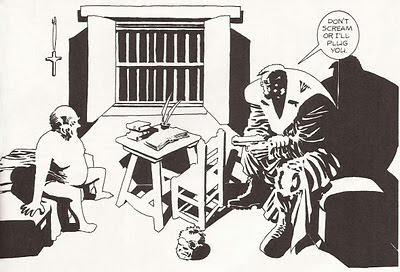
If my summary sounds comic, the true effect of the book has to be experienced to be believed. At the time (Reagan's second term in office), it did a good job of rattling my cage, and a bunch of other people's, too. It fueled several loud calls for censorship, which Miller's publishers promptly used in their promotional materials. I suppose you could say Miller excelled at the "how" of what his material was about. Guess who's narrating here (Hint: it's not the guy holding the head):
 And what was it about? Same old same old. The world is a scary place; the political and religious powers that be are corrupt beyond imagining and wildly out of control, tainting the well-intentioned when they aren't abusing them outright; and only extreme subversion can possibly curb their grim direction — momentarily. Elektra: Assassin is a tour de force that should not be read at too tender an age, or before going to sleep.
Following Elektra: Assassin, Frank Miller's Sin City books seem almost like an afterthought. By now his characters go through the paces. Everything has the Frank Miller look, which never gets boring, but it decorates the trademark Frank Miller plot we've come to expect. It amounts to maladjusted behavior in a shiny package, which at least has the courage of its thin convictions. Miller knows you didn't buy Sin City, or pay admission to see a movie like The Patriot, because you want to see a man find his soul: you spent the money to see some fucked-up shit, and he delivers. If it doesn't scare you the way Elektra: Assassin did, it's because Miller no longer needs to put everything on the line to get your money. Sin City is the equivalent of the last 12 albums by the Rolling Stones, or the last seven by AC/DC: the eleven herbs and spices are all there, but the nutritional foundation has been processed into near non-existence. It's junk-food for the soul — a little of it shouldn't hurt you, but you're arguably better off without it.
If that last declaration places me amongst the blue-hairs, so be it. Hey, I like junk-food, too, but I'm at the age where I have to limit my intake. And let's be honest: that age is any age. Youthful readers who wish to quibble should try this little exercise: hold your own Robert Rodriguez film festival, starting with El Mariachi, Desperado, the three Spy Kids movies, and concluding with Sin City. When it's over, step outside and take a long, deep breath. Look around you, or talk to your neighbor for a few minutes. Then return to your darkened TV set, and see if you don't feel — just a little — like Morgan Spurlock after eating a month's worth of McDonald's.
Having seen neither movie (yet), I'll go out on a limb and suggest that as film directors, Miller and Mel have quite a bit in common, beginning with a deleterious obsession with things Catholic. But where Mel is the ardent convert, an ultra-conservative late to the fold, wielding his aesthetic like a truncheon to brow-beat viewers into the Kingdom, Miller is the raving heretic, throwing open the windows of the sanitarium and coughing in the patients' faces — brow-beating viewers in the opposite direction. With precious few exceptions, Miller's comics depict Catholic priests as shrunken, dissipated connivers, and Catholic nuns as gargantuan, hate-driven viragos capable of inflicting terrible physical humiliation (somewhere in FM's childhood, the boy must have run afoul of Miss Clavel). In nearly all of Miller's work, but especially in the Sin City books, the heretic heroes pummel, blast and dismember a barrage of holy fathers and sisters — behavior seemingly made acceptable because his priests and nuns are presented as willing co-conspirators in an enormous, corrupt regime.
 Catholic authority is but one of Miller's big obsessions: others include pneumatically enhanced women with cold, cold hearts, cynically manipulative conservatives, bleeding-heart liberals, a docile and easily-duped public, malicious flying imps (often in the form of automatons), drapey trench-coats and Chuck Taylor sneakers. Miller has become that uniquely American phenomenon: he turns a profit with his public self-indulgence. His worst material is like bad heavy metal, with its tedious excesses and a head-slapping lack of self-consciousness. Conversely, his best material is like good heavy metal: it knocks you on your ass.
Some 20 years ago, when Miller still had an editor to answer to, he delivered the work he will be best known for: Batman: The Dark Knight Returns. Dark Knight is tightly scripted, meticulously penciled and inked, has worthy literary pretensions, and is single-handedly responsible for the current deluge of comic books on the big screen. Corruption at the highest level, moral dis-ease, the tension between anarchy and fascist totalitarianism and the desperate heave to transcend all these mortal conditions are played out with a giddy ferocity. In tone and physicality, Batman resembles Clint Eastwood's avenging angel of death, William Munny, during Unforgiven's final act.
 Until the final act of Dark Knight, however, Batman more closely resembles Eastwood's The Man With No Name during his feebler hours. Batman was a bit too eager to come out of retirement, it seems. He takes a physical beating that would kill a dozen men; toward the end of the saga's early chapters, he limps about with mashed lips, missing teeth, while clutching broken ribs or an abdominal wound in his sagging costume. The man has lessons to learn before the demi-urge within can tower over the bad guys (including a gormless Superman), and the chief lesson seems to be: if the world is unimaginably corrupt, your methods of subversion have to be unimaginably extreme.
The Dark Knight Returns was an incredible success, and vaulted Miller into rock star status. I dabbled in comics before Frank Miller; once I recognized him, I turned the corner and became a collector. I dug the way his figures swept out into open space — often the white space between panels — with an ethereal grace, or the way they'd bunch up like a clenched fist, ready to explode. His heroes were never merely challenged or tried: they were fed into the crucible, feet first. Torment, humiliation, agony, resurrection and violent triumph — the movies weren't delivering this stuff, not as deliciously as Miller was.
(Digression: Miller's kinetic aesthetic has proven extremely difficult to translate cinematically, because his movement either defies or exaggerates gravity. He borrows heavily from the Shangri-La films, but uses drape-like clothing to add to the drama of the printed page in a way that, until the advent of digital film-making, was impossible to capture. Think of the trench-coated Neo, dodging bullets in the Matrix. Or think of Mr. Incredible purposely leaping off a cliff and falling for half-a-mile before catching a palm tree that flings him gymnastically to the next level. Prior to this we had Rambo, impaling himself on a towering evergreen.)
As good as The Dark Knight Returns was, it was only the launching pad for his best, most controversial project — Elektra: Assassin. Miller took the unusual step of teaming up with artist Bill Sienkiewicz, a man whose conceptual approach was hallucinatory, borderless and garishly, oppressively colored. Collaborating board by board with Sienkiewicz, Miller cooked up a story that played like a Road Runner cartoon envisioned by Hieronymous Bosch. As with Road Runner, Elektra is the ostensible hero of the series, but she is something of a cipher, and the villain chasing her becomes the story's true moral center — which poses a serious problem. Garrett is a government operative, a certified psychopath employed only because he's been physically tinkered with: several limbs are artificial, giving him powers he is incapable of dealing with responsibly.
He chases after Elektra, brandishing bombs and guns and lethal Rube Goldberg devices, all of which boomerang on him. With every foiled plot, he loses more of his genuine self, until the only thing that isn't artificial is a portion of his head. With this compromised instrument, he is able to reach two crucial realizations: he has fallen hopelessly in love with his nemesis, a woman whose cruel streak exceeds his own by a grotesque margin; and she herself is chasing after bigger fish — in this case the Antichrist, a charismatic demon-possessed Democrat set to unleash nuclear annihilation once he gets into office.
If my summary sounds comic, the true effect of the book has to be experienced to be believed. At the time (Reagan's second term in office), it did a good job of rattling my cage, and a bunch of other people's, too. It fueled several loud calls for censorship, which Miller's publishers promptly used in their promotional materials. I suppose you could say Miller excelled at the "how" of what his material was about. Guess who's narrating here (Hint: it's not the guy holding the head):
 And what was it about? Same old same old. The world is a scary place; the political and religious powers that be are corrupt beyond imagining and wildly out of control, tainting the well-intentioned when they aren't abusing them outright; and only extreme subversion can possibly curb their grim direction — momentarily. Elektra: Assassin is a tour de force that should not be read at too tender an age, or before going to sleep.
Following Elektra: Assassin, Frank Miller's Sin City books seem almost like an afterthought. By now his characters go through the paces. Everything has the Frank Miller look, which never gets boring, but it decorates the trademark Frank Miller plot we've come to expect. It amounts to maladjusted behavior in a shiny package, which at least has the courage of its thin convictions. Miller knows you didn't buy Sin City, or pay admission to see a movie like The Patriot, because you want to see a man find his soul: you spent the money to see some fucked-up shit, and he delivers. If it doesn't scare you the way Elektra: Assassin did, it's because Miller no longer needs to put everything on the line to get your money. Sin City is the equivalent of the last 12 albums by the Rolling Stones, or the last seven by AC/DC: the eleven herbs and spices are all there, but the nutritional foundation has been processed into near non-existence. It's junk-food for the soul — a little of it shouldn't hurt you, but you're arguably better off without it.
If that last declaration places me amongst the blue-hairs, so be it. Hey, I like junk-food, too, but I'm at the age where I have to limit my intake. And let's be honest: that age is any age. Youthful readers who wish to quibble should try this little exercise: hold your own Robert Rodriguez film festival, starting with El Mariachi, Desperado, the three Spy Kids movies, and concluding with Sin City. When it's over, step outside and take a long, deep breath. Look around you, or talk to your neighbor for a few minutes. Then return to your darkened TV set, and see if you don't feel — just a little — like Morgan Spurlock after eating a month's worth of McDonald's.
Tuesday, March 29, 2005
Resurrection Man by Sean Stewart
I dug this book out of one of my dustier shelves after I finished reading A Complicated Kindness. I wanted something wildly removed from my old home town and the fiction it seems to inspire, and thought Resurrection Man might just be the ticket.
Stewart does "magic realism", but differently from other practitioners. Gabriel Garcia Marquez, for instance, might have a character who exhales butterflies whenever she speaks, but no-one in her community pays it much mind, because - eyeh, that's just the way it is. In Stewart's world, an occultic sort of magic is increasingly becoming more apparent in a world that, until World War II, ran more or less by rationally explicable means. Now, minotaurs are wreaking havoc in the ghettos, and people are being transformed into creatures that have an inchoate relationship to the shifting reality.
Enter Dante Ratkay - and his own corpse, which he's just discovered on his bureau. Dante knows more than the reader about the way magic works in his world, but not much more. So the reader stays just a step or two behind Dante, as the narrative unfolds - which is mostly quite a thrill. I say "mostly", because the characters in RM all seem to have an enormous chip on their shoulder, and are in the habit of sniping at each other. If the tone of the story had a little more variation, the book would be a lollapalooza. As it is, it was a fast and entirely unique read. I'm curious to try other, later Stewart titles; he was quite young when he wrote RM, and it demonstrates, I think, undeniable talent on the verge of becoming something truly remarkable.
Stewart does "magic realism", but differently from other practitioners. Gabriel Garcia Marquez, for instance, might have a character who exhales butterflies whenever she speaks, but no-one in her community pays it much mind, because - eyeh, that's just the way it is. In Stewart's world, an occultic sort of magic is increasingly becoming more apparent in a world that, until World War II, ran more or less by rationally explicable means. Now, minotaurs are wreaking havoc in the ghettos, and people are being transformed into creatures that have an inchoate relationship to the shifting reality.
Enter Dante Ratkay - and his own corpse, which he's just discovered on his bureau. Dante knows more than the reader about the way magic works in his world, but not much more. So the reader stays just a step or two behind Dante, as the narrative unfolds - which is mostly quite a thrill. I say "mostly", because the characters in RM all seem to have an enormous chip on their shoulder, and are in the habit of sniping at each other. If the tone of the story had a little more variation, the book would be a lollapalooza. As it is, it was a fast and entirely unique read. I'm curious to try other, later Stewart titles; he was quite young when he wrote RM, and it demonstrates, I think, undeniable talent on the verge of becoming something truly remarkable.
Saturday, March 26, 2005
The Incredible World of Spy-Fi by Danny Biederman vs. Batman Collected by Chip Kidd
My parents were strict gatekeepers of the family television. My wife and I once compared lists of shows that were taboo to us, and she was amused at how libertine her list seemed in contrast to mine. But then she was the youngest child in her family, and I was the oldest in mine. When it came to deciding what I could watch (in contrast to my younger siblings), my parents worked with the conviction that although a child could demonstrably be exposed to too much TV, authorities had yet to ascertain such a phenomenon as too little.
As I grew from late adolescence to early adulthood, my mother vocally worried I might indeed constitute just such a case. I bought enormous compilations of TV theme songs and played the records from beginning to end while I organized my growing collection of comic books. I scrounged through flea markets and garage sales for novelizations of TV series I’d been denied. Many of these were Irwin Allen productions — Voyage To The Bottom Of The Sea, Lost In Space, Land Of The Giants — but the crown jewel, the Holy Grail of TV series I’d never seen but nursed an obsession for was The Man From U.N.C.L.E.
As with any good obsession, the less you know about it, the more feverish the speculation. The truth was none of my friends in school knew anything about The Man From U.N.C.L.E., either. Some had older siblings who remembered the show, but it had gone in and out of vogue with an astonishing totality before I and my cronies became sentient, and it was seemingly unfit for the sort of after-school/weekend syndication that Irwin Allen’s shows received. The only exposure I had to it was deep in my grandparents’ basement, where they kept an enormous box of my uncle’s comic books.
Most of these were Scrooge McDuck adventures, but my uncle also had an enormous stash of MAD Magazines and a decent cross-section of Nick Fury adventures and some Archie comics. On the inside cover of one of these Archie books was a picture of a turtleneck-clad David McCallum holding the freakiest looking gun I’d ever seen, and advertising a life-size poster of The Man From U.N.C.L.E.
The cool menace of that one picture was all it took to cook my brain. I imagined a spectacularly violent series; something like Get Smart, with gravitas (I hadn’t yet seen James Bond). Gadgets, guns, cars, dark stove-pipe suits and beautiful women, whirling in a kaleidoscopic carnival adventure. Over the years I saw several publicity photos with that peculiarly 60s “hi-tech” look: Robert Vaughn (what’s this? looks like McCallum’s the second banana), glowering, slouch-shouldered behind a plate of glass with a sequence of bullet-holes punched into it; Vaughn and McCallum firing their weapons on the run, or talking into their fountain pens; a nifty-looking car that ostensibly fired missiles from its gull-wing doors. So long as I never saw an episode, the show’s cache of potential was allowed to grow exponentially in my imagination.
This stew of feverish imaginings came to mind when I recently encountered (and bought) The Incredible World Of Spy-Fi: Wild & Crazy Spy Gadgets, Props, And Artifacts From TV And The Movies by Danny Biederman. It seems Biederman has amassed quite a collection of props and memorabilia, which he takes on the road and displays in museums devoted to either espionage or entertainment. The pictures are good, the props legitimate cause for giddiness for freaks like Biederman (or me). And like most books Chronicle publishes, the price is in line with the subject matter: if you want a coffee-table book that does justice to the Sistine Chapel, you can expect to pay a few bills; a coffee-table book that does justice to the likes of Napoleon Solo and Maxwell Smart shouldn’t be more than $30 (and isn’t).
The book loses some of its gloss, however, once you start reading Biederman’s text. He is a collector, after all, and the tendency for collectors is to talk too much. The fiction-writer’s dictum of “show, don’t tell” applies doubly to obsessive collectors, and no-one has embodied that principle to better effect than Chip Kidd, in his exemplary Batman Collected. Kidd’s book is over 100 pages longer than Biederman’s, and has no lack of text, but Kidd (being a book designer) puts the emphasis on illustration, and shows in his delirious way why he’s so loony about things Batman. It’s also worth pointing out that Kidd doesn’t just raid his own pantry for material, but relies on the collections of others to add some truly bizarre heft to his homage. Plus, right from the opening page Kidd demonstrates a sense of humor about the absurdity of it all, sweetening the invitation for prospective readers.
As for my own U.N.C.L.E. obsession, it came to an end with the advent of the VCR. I taped a few late-night episodes at a cable-subscribing friend’s place, then witnessed for myself the wide disparity between what I hoped the show would be, and what in fact it was: a light romp, occasionally infused with cleverness – typical 60s television, in other words. Damn...
Still, these gadgets continue to hold their appeal, and I’m not by nature a gadget guy. I dislike cell-phones, haven’t purchased an iPod, and couldn’t be bothered with a Palm Pilot or Blackberry. But a phony pack of cigarettes, with a radio-dial? Va-va-voom! Which makes me think the inescapable deeper yearning is not for previously verboten TV shows, but that quiet corner in my grandparents’ basement, where I could discover clues to an exotic world that lay somewhere beyond the limits of our small town, but not my imagination.
Biederman's site is here. You can buy a lifelike replica of the Man From U.N.C.L.E. gun, here. There are a number of sites devoted to U.N.C.L.E. — a good place to start is here. And I probably read half the ACE paperbacks before I finally saw an episode of the show; they were mostly disappointing, but The Cross Of Gold Affair was indeed quite violent, and put together several weirdly disparate elements (a hippie chick falls for Solo), sustaining my hopeful expectations of the show.
As I grew from late adolescence to early adulthood, my mother vocally worried I might indeed constitute just such a case. I bought enormous compilations of TV theme songs and played the records from beginning to end while I organized my growing collection of comic books. I scrounged through flea markets and garage sales for novelizations of TV series I’d been denied. Many of these were Irwin Allen productions — Voyage To The Bottom Of The Sea, Lost In Space, Land Of The Giants — but the crown jewel, the Holy Grail of TV series I’d never seen but nursed an obsession for was The Man From U.N.C.L.E.
As with any good obsession, the less you know about it, the more feverish the speculation. The truth was none of my friends in school knew anything about The Man From U.N.C.L.E., either. Some had older siblings who remembered the show, but it had gone in and out of vogue with an astonishing totality before I and my cronies became sentient, and it was seemingly unfit for the sort of after-school/weekend syndication that Irwin Allen’s shows received. The only exposure I had to it was deep in my grandparents’ basement, where they kept an enormous box of my uncle’s comic books.
Most of these were Scrooge McDuck adventures, but my uncle also had an enormous stash of MAD Magazines and a decent cross-section of Nick Fury adventures and some Archie comics. On the inside cover of one of these Archie books was a picture of a turtleneck-clad David McCallum holding the freakiest looking gun I’d ever seen, and advertising a life-size poster of The Man From U.N.C.L.E.
The cool menace of that one picture was all it took to cook my brain. I imagined a spectacularly violent series; something like Get Smart, with gravitas (I hadn’t yet seen James Bond). Gadgets, guns, cars, dark stove-pipe suits and beautiful women, whirling in a kaleidoscopic carnival adventure. Over the years I saw several publicity photos with that peculiarly 60s “hi-tech” look: Robert Vaughn (what’s this? looks like McCallum’s the second banana), glowering, slouch-shouldered behind a plate of glass with a sequence of bullet-holes punched into it; Vaughn and McCallum firing their weapons on the run, or talking into their fountain pens; a nifty-looking car that ostensibly fired missiles from its gull-wing doors. So long as I never saw an episode, the show’s cache of potential was allowed to grow exponentially in my imagination.
This stew of feverish imaginings came to mind when I recently encountered (and bought) The Incredible World Of Spy-Fi: Wild & Crazy Spy Gadgets, Props, And Artifacts From TV And The Movies by Danny Biederman. It seems Biederman has amassed quite a collection of props and memorabilia, which he takes on the road and displays in museums devoted to either espionage or entertainment. The pictures are good, the props legitimate cause for giddiness for freaks like Biederman (or me). And like most books Chronicle publishes, the price is in line with the subject matter: if you want a coffee-table book that does justice to the Sistine Chapel, you can expect to pay a few bills; a coffee-table book that does justice to the likes of Napoleon Solo and Maxwell Smart shouldn’t be more than $30 (and isn’t).
The book loses some of its gloss, however, once you start reading Biederman’s text. He is a collector, after all, and the tendency for collectors is to talk too much. The fiction-writer’s dictum of “show, don’t tell” applies doubly to obsessive collectors, and no-one has embodied that principle to better effect than Chip Kidd, in his exemplary Batman Collected. Kidd’s book is over 100 pages longer than Biederman’s, and has no lack of text, but Kidd (being a book designer) puts the emphasis on illustration, and shows in his delirious way why he’s so loony about things Batman. It’s also worth pointing out that Kidd doesn’t just raid his own pantry for material, but relies on the collections of others to add some truly bizarre heft to his homage. Plus, right from the opening page Kidd demonstrates a sense of humor about the absurdity of it all, sweetening the invitation for prospective readers.
As for my own U.N.C.L.E. obsession, it came to an end with the advent of the VCR. I taped a few late-night episodes at a cable-subscribing friend’s place, then witnessed for myself the wide disparity between what I hoped the show would be, and what in fact it was: a light romp, occasionally infused with cleverness – typical 60s television, in other words. Damn...
Still, these gadgets continue to hold their appeal, and I’m not by nature a gadget guy. I dislike cell-phones, haven’t purchased an iPod, and couldn’t be bothered with a Palm Pilot or Blackberry. But a phony pack of cigarettes, with a radio-dial? Va-va-voom! Which makes me think the inescapable deeper yearning is not for previously verboten TV shows, but that quiet corner in my grandparents’ basement, where I could discover clues to an exotic world that lay somewhere beyond the limits of our small town, but not my imagination.
Biederman's site is here. You can buy a lifelike replica of the Man From U.N.C.L.E. gun, here. There are a number of sites devoted to U.N.C.L.E. — a good place to start is here. And I probably read half the ACE paperbacks before I finally saw an episode of the show; they were mostly disappointing, but The Cross Of Gold Affair was indeed quite violent, and put together several weirdly disparate elements (a hippie chick falls for Solo), sustaining my hopeful expectations of the show.
Wednesday, March 23, 2005
The Elusive Art Of Video Game Engagement
I recently, with some trepidation, bought a Nintendo GameCube - "trepidation" because I squarely belong to that tribe of males that can get completely addicted to a game once it's loaded. I don't want to think too much about the money I pissed away in quarters when I was a university student, because it would certainly amount to a lamentable sum. I eventually learned to moderate, but then the PC game came into its own with "Wolfenstein" and I had to learn the lesson anew.
I'm happy to report that the GameCube does not yet pose such a threat to my time and energy. I don't play it when the girls (including my wife) are awake, and I'm quickly discovering that gaming institutions haven't much progressed beyond the rudimentary games we saw in the early 90s. The sole improvement seems to lie in the graphics department, and I'm starting to consider just what an imaginative deficit that amounts to.
I recently rented one of the newer Star Wars games. It offers a well-executed flight simulation, and some nifty tableaus, but after that - nothing. The overall look is cold and uninviting, even with all the detail. It seems to me the weakness of a game like that is it's graphic comparison: it wants to look real, but its precision of detail only serves to highlight the disparities. For an interactive medium, the final effect is surprisingly "cool", in the McLuhan sense of the word.
In contrast to that is the only game (thus far) to truly engage me: The Simpsons Hit & Run. The engineers have rendered the Simpsons and their hometown of Springfield in an impressive 3D format that attempts not to look "realistic" but "whoa - kewl!". Everything has the smooth edges of a Pixar film, but the artists cleverly include all manner of satirical touches to "rough" it up. Homer's nuclear powerplant, for instance, is a labyrinth of glowing radioactive breaches, which gradually mutate into comically absurd luxuriousness as the player gets closer to the plant's owner, Mr. Burns. Playing Hit & Run makes me wonder why anyone bothers with the "Super-Sleaze Me" Grand Theft Auto games: you run over just as many pedestrians (which usually prompts Lisa to groan, "Great: more liberal guilt!"), but the final effect is the guiltless laugh of parodic self-recognition.
The graphics are part of the magic that makes Hit & Run work, and I like the direction the artists took. I'm currently playing XIII, a first-person shooter based on a comic book, with darklined graphics to match. I've grown somewhat blase toward shooters, but again, the graphics give this one a more compelling feel than some of the "realistic" entries available. I'm told Viewtiful Joe is absolutely spectacular and utterly irresistible - and its platform is two-dimensional. I do believe when my wife takes her next business trip, I'll be giving Viewtiful Joe a try.
I'm happy to report that the GameCube does not yet pose such a threat to my time and energy. I don't play it when the girls (including my wife) are awake, and I'm quickly discovering that gaming institutions haven't much progressed beyond the rudimentary games we saw in the early 90s. The sole improvement seems to lie in the graphics department, and I'm starting to consider just what an imaginative deficit that amounts to.
I recently rented one of the newer Star Wars games. It offers a well-executed flight simulation, and some nifty tableaus, but after that - nothing. The overall look is cold and uninviting, even with all the detail. It seems to me the weakness of a game like that is it's graphic comparison: it wants to look real, but its precision of detail only serves to highlight the disparities. For an interactive medium, the final effect is surprisingly "cool", in the McLuhan sense of the word.
In contrast to that is the only game (thus far) to truly engage me: The Simpsons Hit & Run. The engineers have rendered the Simpsons and their hometown of Springfield in an impressive 3D format that attempts not to look "realistic" but "whoa - kewl!". Everything has the smooth edges of a Pixar film, but the artists cleverly include all manner of satirical touches to "rough" it up. Homer's nuclear powerplant, for instance, is a labyrinth of glowing radioactive breaches, which gradually mutate into comically absurd luxuriousness as the player gets closer to the plant's owner, Mr. Burns. Playing Hit & Run makes me wonder why anyone bothers with the "Super-Sleaze Me" Grand Theft Auto games: you run over just as many pedestrians (which usually prompts Lisa to groan, "Great: more liberal guilt!"), but the final effect is the guiltless laugh of parodic self-recognition.
The graphics are part of the magic that makes Hit & Run work, and I like the direction the artists took. I'm currently playing XIII, a first-person shooter based on a comic book, with darklined graphics to match. I've grown somewhat blase toward shooters, but again, the graphics give this one a more compelling feel than some of the "realistic" entries available. I'm told Viewtiful Joe is absolutely spectacular and utterly irresistible - and its platform is two-dimensional. I do believe when my wife takes her next business trip, I'll be giving Viewtiful Joe a try.
Religion Affective Disorder
"RAD" - hmm...
I thought, yesterday, that this year might be the exception. It was sunny and warm, I was happy, if a little edgy. But this morning the clouds swept in with a cold wind from the east, and I recognized yesterday's energy for what it was: the manic swing of spring fever. There was no escaping it - the gloom and melancholy that comes with the Holy Week leading up to Easter.
I don't recall feeling this way as a child, but I certainly did when I was a moody adolescent. The Easter narrative plays neatly with psychological conditions that bedevil a teen: the glory of youth and young manhood leading to ill-advised revolutionary impulses (purging the temple dealers), followed by a sense of betrayal and a tumultuous persecution complex, concluding inevitably at the final (albeit torn) curtain. As I got older, and experienced the usual cycles of life, other events fed emotional fuel to the low burn of religious recognition: three of my grandparents have died in the spring, usually within a week or two of Easter, which certainly adds emotional depth and complexity to my identification with the holiday.
I don't like it, but what am I to do? To quote the old soul preacher from Philadelphia, "It's Friday, but Sunday's coming." Easter Monday, for any reason you care to name, usually brings the release and relief I seek.
I thought, yesterday, that this year might be the exception. It was sunny and warm, I was happy, if a little edgy. But this morning the clouds swept in with a cold wind from the east, and I recognized yesterday's energy for what it was: the manic swing of spring fever. There was no escaping it - the gloom and melancholy that comes with the Holy Week leading up to Easter.
I don't recall feeling this way as a child, but I certainly did when I was a moody adolescent. The Easter narrative plays neatly with psychological conditions that bedevil a teen: the glory of youth and young manhood leading to ill-advised revolutionary impulses (purging the temple dealers), followed by a sense of betrayal and a tumultuous persecution complex, concluding inevitably at the final (albeit torn) curtain. As I got older, and experienced the usual cycles of life, other events fed emotional fuel to the low burn of religious recognition: three of my grandparents have died in the spring, usually within a week or two of Easter, which certainly adds emotional depth and complexity to my identification with the holiday.
I don't like it, but what am I to do? To quote the old soul preacher from Philadelphia, "It's Friday, but Sunday's coming." Easter Monday, for any reason you care to name, usually brings the release and relief I seek.
Subscribe to:
Posts (Atom)