Friday, September 20, 2013

My Braaaains: Overrated? Overheated? Or Just Missing?

This is going to be a bit helter-skelter, so bear with me. I'm here rearranging the words in my review of David Bergen's The Matter With Morris — the single most pleasurable read for me this year, and my current Favourite Novel From A Member Of My Tribe — when the randomizer of our household music machine spits out this chestnut:

Sally's into knowledge
Spent her years in college
Just to find out nothing is true
She can hardly speak now
Words are not unique now
'Cos they can't say anything new

You say humanist philosophy is what it's all about?
You're so open-minded that your brains leaked out!

Some Christian Rock lyrics for you, courtesy of a young Steve Taylor, circa 1983, which, in their blunderbuss way, take aim at the heart of The Matter With Morris.

I cringe to admit it, but at the time I thrilled to hear (young) Steve Taylor's droll delivery of those particular lines.

I was 18 years old, getting ready with the rest of my buddies (Mennonites, with precious few exceptions) to begin post-secondary education. I was also an earnest Evangelical — ditto, my mates. And we were aware that one of the risks attending post-secondary education was getting too smart for Church. Through the past 13-plus years of Sunday School we'd taken note of all the surly older brothers and sisters who left for a semester, then returned at Christmas with a dark new energy and a poisonous contempt for the Gathering of Saints. Surely not I, Lord.

Taylor's derisive snort didn't so much address the issue as turn tables on the stereotype — which, for a nervous 18-year-old, was good enough.

"Next stop: Bible College!"

Thirty years later, I remain a church-goer. And I call myself Christian, even if some in the flock would dispute the claim. The young Steve Taylor might not go quite that far, but he'd probably consider me deeply entrenched in the “Brainless” end of the spectrum.

Converting from one seemingly definitive state to another — even Apostasy — takes a lot of work, and I've better things to spend my energies on. I say this as someone who, briefly, in my 20s, considered converting to Judaism. The fact that I'm still a spineless1 Mennonite probably reveals just how seriously I applied myself to that particular thought experiment. It struck me as a staggering commitment of energy, for limited returns.

Prior to this, a zen roshi I'd been spending some time with (Whisky Prajer, ever the dilettante — and why not?) suggested, “Stick with a religion for as long is it's useful.” I took her to mean it might be time to shed the old wineskin, but as I considered Judaism I began to comprehend the flip-side of the koan: I still needed the eggs. Better, then, to apply those qualities I found admirable in the alternative religion to the one I had grown up in.

So: brainless as charged — but sincerely so.

This is why I pay attention to conversion stories — the more dramatic, the better. What prompts a person to reboot into a seemingly alien Operating System? And does it take? How, and how deeply?

I tend to think there is less change happening than is being proclaimed, and religious history is liberally peppered with rascals and knaves keen to prove me right. Sergei Kourdakov is one such: a Russian defector who went from Communist-trained heavy, groomed to persecute hapless Believers, to penitent Believer himself. The Persecutor, Kourdakov's “memoir,” was a staple in the libraries of Evangelical churches, including the one I grew up in. I read the book when I was 10, credulously swallowing his sordid stories of rounding up furtive fellowships and subjecting them to all manner of humiliation and indignity. So promising a persecutor was our Sergei, that he was duly summoned to Brezhnev's high command, where he witnessed first-hand Empire-sanctioned orgies. The book's end-note indicated that Kourdakov had told his American friends that if he were to die in mysterious circumstances, they would know his former overlords had caught up with him. Needless to say, Sergei was dead at the time of the book's publication.

When I mentioned my reading material to my father, he took a deep breath, then said he had serious misgivings about what was being . . . sold here. I'm not sure what led my father to think he smelled a rat,2 but some three decades later an independent documentary, Caroline Walker Pallis' Forgive Me Sergei, lays out a damning counter-narrative to the one I read as a child. In her review of the film, Katherine Jeffrey writes,

Ultimately [Walker Pallis] is forced to confront the overwhelming evidence that the central events of The Persecutor are not merely embellished but completely fabricated. No corroborating witnesses can be found anywhere Sergei lived, though physical descriptions of the cities are accurate and personal names are real. Christians in Petropavlovsk deny that the violent purges the book describes ever happened. Some of the villains of Sergei's childhood turn out to be ordinary or even admirable characters. Among Sergei's military acquaintances and childhood friends whose names and photographs appear in the book, and to whom passages of The Persecutor are read on camera, some react with shock or indignation, others with simple incredulity. The idea that one would lie in order to get ahead in America is unsurprising to them, but they resent having been used as (typically repugnant) narrative props for an outrageously fraudulent story.

It seems one needn't be predisposed to “humanist philosophy” to be so open-minded as to allow one's brains to fall out.

"Oh for T-shirt with witty caption!"

Speaking of humanist philosophy, now's a good time to give a shout-out to the Poindexters at The Christian Humanist. Although I'm predisposed to playing gadfly and leaving snarky comments on their blog and Facebook page, and they are predisposed to rapturous declarations common among academics and serious-minded religious types, my admiration for their attention to the apparatus is genuine. They take seriously the Protestant Imperative, which I enjoy and commend them for. Excelsior, dudes!


1 “No brains, no spine, he's much too shy!”
↩
2 Possibly the fact that Sergei was shacked up in a Colorado cabin with a 17-year-old girl when it happened, and that the gun that killed him belonged, like the cabin, to the girl's father.↩

Thursday, September 12, 2013

All The Boss's Bastards, And Their Rowdy Little Bands

When I first heard about The Sons of Lee Marvin, I thought, “I want in!” When I heard who got it all rolling, I thought, “I'll stick to Groucho's Club, thanks.”

The initial Sons of Lee Marvin? Jim Jarmusch and Tom Waits.


A couple of cool hep-cats. Likeable. Enviable. Admirable, even. But as much as I like, envy and admire those guys, even I have to admit their respective acts have occasionally tipped into something a wee bit indulgent. Pretentious. Fey. Precious, even — e.g., calling yourselves The Sons Of Lee Marvin, or more recently, The Bastard Sons Of Lee Marvin.

“Fey” and “precious” should be avoided by anyone claiming lineage to Marvin (blame your mother and you've really blown it). But “pretentious” isn't so bad. After all, Marvin was an actor, someone paid to pretend. Also, “pretenders to the throne” may have their deficiencies of character, but a lack of ambition isn't among them. If you're a slightly odd-looking dude, Marvin's throne is a fine one to pretend to.

The Boss's Bastards are a different breed altogether. These are the kids who listened to Darkness At The Edge Of Town and Born To Run and thought, “Yes. Yes! I can do this!”

"Le patron est mon père!"
They've got the throne in their sights. And, brother, they've got ambition.

I'm talking about grizzled vets like Mike Cooley, Patterson Hood and Jason Isbell, blue-collar sprats who scraped together enough for a kit and a van, called themselves the Drive-By Truckers then hammered themselves into public consciousness one rowdy juke-joint at a time.


If you want some idea of what that sounded like, Alabama Ass-Whuppin', their first live album (and my second-favourite DBT disc), has been re-mastered and re-released, here.

I'm also talking about younger acts, like The Hold Steady, Arcade Fire and The National, who caught the Boss's gene for earnest self-expression and spliced that into brooding contemplations of suburban ennui. And I'm talking about Okkervil River, whose latest, The Silver Gymnasium, (here) is all of that, plus — plus “irreverent” and “catchy as hell” and “fun” — and might well qualify as my favourite disc of the late-summer.


And I'm even talking about Low Cut Connie, who, at first listen reminded me mostly of early They Might Be Giants — though where the Giants came across as dweebs cracking wise between recess beatings, Connie came across as jokers whose next laugh was likely to come from delivering a few bruises of their own. But, like The Boss, Connie demonstrates just how far a tankful of attitude can take you in a crowded room of noisy drunks. In 1986 the Boss may have allowed Tipper Gore the last (non) word when he self-censored his live Mission Statement during “Raise Your Hand” (quote- “You think this is a free ride? You wanna play, you got ta pay! Now I wanna see you get up. And I want you to walk over to your radio, turn the mother [silence] as loud as she'll go, open up the windows, wake up the neighbours, 'cos if there's something you need, if there's something you want, you've gotta raise your . . .” etc. -end-quote) but Connie gleefully reclaims the prerogative. They also get the last word on fun: I bought Call Me Sylvia (here) back in January; nine months later it's proven itself the perfect soundtrack for the early evening hours of a Friday night, when a fellow wants the weekend to proceed on the right note.


But if you find your particular weltschmerz is best echoed in blue-collar anxiety, drama and miscreant tendencies, you'll want to hew closer to the Boss's country leanings. I refer you then to Eric Strickland & The B Sides. With their song-writing, Strickland and company have clearly graduated with honours from the George Jones School of Country, where strong drink is responsible for the bulk of one's errors in judgement, if also the bulk of one's succour. That sort of material is a natural fit on my playlists: this summer Eric's I'm Bad For You (here) formed a welcome “b side” to Wayne Hancock's Ride.


Wednesday, September 11, 2013

Today In Tar-Sands

Curious as to why the Keystone XL Pipeline is such a big, freakin' deal? These three pieces should go some distance to enlighten you. The POV that generates the lot of them is, I think, plainly antagonistic toward pipeline development, but they each contain specific, critical insights into some crucial failures of perspective, communication, and ethical commitment on the part of the various oil industry proponents, including our Prime Minister.

The first is a lengthy New Yorker profile by Ryan Lizza. Lizza's comes closest to covering “both sides” of the debate, and although he does not state it explicitly, he adroitly exposes the vulnerability of the environmentalist arguments (see if you can spot it).* At the moment, it does appear as if the environmentalist argument has considerable sway. There are reasons for that, and among the most notable is that under Harper, “Canada's record of keeping its climate change promises has been deplorable.”

It should be said that Canada's record on that score has been deplorable no matter who's in power. But the fact that Harper can't even meet his own sub-par promises (“Mom! I swear! I'll make 48% on the next science test! Just please let me go to the skate park!”) makes him a non-negotiator. As John Michael McGrath points out, “There are many things Stephen Harper is good at, politically, but negotiation has never been one of them.”


*Here's a clue. Here is another.

Friday, September 06, 2013

It is a long way to the top if you wanna rock 'n' roll. And it doesn't include Mark Evans.

My rating: 3 of 5 stars

“I started to sense all was not well with me and the band. It was like the old story about a poker game: if you can't work out who the sucker is after the first few hands, well, it's probably you.”

Mark Evans
, Dirty Deeds: My Life Inside/Outside AC/DC

I'm wracking my brains, trying to locate my motivation for reading — and finishing — this book. I thought I was pretty much through with rock 'n' roll memoirs. Anyone who's read a few knows they are all remarkable — until they aren't. There is usually a point in these books when it becomes clear to the reader that the ego behind the words has ballooned into a state that no longer recognizes the common parameters of human existence. They remain savvy enough about commerce (particularly when it comes to selling themselves) but have lost perspective on just about everything else.

Mark Evans' story is somewhat distinctive: he got in on the ground floor of AC/DC, shortly after Bon Scott took over as singer/lyricist, just as the Young brothers' “experimental phase” was winding down and their “formula to success” phase was winding up. Evans picked up the bass and, together with Malcolm Young and drummer Phil Rudd, held down the low end while Angus and Bon did all the jumping around — in countless dodgy venues, all over Australia, then eventually in Europe.

The sound and the show generated international acclaim and success — everywhere but in the U.S. The plan was to book a studio and throw everything they had at the reel-to-reel, then hit American shores and tour the album until the wheels fell off the bus. There was just one order of business the band wanted to take care of first: shit-can Evans, and send him home.

So Evans returned to Australia, holding down the corner table of his favourite pub in the hardscrabble neighbourhood of his youth, while Highway To Hell shot his now-former mates to global rock star status.

There were, naturally, legal battles that ensued, during which Evans kept mum about his time and dealings with the band. Rock journalists looking for insight into those years had to content themselves with interviews with friends and roadies, one of whom summed up the scene as, “Mark was too nice a guy to survive that lot.”

The book goes some distance to confirm that observation. With an out of court settlement behind him, Evans emerges with typical Australian candour. He manages to be both blunt and magnanimous, self-effacing and rowdy, even into his senior years. He's frank about his errors in judgement, including a lengthy scene when he went too far taking the piss out of Angus. Evans doesn't seem to hold any grudges, though — he gives it up to Cliff Williams for holding down his former job for over 30 years, and shrugs with modest disappointment at being recused from the band's induction to the Rock & Roll Hall Of Fame.

Far and away the most moving segments of Evans' memoir are its bookends: a near-Dickensian childhood marked by deprivation and heartbreak; and the late-in-life death of his first-born, so many years after Evans had settled down into a mostly “normal” life.

As for the middle, well, it's a rock memoir. There is Dionysian excess, to be sure, but in the wake of mind-boggling (and stomach churning) revelations like The Dirt or The Long Road Out Of Hell, Evans' “booze and birds” recollections are quite prim. As for the other band members, Bon remains something of a cipher, albeit of the Advanced Alcoholic variety. Drummer Phil Rudd comes across as an introvert who toed a fine line around the Young brothers. And no wonder: when it comes to near-feral control of an entertainment property, the Youngs put Col. Tom Parker to shame. Anyone outside their extended family skates on very thin ice indeed.*

Evans learned this lesson the hard way, which is really the final word on his experience with that group. That he's able to relate it with such charm and good humour is Evans' own final testament — and the critical element that kept me reading to conclusion.

*Witness current singer Brian Johnson's “memoir,” a book not about music, but about cars.


Wednesday, August 28, 2013

Unpacking The Beach Bag: Pulpy Pleasures

A friend pressed a copy of Joyland into my hands, and wondered if it mightn't change my general opinion of Stephen King's work. In fact I found it fell very quickly into my usual experience of King. I enjoyed it, until I didn't. And then I stopped reading. No need to flesh that out, really.*

Still, King is kind of a fun guy to have on the scene, no? It amuses me to see the LARB furiously back-pedal after their early “usurp the King” broadside. FWIW, Colin Dickey's sympathies are very close to my own. He praises King the Reader, and I'm with him on that. For all King's bitching about New Yorker fiction, he's the guy who introduced me to Roberto Bolaño in the pages of Entertainment Weekly. I like him for that unexpected sort of provocation. Also, I unreservedly recommend his On Writing to anyone who reads English, not just for its good advice (“The adverb is not your friend”), but for King's self-disclosure: including before-and-after drafts of a short story is a gutsy, and reader-empowering, stunt that most writers are much too insecure to do.**

Anyway, somewhere around the halfway mark, I dropped Joyland and picked up Zoo Station by David Downing, a book I've had for quite some time. It seems Jeff Bezos noticed my affection for Philip Kerr's Bernie Gunther novels, and he insisted I really ought to give Downing a look. I hesitated. If Downing wasn't as good as Kerr at this whole Berlin Noir scene, it would be tough slogging and a begrudged ten dollar purchase. If Downing was better, well, that could be problematic, too.

“Noir” isn't Downing's game, however, though he is acutely aware of the many tragic shades of gray that ran through post-Weimar Germany. His publisher pitches the book as “Crime” and “Spy Thriller,” two classifications which fit, if somewhat on the Extra-Large side of things. Downing's protagonist, John Russell, is a British free-lance journalist treading the tides of midlife during the rise of the Nazis. He wants to stay close to the son he fathered in Germany, even as he notes with horror and depression the nation's lock-step toward war — and worse. Russell's trade is not exactly in demand — at least not from reputable sources — so he is living from hand-to-mouth. Then someone from a not-so-reputable source (in Russia) offers him a job that seems too good to be true. A survivor of the trenches as well as an earlier dalliance with Communism, Russell is slow to accept, but eventually he does. Without giving away any more, the set-up is a subtle and convincing gateway into the geopolitical machinations of the day. I loved it, and am cuing up the remaining books in the series.

On the non-literary side of things, I recently picked up season one of Friday Night Lights. I had my doubts about its worth, and the first episode was touch-and-go. So much of what I was seeing looked like something from another planet. Does small-town Texas really pray before and after each individual high school football game? Even in the Mennonite village of my childhood, that would have been pushing the religious thing a nudge too far.

But that candid approach to the material, and to the characters, won me over with surprising speed. Emboldened, I foisted the series on my family — even though the younger daughter (14) hates, hates, hates sports and will not abide any movie with a sporting event as its center-point. And I am here to tell you: Mikey likes it! In fact, nobody in this family can get enough of this football-centered soap opera.

That's just season one, mind you — there are four more to go (and I'm told S2 was a nearly-unrecoverable stinker). The only series I've seen justify a fourth season is The Wire. Five worthy seasons is doable; attempting it, however, remains unrecommended.


*Although I'll throw out one bitchy aside: it's jarring, to say the least, while reading a novel set in 1974 to encounter one character who says, “Is it live, or is it Memorex?” and another who offers to microwave a bowl of soup — within the first 35 pages. Granted, King's copy-editor probably wasn't even a gleam in her daddy's eye in 1974. But in a family of writers who apparently read each other's work, and don't dint on the criticism, these lapses are … surprising.

**Joel remarked on the effect King's fiction has on the adolescent reader, which Lydia Kiesling rather touchingly describes, at length, here.

Friday, August 23, 2013

Unpacking The Beach Bag: Comic Books

Ah, vacation. My impulse to throw books into the beach bag is as strong as this guy's, but I'm old enough and experienced enough to curb it before I get to 24. And while I'll agree that the mass-market paperback is still the ideal medium for the journey, I'm finding that after my second glass of wine the eyes take longer to focus on the print. Better, then, to add a few comic books to the mix.

It's been a DC summer for me — I guess most summers are (that shouldn't surprise me, but it does).

I started with Ed Brubaker and Cameron Stewart's Catwoman: No Easy Way Down. As a storyteller, Brubaker is a patient craftsman who revels in the slow-reveal of subtle emotional surprises. He is well-served by Stewart's art, which riffs off Darwyn Cooke's aesthetic of bold lines and pastel colours.


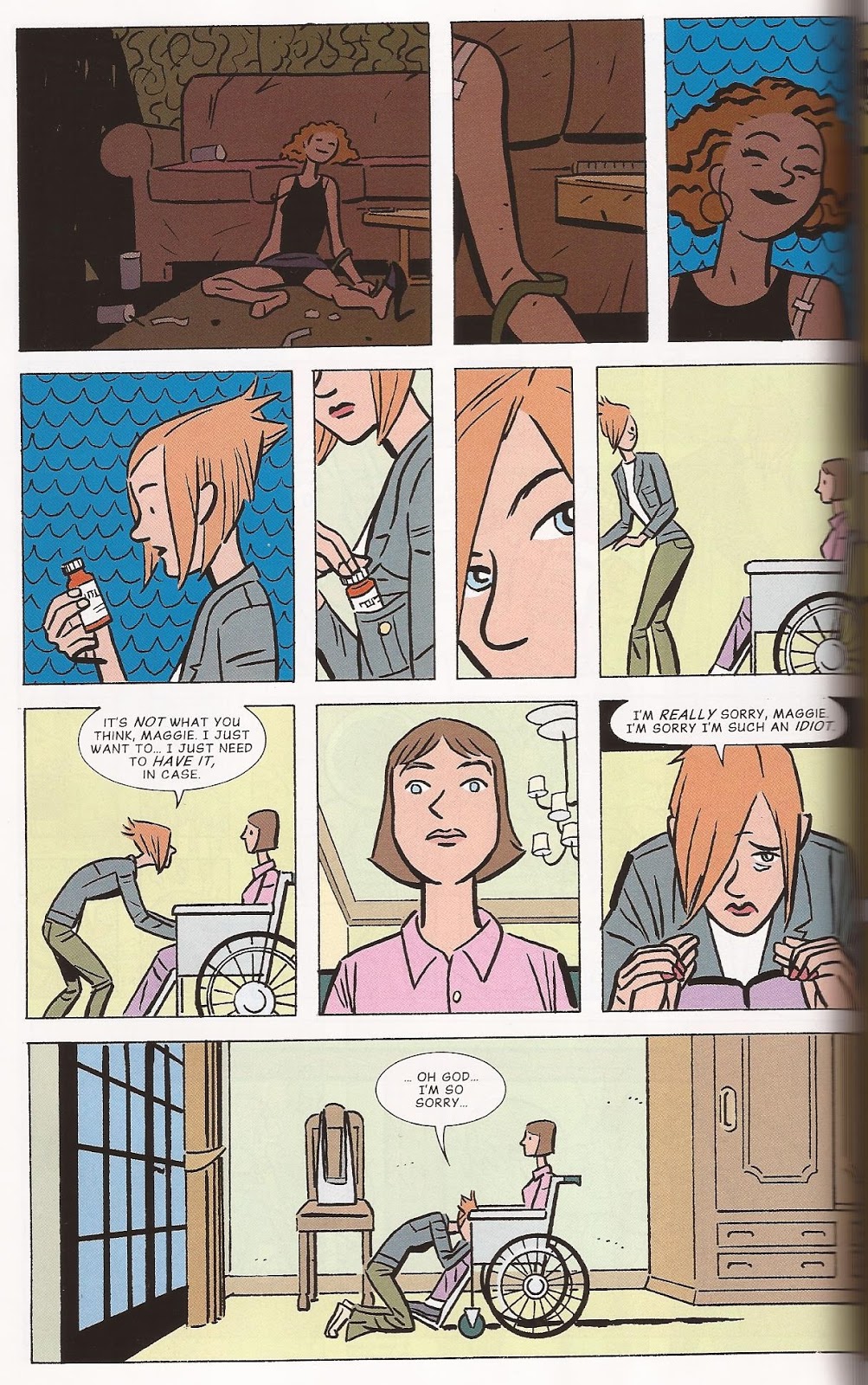
Midway through the book, however, the storyboard is given over to Javier Pulido, who really strips it down, even pulling in some formalist experimentation that reminded me of David Mazzucchelli or Art Spiegelman. In these two pages he illustrates a character's inner struggle with her addictions:


Pulido's technique doesn't just elevate Brubaker's building-block approach to narrative, it also turns up the heat on the title character's sexual tension — and confusion — with the characters around her (including, of course, the Batman). It is a fabulous few pages, but sadly short-lived. The storyboard is handed back to Stewart, and the experiments come to an abrupt halt. It's a shame, but it's still well-above-average for the industry. To quote Abe Lincoln, if you dig this stuff, you'll really dig this stuff.

And Brubaker gets a lot of love from the comic book store set — even the reliable grump Frank Miller sings his praises.* Hey, Brubaker deserves it — the dude's not just prolific (and how!), he's engaging. But the possibility that he might just be the industry's brightest light, however, is an unsettling thought.

Chalk it down to writer's envy. If you even dabble in story-telling, your brain knows it's all smoke-and-mirrors, or sleight-of-hand. When you read someone else's work, and that someone is trumpeted as God's Gift To The Genre, you want to be hit with a Houdini (or, if you prefer meta, Penn & Teller). When you get to the end of the story, you want to say, “Wait: what just happened there? How'd he do that?” Well, with Brubaker you pretty much know. He's got fluid hands, but the ace of spades always turns up behind your ear, or under your tongue. It won't be found inside that iced trout you just brought home from the market.

Miller's tip-of-the-hat is generous, deserved, and spot-on. Brubaker's writing is every bit as accomplished as Miller's was in Year One, and when coupled with a talent like Pulido's, it dazzles (akin, say, to the riskier Miller/Mazzucchelli Daredevil: Born Again). But it's still safe. Snotty old sod that I am, I keep hoping for something to knock me over.**,***

Speaking of “safe,” DC has gone and followed up last year's punky Batman:The Court Of Owls with The Night Of Owls (A) and City Of Owls (A): two very safe — and entirely disappointing — volumes in the DC canon. Scott Snyder is still in charge of the story, and he's proficient enough to hold reader interest until the Big Reveal at conclusion.**** But the deeper delight of Court was Greg Capullo's playful art. Capullo is still on board for much of the two books, but he seems reined in. Worse, because both these books rely heavily on character-title cross-over, other artists show up with the standard DC template, producing fare which ranges from the merely acceptable to the completely risible.

In the latter category is the industry's rendering of female characters. Look, I am not opposed to pin-up art. If you guys really need to express your horny little ids, that's what those Betty & Veronica back pages are for (ditto, Tumblr). Or, if you fancy yourselves the next Howard Chaykin or Wally Wood, throw something up on Kickstarter. Your overlords openly rely on horny 45-year-old SWMs eager to part with chump change — go on, and beat them at their own game for once.

But this business of forcing your heroines to mince about the rooftops, 


or daintily break ribs and teeth, 


while holding Calendar Girl poses leeches emotional oomph from your sequential art. Seriously: DC's writers do a better-than-average job of presenting kick-ass women characters, and you fan-boy artists have to dress it up like a Victoria's Secret pillow-fight?


You haven't the faintest clue just how sad that makes you look. And lest you miss my point, let me spell it out for you: this isn't a “I guess we'll just cave in to the femi-nazis” issue — it's a “How porni-fried and stoopid do your brains have to be for you to commit that shit to paper?” issue. Take your hands off your weenies and get a grip on your art.

Anyway, the Owls storyline is finished, and it's forgettable. Feel free to read it and leave it on the beach.

Next: some pulp, including Stephen King.

*“Brubaker's got the chops. This is one damn fine comic book.”

**“Bowl me over” — the way Elektra: Assassin did, back in the day (FWIW, Brubaker's Vertigo title Fatale is playing out quite promisingly. But as with television, I'm not giving it my endorsement until that show is over).

***I feel the same way about Neal Gaiman's stuff. Whenever I finish something by him I tend to think, “Nicely done. But, uh, isn't there a faster way to get the same results?” There probably isn't, which is why a little additional flash delivers such incomparable value. In Gaiman's case, the spectacular movie Coraline outshines the book. In Brubaker's case, Pulido's art is just the thing to fan the spark of this viewer's interest.

****Which I thought was rather ho-hum, finally. I haven't followed Batman's New 52 story arc all that closely, but from what I gather in the 'Owls' books alone, he's already been subjected to some tectonic relationship-jolters. The one at the end of 'Owls' oughtn't to generate more than a shrug and a “So?”

Wednesday, August 21, 2013

The Self-Promoting Genius of Elmore Leonard

I've read exactly six Elmore Leonard novels. This puts me in the peculiar spot of having read a fair representation of the man's work, without quite picking him up as a habit. I'm settling on the reasons for that, but I'll get to those after I've digested Raylan.

I devoured his profiles and interviews, though. The man was a canny self-promoter nonpareil.

1967: The ad-man cometh.

Here is a classic example: a Brit interviews “Dutch” and swallows the “What a humble man” shtick hook, line and sinker. Now, granted, at this point it's bad form to suggest Leonard was anything but. Certainly he was a master at charming self-effacement. But look at the little digs he takes at Quentin Tarantino and Martin Amis. They're delivered in a “Just joshing amongst friends” tone, and both subjects seemingly laugh it off. But these “off-handed” jabs also hit the bulls-eye — pretty hard — making Dutch the winner-by-a-knockout in this profile, without either of his targets realizing what hit 'em.

I'm going to miss that.