Thursday, June 13, 2013

The Fat Years, Chan Koonchung


The Fat YearsThe Fat Years by Chan Koonchung
My rating: 3 of 5 stars

Chan Koonchung's The Fat Years is the first and final title I've put on my “Currently Reading” list. The book has received criticism here for being stilted and didactic, but I found it quite a breezy read — until the final 25 pages, when Chan props up a puppet character to recite an “alternate” Chinese history that accounts for the month that's gone missing from the Chinese collective memory.

The missing month poses no mystery whatsoever to Western readers, and probably not to Chinese readers, either. But as a literary conceit, it's a sturdy enough vehicle to pull readers through the salons and commercial venues and evangelical Christian churches that have gone viral in contemporary rural China. The characters spend a lot of time speculating on the “lost” history, and the ascendant direction China is taking. Midway through the novel, Chan invokes Paul Auster, and though I could see parallels to Auster's baffled, anxious seekers, I found Chan's protagonists and their quest to be more akin to Douglas Coupland's determined secular materialists, who can't quite shake the paranoid feeling that Something Too Large To Be Named is shaping their destiny in manifestly unpleasant ways.

The bulk (sorry) of The Fat Years is eminently readable, but I finally ground to halt during the final monologue. The book lay beside my bed for the last six months, until last week, when I picked it up to see how much I had left to read. I was abashed to discover it was less than five pages. Those five pages didn't go anywhere I hadn't anticipated. Were it not for the rigid history of digital record, I could claim to have finished this book months ago. But you and I know the Truth.


View all my reviews

Saturday, June 08, 2013

Week Links

I apologize for the lack of original material this week. Whether it's due to last week's uncharacteristic clearing of the carburetor, or to other extenuating circumstances (read: Stanley Cup Play-Offs (you know who I'm cheering for)) I couldn't say, but I'll go with "Hockey," since it naturally segues into this week's collection of worthy links.

Over at the New York Times website, Nate Silver takes up beaucoup blogspace exploring the numbers behind Why Canada Can't Win The Stanley Cup. Silver concludes with a league restructuring proposal that is so common-sensical, Gary Bettman is sure to run in the opposite direction.

Also from New York, via The New Yorker: Nicholas Schmidle fleshes in the larger story behind the murder of sniper-celeb Chris Kyle, by former Marine Eddie Ray Routh. Both men were afflicted with PTSD, Routh especially. That Routh's increasingly desperate family members were unable to procure  treatment and, especially, containment for this troubled man is a fact that brings disturbing questions to mind. In the same issue (June 3), Nick Paumgarten profiles gonzo-climber Ueli Steck, whose feats on the world's riskiest ascents beggar the imagination. Print or subscription only, in that case, so rush to your local news-rack.

The skeletons in The Ford Family Closet are rattling out increasingly funky rhythms. VICE nails it, in this compare-and-contrast piece: Here's Why The Rob Ford Scandal Is Just Like The Wire. Also, Andrew Potter thinks hard about people's unflagging support of the Ford Brothers, and wonders if Mayor Rob might not become the Amy Winehouse of Canadian Politics.

As difficult as it is for some of us to wrap our heads around the affection some people have for the Fords, there are people who felt -- and still feel -- similarly about "Dear Leader" Kim Jong-Il. His sushi-chef, for one. An intimate and disturbing look at the bizarre antics in North Korea's highest echelon.

There's your bread. Now let's get back to the circus of pro-hockey.

"Where's Wallace, Doug? Doug! Where's Wallace?!"

Thursday, May 30, 2013

“I'm A Real Wild Child” The (Tragically Temporary) Salvation of John J. Rambo

This is my conclusion to yesterday's post.

First Blood sets up Sylvester Stallone's character as a Lone Wanderer — a hippie-type, nameless for the first 12 minutes, wearing an Army jacket and carrying a bedroll. He strides into an Edenic setting, surveys it . . .
. . . and smiles.
It ain't much, and it's the only smile we get for the entire movie.

He approaches a black woman, hanging laundry on a line. She appears to be barely submerging her hostility. He notes her surliness, but cheerfully presses on, showing her a picture of the man he is looking for, an old army buddy from 'Nam. She informs him that his friend has died, of cancer — from Agent Orange. This woman has just said the most lines a woman will deliver in this movie. She offers him neither solace nor hospitality.
The Wanderer's smile disappears. He apologizes, gives her the picture, and discards a small address book as he leaves Eden and returns to the road.

Now the sky clouds over, and the temperature drops. After walking undisclosed miles, Our Hero approaches a town: the ironically-named Hope.
Here our next Protagonist steps out, surveys, and smiles: Sheriff Teasle (Brian Dennehy).
He likes what he sees. Hope isn't perfect — he asks one resident old-timer, “Gonna take a bath this week?” (cleanliness is a big deal for this Sheriff) — but it's perfect enough. He spots the Lone Wanderer, decides he doesn't like what he sees, and ushers him out to the far side of town, telling him to keep walking. The Lone Wanderer turns around and walks back toward Hope. The situation deteriorates.

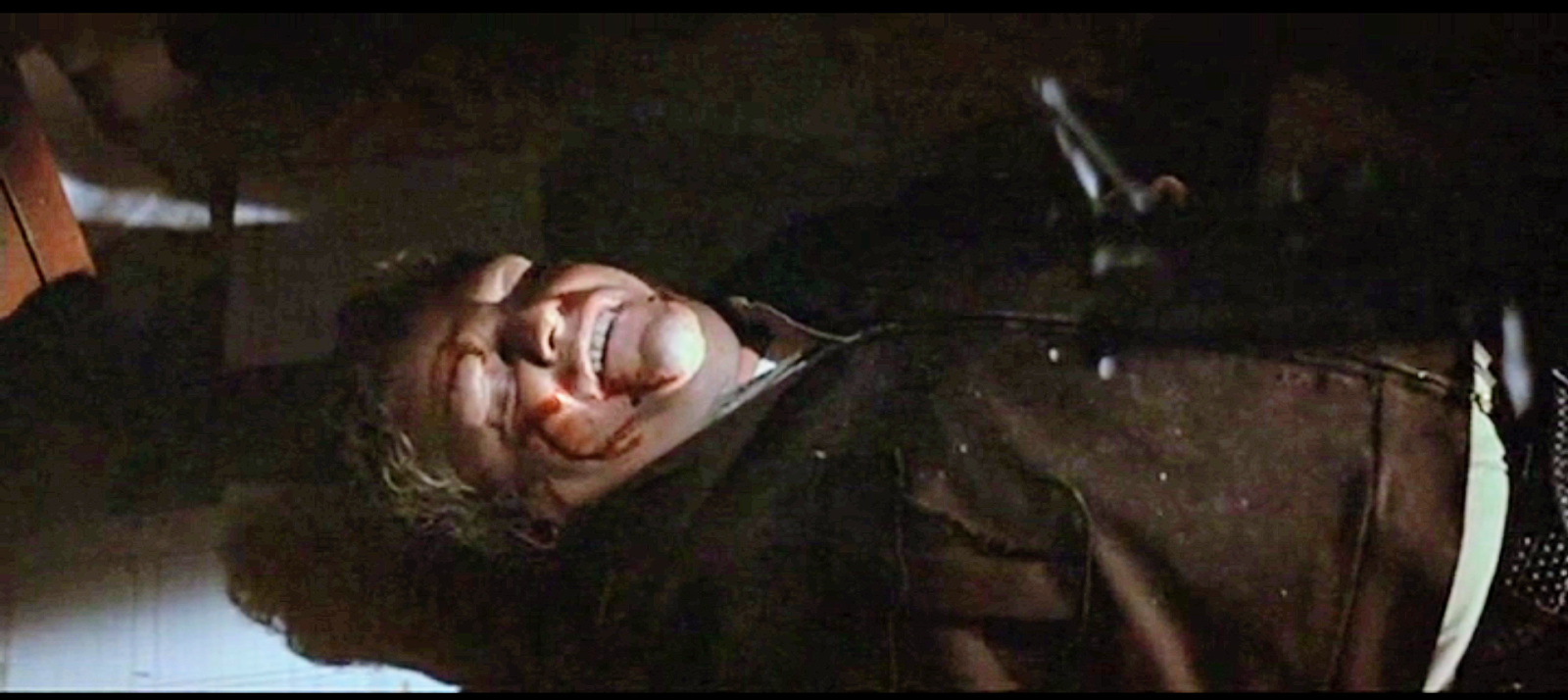
The direction the script could take — the direction many subsequent Stallone scripts have indeed taken — is to set Teasle as the antagonist, and the Lone Wanderer as the protagonist. First Blood takes pains to keep that from happening, by introducing an unregenerate antagonist and bully: Galt (the incomparable Jack Starrett).
Galt, left; David Caruso, dutiful son, centre.
So far the Wanderer has been quietly undermining their assumed authority. Like a mopey adolescent, he only does half of what they tell him to do, testing their patience. Teasle stares incredulously at the kid, trying to understand what the hell is wrong with him. Galt just wants to beat him up, but he is held in check, somewhat, by Teasle.
Dutiful son #2, left.
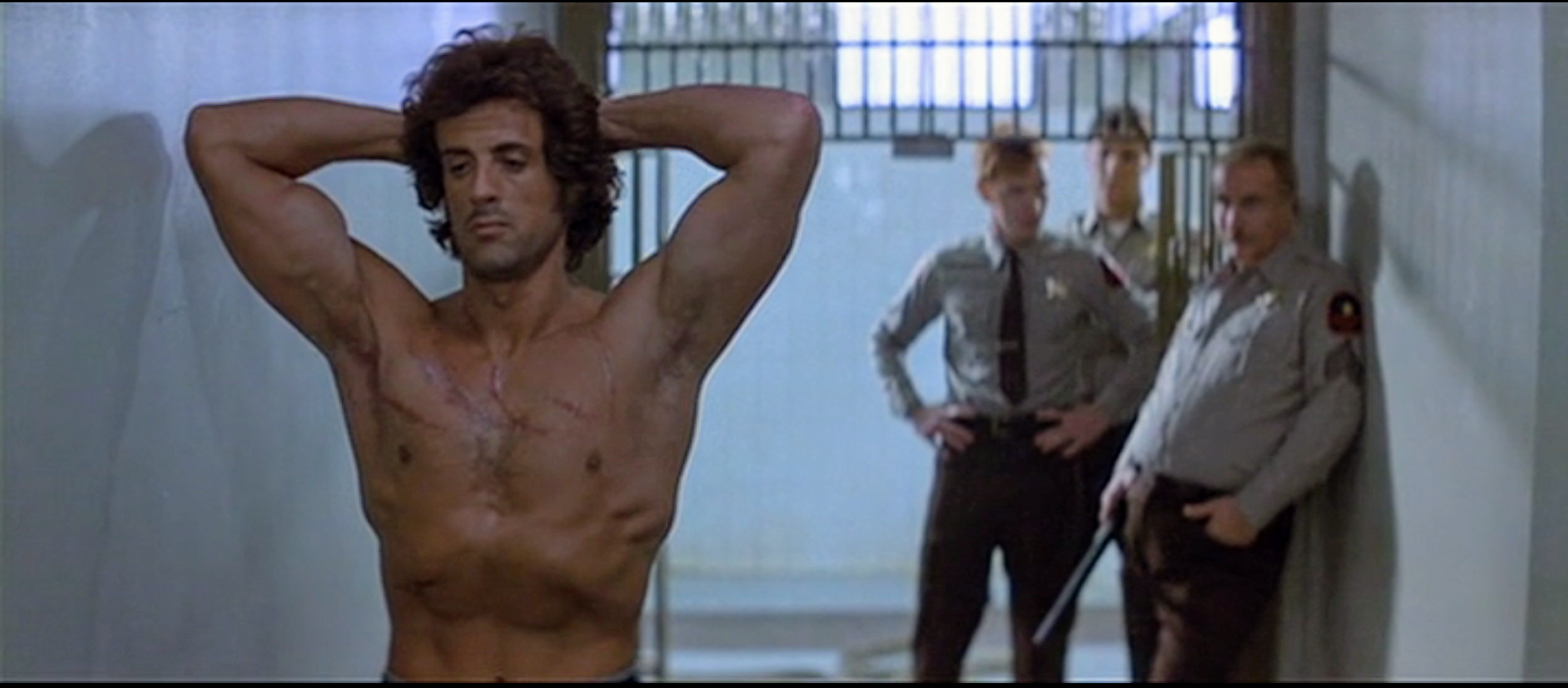
In the police station, names are introduced. There are a number of young deputies — Ward, Mitch, Lester. The Wanderer is John J. Rambo, recipient of a Congressional Medal of Honour. A broader psychological portrait is fleshed out, with Teasle as a father figure — to the boys around him, and increasingly to Rambo. The boys affirm his authority, and they seem happy. This John guy clearly accepted authority from someone, once upon a time. Why can't he get with the program and defer to Teasle?
The situation escalates. Teasle pushes, Rambo passively resists. Then Galt assaults, triggering the dark forces we know are pent-up in Rambo. The Wanderer transforms into the Wild Child, and escapes. Teasle takes off in pursuit. Out of town, in the mountains, Teasle's car crashes . . .
. . . just as Rambo's motorcycle flips. If the two protagonists were sane, they'd take a deep breath, extend a hand and say, “Can we start from square one?” But by now we know they share the exact same character flaw: each cannot abide the other's authority.

The kid scampers into the woods. The Father summons the Family, and lumbers in after him.

It takes some time, and involves considerable peril — Galt, the Nobodaddy, comes closest to destroying the Wild Son, and perishes in the process1 — but Rambo endures and slowly turns the tables of authority on the avenging Father. He spares Teasle, and advises him to “Let it go,” words that, perversely enough, form an invitation to the opposite effect.
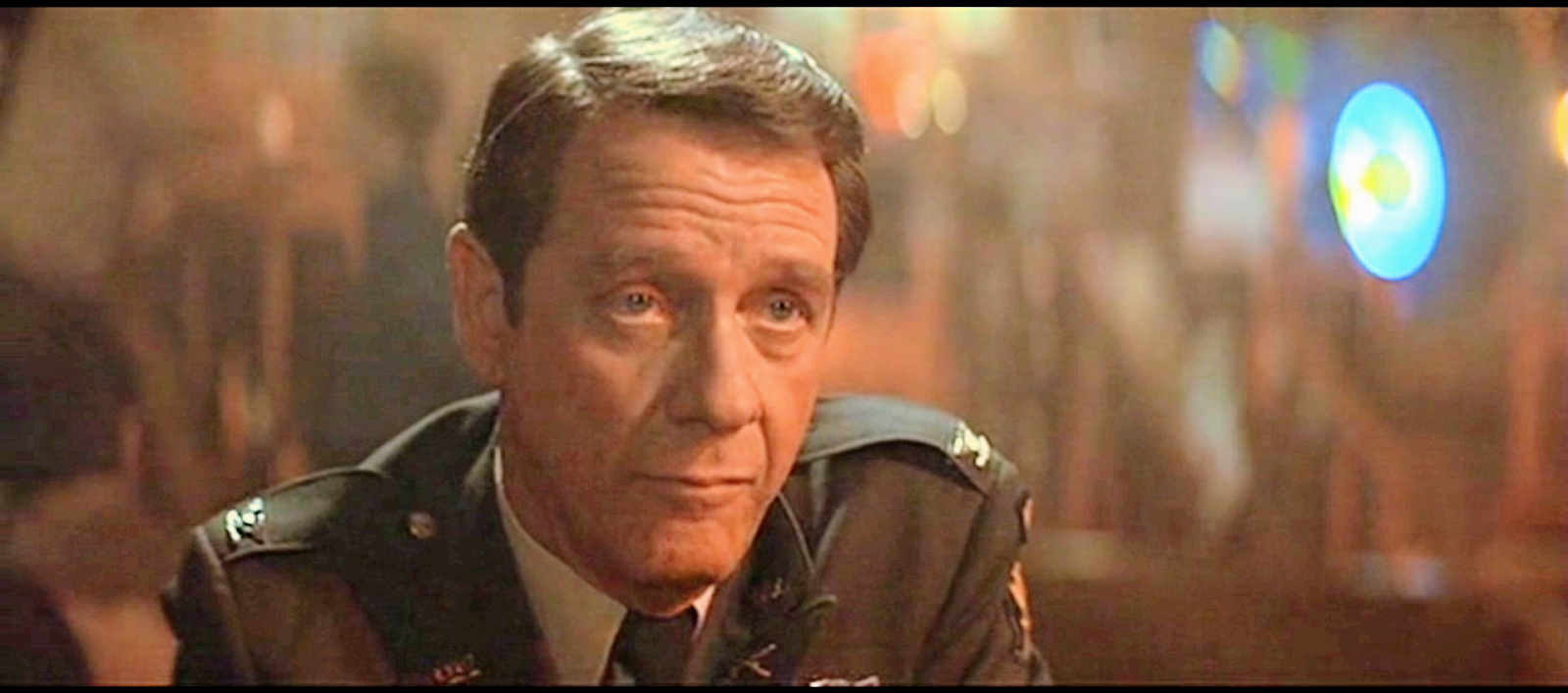
Teasle does the expected, and summons the State Troopers to help him in his quest. And thus we are introduced to the third and final protagonist — the Mother Figure, Colonel Trautman.
"I've come to get my boy."
Played with old-school cool by Richard Crenna, Trautman is a nearly unreadable cipher. His terse utterances signify Military Swagger — “God didn't make John Rambo: I did.” “You send that many men after him, don't forget one thing: a good supply of body bags.” etc — and he prowls around Teasle's camp of Weekend Warriors with a leonine authority that Teasle simply cannot muster. But for all his clipped verbal bravado, Crenna's Trautman in fact spends most of his screen-time silently observing the proceedings.

Trautman clearly has rank and common-sense on his side. But where a younger Trautman might bump chests with the blowhard Teasle and end this circus before it gets worse, the older Trautman — invested with Crenna's sorrowful, sagging hound-dog face — is the very picture of matronly discretion and composure, frequently communicating that most distant trait of masculinity: deep regret for the road not taken.
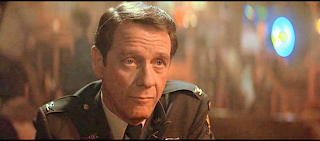
As the Mother figure, Trautman understands that the Father and Son share equal responsibility for this debacle. But as the Mother figure, Trautman is also too deeply invested in the spiritual drama to see a clear way through to salvation. Trautman's practical solution — “Let him go. Issue an APB. In a month he'll get picked up in Seattle, or some other city, and no-one will get hurt” — is superficially spot-on. He knows that without the fight, the Son is nothing — just another drifting loser. He also knows the same holds true for the Father. The Mother intuitively knows there is no “practical” road to wisdom for either of these loved ones,2 and so does not press the point.

The conversations between Teasle and Trautman are akin to the dialogues of long-married couples who have settled on a script. (Think I'm stretching credibility? Try this: go here, and read Trautman's lines with Angie Dickinson in mind.) “She” proposes the practical solution — ”Let him go.” “Now why don't you forget what you're thinking and clear out while you can?” The Father jeers back at The Mother — “And what would you do? Wrap your arms around him and give him a big sloppy kiss?” Confronted with this bluster, Trautman tellingly does not dismiss the possibility out of hand, and instead (yet again) keeps his counsel.

Of course the Son is triumphant in the wild, and returns to Hope to visit vengeance on the Father. The Father, defeated, eggs him on in typical “masculine dis-associative” language: “Go ahead, you crazy son of a bitch!” (You're your mother's fault.)
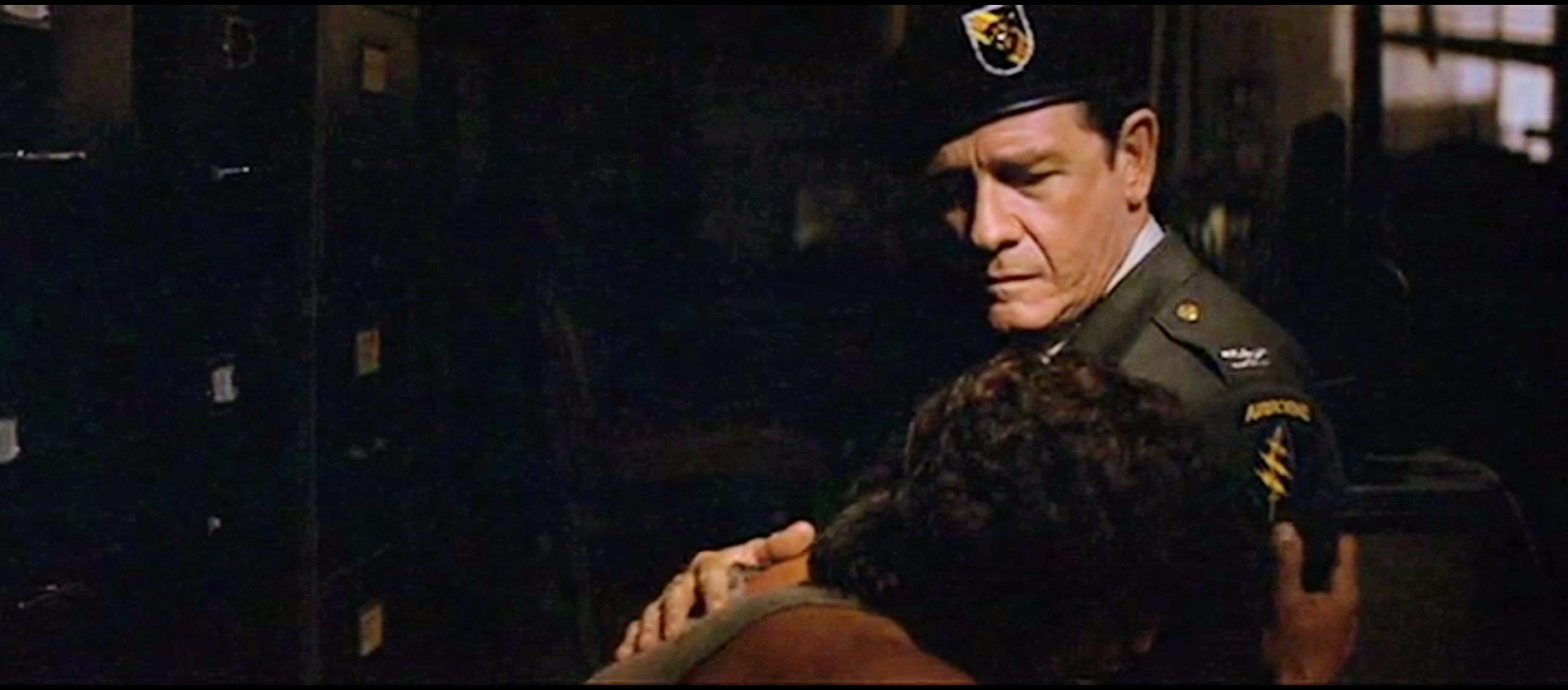
Rambo seems on the verge, but Trautman steps forward, interrupting the patricide.
"It's over, Johnny!"
Beneath the Maternal gaze, the Son's defences crumble.
He rages . . .
. . . then he sorrows . . .
. . . then he wilts.
It turns out that the Mother's embrace was exactly what the Son required.

There are people who don't quite “get” that scene — Roger Ebert was flummoxed by it. He thought the content of that final monologue had been delivered with more force in movies like Coming Home. This may be true — for a film critic. In his commentary for the DVD, novelist David Morrell marvels at the bales of letters he's received from Vietnam vets who said this was the first movie they could take their wives to and say, “See, that's what I'm trying to tell you!” I submit that the bizarre, and seemingly accidental, wisdom of this scene — in this movie — holds a primal appeal to four types of movie goer: Active Personnel and the family members who love them; adolescents, and the parents who love them. Ebert was none of these things when he saw the film.

Rambo's monologue is a wildly audacious gamble,3 and Stallone invests everything — every emotion, every instinct, every facet of his intelligence as an actor — he has in it. If the scene doesn't work for you, it's not because Stallone was holding back, or keeping anything to himself. Ebert thought the movie in the woods was the movie that should have survived. But take away the monologue, and Stallone's invested delivery, and the movie comes apart at the seams.

Prior to First Blood there were glimmerings that Stallone could sell as an action figure. Sadly, Ebert's kvetch (“Stick to action, Sly”) proved to be the road taken for Stallone and his handlers. The subsequent Rambo adventures lack all traces of the heart and soul Stallone pulled out and threw on the table (Crenna's performances also suffer, his jolliness for the regular paycheck too obvious to conceal). Indeed, all Stallone's subsequent performances have a searching quality to them, as if he might locate something of whatever it was that made this movie and this role so very memorable, if only he knew where to look.

So it goes. Hoping for another good Stallone action movie is probably like hoping Brando would pull it together one last time for a final bravura performance that actually meant something to the man himself. It'll likely never happen. But there are still a few of us hoping Stallone catches sight of his original brilliance, before the final curtain drops and extinguishes it altogether.


1 Galt's is the only death in this movie, another anachronism for an action flick (thoroughly “remedied” by the sequels).
2 Here I might be stretching the film to fit my reading of it: the more credible reading is that Trautman sees in Teasle the younger, bloodthirsty man that Trautman himself once was, back in 'Nam.
3 The only Hollywood movie I've seen take this level of risk since then is P.T. Anderson's Magnolia.

Wednesday, May 29, 2013

Is ‘First Blood’ Sylvester Stallone's ‘Last Tango In Paris’?

Is there any chance I'll ever enjoy a new Sylvester Stallone movie on an irony-free level? The odds are long, I grant you. Neither of us is getting any younger. In the last three decades the closest he's come to achieving that feat is Cop Land (1997) an inept movie of sincere, but modest, charm. Other than that, well . . . I haven't seen everything Stallone has done. But I've seen more than half of his movies.

Which is to say I've seen a lot of crap.

The movies that run between the original Rocky (1976) and Rocky III (1982) stand head and shoulders above the rest of Stallone's career. F.I.S.T., Paradise Alley, Nighthawks, Victory and even Rocky II showcase the charisma and talents of a journeyman actor flexing considerable chops and steadily gaining the confidence of the camera. But by Rocky III we see the “new” Stallone taking shape: a journeyman celebrity, who steadily morphs into the Slab of Sly we know and watch today.

The four non-Rocky movies drew a modest box-office, so a third trip to the Rocky well was pretty much expected. Prior to that, however, Stallone was shooting the movie that altered his career more definitively than even his award-winning brain-child, and shaped the public's movie-going appetite for the next 20 years: First Blood.


Although First Blood ushered in many of the tropes of the '80s Action Movie — a muscle-bound hero who levels swathes of enemy troops by using superior cunning and a really big gun — it remains in many ways a quintessential product of the '70s. Prior to this movie, director Ted Kotcheff (a Canuck!) had delivered The Apprenticeship of Duddy Kravitz, Fun With Dick And Jane, and North Dallas 40three stand-outs among other recognizable '70s fare. Standing beside him as Director of Photography is Andrew Laszlo, who performed the same function for Walter Hill, in The Warriors (wpeschewing zooms, and keeping the lenses wide, Laszlo pulls a certain grit into the frame, a practice that eventually got polished into oblivion in the decades that followed.

Consequently there are visual elements that belong to the '70s as well. First, if we consider Stallone's trademark physique . . .
. . . the athleticism, while definitely a cut above even physique-conscious types like Burt Reynolds and Clint Eastwood, is nowhere near what Sly currently maintains. It is even conceivable he achieved his original “Rambo” physique by natural means.

Along the same sight-lines: relative newcomers to Stallone might be surprised to discover he is “vertically challenged” (William Goldman famously followed Stallone into a swimming pool just to ascertain this fact). For decades now Stallone has been framed in such a way as to give him the height advantage — not just with women, but men as well. First Blood however, shamelessly capitalizes on his true physical status, framing him naturally as a smaller “underdog” the audience will root for.
Sly, all 5'7" of him, on left.
This being the pre-digital age, the stunts are all very physical, and utterly beholden to gravity — including, most spectacularly and memorably, a leap from a sheer face of rock to a drop dozens of meters below.
Look Ma: no green-screen!
And then we have a screenplay, whose credits include novelist David Morrell (for the modestly-promising source material), Michael Kozoll, William Sackheim and . . . Sylvester Stallone — which I suspect should probably read, “Sylvester Stallone.” He takes credit for Rocky and Paradise Alley as well, of course, and I suppose it's possible he pounded them out on a typewriter in his off hours.

The author photo should
clear up any doubts
However, given this early run of movies, and the long dreadful onslaught that's followed, I have to wonder if he didn't have someone in his posse who could spot — and improve on — an already promising script. The standing theory is either Stallone finally alienated this person (an ex-wife?), or the actual punches he kept gratuitously taking to his head finally robbed him of all narrative sense.

There is, however, a third possibility: that First Blood was for Stallone what Last Tango In Paris was for Brando — a decimating personal apocalypse that forced the actor to draw from previously unplumbed depths, and confronted him with a terrible self-awareness which he spent the rest of his lifetime fleeing.

“Wait,” you say, “aren't we talking about an action movie?

Ah, but First Blood isn't just your run-of-the-mill action movie — it's a brutal journey into the Heart of Darkness that is American Masculinity.

Next: The horror. The horror!

Sunday, May 26, 2013

Trekking Even Further Into Darkness

A few further links into the growing disappointment of Star Trek Into Darkness. First, the spoiler-free stuff:


The Harlem Shake is kind of a big deal right now. But the Star Trek Shakethat's been a big deal since the '60s! Here are some GIFs to help you out with that.

So you've seen the last two Star Trek movies and had a good time — good enough to finally consent to watching The Wrath Of Khan after years of pestering from your boyfriend (“Greatest Star Trek movie — ever!”). Your first thought: “Kinda overrated, no?” Ho-ho-hoooold on there, newby!

Next: the SPOILER-LADEN links:

After his subtle, spoiler-free meditation equating Abrams' Trek to the trophy partner we gave up our soul mate for, Locke Peterseim tucks in and exposes where Abrams and Crew are egregiously betraying Trekkies.

The arena of charged political debate is hardly verboten to Trek writers. But would George W. Bush dig this movie? Would Dick Cheney?

In a brilliant bit of fan-fic from The Awl, Leonard “Bones” McCoy surveys the post-Into Darkness landscape and wonders if, “perhaps on further reflection, we were a bit naive”?

And finally, Roger Ebert's far-flung Turkish correspondent Ali Arikan argues robustly that “Survivor's Guilt” ought to qualify Mr. Spock for the role of the central hero in the new Star Trek.

O, Canada -- What Is Up With Your Politics?

Our two leading political scandals offer a study in contrasts.


On the one hand we have our famously reclusive Prime Minister, holding down the nation's most visible job and, beyond tweeting a few shots of his beloved cat, keeping his daily dealings as hush-hush as possible. He lards a Senate he once offered to abolish — nothing new, that, and voters expected no less. And of course it takes some time, as these stories tend to, but eventually it comes out that some of these appointments are indulging either in some creative accounting, or are being spectacularly sloppy with their expense claims. It takes a little longer — some think a little too long — but eventually heads are rolling.

On the other hand we have the Mayor of Toronto, who can't seem to do anything privately — including, ostensibly, taking a toot off a glass pipe. His sense of entitlement is wildly evident, his capacity for self-indulgence and bold ineptitude a matter of public record. But he got to where he is by being “just folks,” and — more importantly — by capitalizing on a garbage strike that really, really, really pissed off the people who actually vote.

I never dreamed the stink of that strike could become such a distant memory so very quickly, but the Ford Brothers and their Collapsing Circus of Casualties have done the impossible.

It's the “circus” element that surprises, delights, disgusts. The people in the spotlight are all seasoned performers — once-proficient jugglers now baffled by the directions the balls are bouncing. In the case of former Senators Duffy and Wallin, we're talking about television journalists, fer cryin' out loud: people who covered the beat. Their Senate appointments relieved them of all professional expectations to be The Measured Voice of Reason, and introduced them to the rowdy world of partisan banquets and barbecues, where they guzzled Cutty Sark and delivered Catty Snark. Heady drinks, indeed, to so besozzle these former journos into forgetting precisely what morsels of indiscretion inevitably bring the Fifth Estate sniffing into corners one typically thinks of as “private.” No doubt the two of them are hard at work on “It's somebody else's fault” memoirs. By the time they're published, Harper won't have any teeth left to grind. And if he appeared to be paranoid and overly-controlling before this broke, wait'll you see what's next.

As for the Ford Brothers, I'm forced to recall one of George Carlin's quieter footnotes: “Where do people think these politicians come from?”

We've all been to High School. We all know swaggerers from privileged homes who dealt a little (or a lot) of hash, and who gradually parlayed that swagger into “respectability.” Now take a glance at the Ford Brothers.


You don't need a PhD in Psychology to read their body language — they think they're still in High School.

The front page news isn't news to anyone who's awake. C'mon: we know the Ford Brothers. It's the people who do the quiet work, the drudge work, the difficult work, in the hallways and offices and church basements and school gymnasiums we're not so familiar with — because that's the sort of work and those are the types of places we'd rather avoid.

Sound like I'm pointing fingers? Fine: I'm even lazier than you are. So let me advocate my standard of staying informed as the bare minimum for responsible citizenry. And here's the good news: it's pathetically easy!

Google the councillors in your riding. Google the candidates from the last election. They've all got Twitter-feeds (or Facebook pages). Now add them — all of them — to yours. The ones that are the most boring, that are begging you to attend a re-zoning meeting while you're watching the Monday night hockey game, are the ones to pay attention to and the ones you probably ought to be promoting in your own little way.

If we all do that, maybe — just maybe — we can keep dealers and goons out of City Hall. 


Monday, May 20, 2013

Star Trek Into (Spoiler-Free) Darkness

Four years ago I wrote, “In the Star Trek universe, yesterday's movie is only as good as tomorrow's.” Well, I saw “tomorrow's” movie — yesterday — and thought it was roughly as engaging as Abrams' first franchise movie had been. Which is to say, the sense of diminishing returns is setting in, big time.

I did have fun, yesterday, watching the kids explore and play with the grown-up roles they've been handed. And it was mostly fun tallying up the “alternative” tweaks the new time-line introduces. But here the strain of the premise is beginning to creak — at times quite painfully.
"Captain: he did say 'creak,' did he not?"
J.J. Abrams' is resolutely non-Trekkie — which needn't be a problem. Nicholas Meyer wasn't a Trekkie, either, and he single-handedly resurrected the franchise with his narrative instincts. But where Meyer demonstrated a novelist's capacity for depth of character and irony patiently cultivated for the distant pay-off, Abrams and his (assuredly) Trekkie writers are resolute storyboard dazzlers, opting for flash and distraction and perpetual one-upmanship. “You liked ____ in The Original Series, right? Well, we do it too — only this way!” I burst out laughing at one such tweak — unfortunately at a time when Abrams & Co. were hoping I'd be dabbing at my eyes.

“This new franchise is starting to feel like the young trophy partner we left our soul mate for,” says Locke Peterseim, in a terrific (spoiler-free!) deconstruction: “sleek and alluring and lots of fun, but eventually blithely inane.”

I wanted to send our mutual trophy partner a little post-coital reading — David Gerrold's TOS corrective.* But two realizations stalled this impulse: a) Trek has always worked best as television, where it can be oh-so-patiently developed into a vehicle with legs. And b) this Trek isn't really for Locke or me, or our generation — not primarily, at any rate. That we can willingly take our kids to see these movies and not complain too bitterly on the ride home is pure gravy for Paramount. In another four or five years the kids will be taking their dates to see the next instalment, while we old-timers stay home and content ourselves with DVD memories of the soul mate that slipped away.

And Paramount is super-fine with that, too.
"You say 'trophy partner' like it's a bad thing!"
*Gerrold calls out, among other howlers, the egregious absurdity of a Starfleet flagship staffed by over 400 professionals playing host to three or four hot-shots who do all the work and have all the fun.