Sunday, May 26, 2013

Trekking Even Further Into Darkness

A few further links into the growing disappointment of Star Trek Into Darkness. First, the spoiler-free stuff:


The Harlem Shake is kind of a big deal right now. But the Star Trek Shake — that's been a big deal since the '60s! Here are some GIFs to help you out with that.

So you've seen the last two Star Trek movies and had a good time — good enough to finally consent to watching The Wrath Of Khan after years of pestering from your boyfriend (“Greatest Star Trek movie — ever!”). Your first thought: “Kinda overrated, no?” Ho-ho-hoooold on there, newby!

Next: the SPOILER-LADEN links:

After his subtle, spoiler-free meditation equating Abrams' Trek to the trophy partner we gave up our soul mate for, Locke Peterseim tucks in and exposes where Abrams and Crew are egregiously betraying Trekkies.

The arena of charged political debate is hardly verboten to Trek writers. But would George W. Bush dig this movie? Would Dick Cheney?

In a brilliant bit of fan-fic from The Awl, Leonard “Bones” McCoy surveys the post-Into Darkness landscape and wonders if, “perhaps on further reflection, we were a bit naive”?

And finally, Roger Ebert's far-flung Turkish correspondent Ali Arikan argues robustly that “Survivor's Guilt” ought to qualify Mr. Spock for the role of the central hero in the new Star Trek.

O, Canada -- What Is Up With Your Politics?

Our two leading political scandals offer a study in contrasts.


On the one hand we have our famously reclusive Prime Minister, holding down the nation's most visible job and, beyond tweeting a few shots of his beloved cat, keeping his daily dealings as hush-hush as possible. He lards a Senate he once offered to abolish — nothing new, that, and voters expected no less. And of course it takes some time, as these stories tend to, but eventually it comes out that some of these appointments are indulging either in some creative accounting, or are being spectacularly sloppy with their expense claims. It takes a little longer — some think a little too long — but eventually heads are rolling.

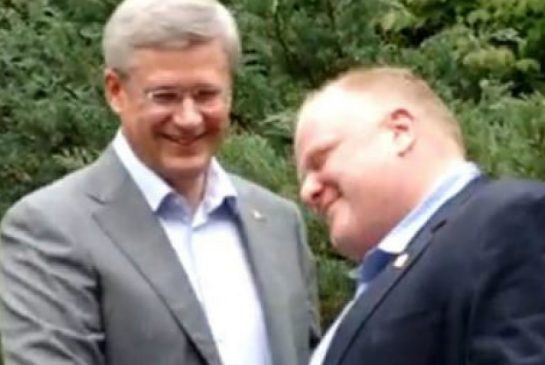
On the other hand we have the Mayor of Toronto, who can't seem to do anything privately — including, ostensibly, taking a toot off a glass pipe. His sense of entitlement is wildly evident, his capacity for self-indulgence and bold ineptitude a matter of public record. But he got to where he is by being “just folks,” and — more importantly — by capitalizing on a garbage strike that really, really, really pissed off the people who actually vote.

I never dreamed the stink of that strike could become such a distant memory so very quickly, but the Ford Brothers and their Collapsing Circus of Casualties have done the impossible.

It's the “circus” element that surprises, delights, disgusts. The people in the spotlight are all seasoned performers — once-proficient jugglers now baffled by the directions the balls are bouncing. In the case of former Senators Duffy and Wallin, we're talking about television journalists, fer cryin' out loud: people who covered the beat. Their Senate appointments relieved them of all professional expectations to be The Measured Voice of Reason, and introduced them to the rowdy world of partisan banquets and barbecues, where they guzzled Cutty Sark and delivered Catty Snark. Heady drinks, indeed, to so besozzle these former journos into forgetting precisely what morsels of indiscretion inevitably bring the Fifth Estate sniffing into corners one typically thinks of as “private.” No doubt the two of them are hard at work on “It's somebody else's fault” memoirs. By the time they're published, Harper won't have any teeth left to grind. And if he appeared to be paranoid and overly-controlling before this broke, wait'll you see what's next.

As for the Ford Brothers, I'm forced to recall one of George Carlin's quieter footnotes: “Where do people think these politicians come from?”

We've all been to High School. We all know swaggerers from privileged homes who dealt a little (or a lot) of hash, and who gradually parlayed that swagger into “respectability.” Now take a glance at the Ford Brothers.


You don't need a PhD in Psychology to read their body language — they think they're still in High School.

The front page news isn't news to anyone who's awake. C'mon: we know the Ford Brothers. It's the people who do the quiet work, the drudge work, the difficult work, in the hallways and offices and church basements and school gymnasiums we're not so familiar with — because that's the sort of work and those are the types of places we'd rather avoid.

Sound like I'm pointing fingers? Fine: I'm even lazier than you are. So let me advocate my standard of staying informed as the bare minimum for responsible citizenry. And here's the good news: it's pathetically easy!

Google the councillors in your riding. Google the candidates from the last election. They've all got Twitter-feeds (or Facebook pages). Now add them — all of them — to yours. The ones that are the most boring, that are begging you to attend a re-zoning meeting while you're watching the Monday night hockey game, are the ones to pay attention to and the ones you probably ought to be promoting in your own little way.

If we all do that, maybe — just maybe — we can keep dealers and goons out of City Hall. 


Monday, May 20, 2013

Star Trek Into (Spoiler-Free) Darkness

Four years ago I wrote, “In the Star Trek universe, yesterday's movie is only as good as tomorrow's.” Well, I saw “tomorrow's” movie — yesterday — and thought it was roughly as engaging as Abrams' first franchise movie had been. Which is to say, the sense of diminishing returns is setting in, big time.

I did have fun, yesterday, watching the kids explore and play with the grown-up roles they've been handed. And it was mostly fun tallying up the “alternative” tweaks the new time-line introduces. But here the strain of the premise is beginning to creak — at times quite painfully.
"Captain: he did say 'creak,' did he not?"
J.J. Abrams' is resolutely non-Trekkie — which needn't be a problem. Nicholas Meyer wasn't a Trekkie, either, and he single-handedly resurrected the franchise with his narrative instincts. But where Meyer demonstrated a novelist's capacity for depth of character and irony patiently cultivated for the distant pay-off, Abrams and his (assuredly) Trekkie writers are resolute storyboard dazzlers, opting for flash and distraction and perpetual one-upmanship. “You liked ____ in The Original Series, right? Well, we do it too — only this way!” I burst out laughing at one such tweak — unfortunately at a time when Abrams & Co. were hoping I'd be dabbing at my eyes.

“This new franchise is starting to feel like the young trophy partner we left our soul mate for,” says Locke Peterseim, in a terrific (spoiler-free!) deconstruction: “sleek and alluring and lots of fun, but eventually blithely inane.”

I wanted to send our mutual trophy partner a little post-coital reading — David Gerrold's TOS corrective.* But two realizations stalled this impulse: a) Trek has always worked best as television, where it can be oh-so-patiently developed into a vehicle with legs. And b) this Trek isn't really for Locke or me, or our generation — not primarily, at any rate. That we can willingly take our kids to see these movies and not complain too bitterly on the ride home is pure gravy for Paramount. In another four or five years the kids will be taking their dates to see the next instalment, while we old-timers stay home and content ourselves with DVD memories of the soul mate that slipped away.

And Paramount is super-fine with that, too.
"You say 'trophy partner' like it's a bad thing!"
*Gerrold calls out, among other howlers, the egregious absurdity of a Starfleet flagship staffed by over 400 professionals playing host to three or four hot-shots who do all the work and have all the fun.

Friday, May 17, 2013

Robert Crumb, Chris Sanders & The Fine Art Of Genuine Desirability In A Disney Pin-Up

All links SFW, with one noted exception.

Some furor has been raised over Disney's manipulation of Pixar character Merida. The headstrong tomboy in Brave has been given a makeover, rendering her more Disney-feminine. The aesthetic formula at play seems to work something like this: Fancy Strapless Shoulder-Baring Gown (+) Shiny Buckle (–) One or Two Ribs (–) Signature Weaponry (=) Pretty Princess.
My first reaction was surprise at how deftly both Disney and Brenda Chapman, Brave's creator, capitalized on the moment. Brave was a fair-to-middling Pixar product that garnered fair-to-middling box office results (in league with How To Train Your Dragon and Dr. Seuss' The Lorax but nowhere close to Toy Story 3). As the parent of daughters I applauded the attempt at a female lead impelled by passions unrelated to Finding True Love, even if I (and my daughters) finally found the emotional content underwhelming.

But with regards to the controversy of Disney's Body Image Problem, I have to admit — it is a problem. That Disney attends to the aesthetics of sexual attraction* doesn't bother me: if their characters didn't have some sexual appeal, Disney's standard storyline would be entirely without interest. Still, as a hetero dad who's endured a parade of Disney cheesecake, I find it remarkable how aesthetically forgettable most Disney heroines are — forgettable because they're interchangeable. The Little Mermaid, Jasmine, Belle, Tiana — what's the difference, and who cares? If a straight fella (who enjoys a little lewd cartoonery ) ain't piqued by the Disney figurine, I have to conclude the artists are banking on the age-old absurdity of fashioning heroines who are aesthetically attractive to girls.

That Disney apes Vogue in this regard is hardly a surprise: Disney has commodities galore it intends to sell, to as many children and parents as possible. Whether Disney has a larger interest in expanding its aesthetic is finally for the market to determine. The Merida Makeover is their canary in the coalmine.

Anyway, as I mused over the past decade-plus, I realized there is exactly one (1) Disney heroine whose desirability factor stands head-and-shoulders — or hips-thighs-calves-and-feet — above this parade: Lilo & Stitch's Nani Pelekai.
Nani, on right.
Here she stands in contrast to a “Pamela Lee Anderson” figure — another body-type we don't see much of in Disney movies:
I won't say I find the latter body-type unattractive, what with its sweeping hips, the supple shoulders supporting an ample, but not grotesque, decolletage, and of course those arms and the cut of the . . . uh . . .  where was I? Right: let's not replace one culturally predominant unrealistic body “ideal” with another. Perhaps it is best to note Nani's posture and facial expression, which indicate Our Hero is in a supplicant relationship to the curvier (white) woman. (The scene ends badly.)

Still, Nani, as drawn by Chris Sanders, is a figure of considerable power, thanks chiefly to her muscular, almost chunky, base — more than a little reminiscent of Robert Crumb's favoured proportions, on display here . . .
. . . and more explicitly here (NSFW, I suppose — there's none of Crumb's unhinged sexual hi-jinx, but, y'know, she is nude).

I Googled for more Chris Sanders, curious to see where Nani fit in with his overall aesthetic. When it comes to his pin-up art, Sanders does indeed have a fetish for sturdier bases . . .
"Where's Spring Breakers playing, again?"
. . . but after that the distinctives become subtle to the point of disappearing. Bruce Timm, Dean Yeagle and even Darwyn Cooke lean heavily on many of the same tropes: essentially wasp-waisted, pert-nosed, late adolescent girls in varying states of compromised (or soon-to-be-compromised) innocence. I understand the thematic predominance, but if you draw up a giant screen of these guys' pin-ups, the final effect is a blurred uniformity — 21st Century America's india ink version of the Venus of Willendorf.

It may be that Nani's singular appeal relies on her sharp aesthetic contrast to the Disney template. But as bold a departure as her curvature is, the power of her story also contributes — greatly — to her appeal. She is perhaps Disney's most fully-realized female character.

A single young woman who becomes the sole guardian of her little sister after their parents are killed in a car-wreck, Nani finds she cannot manage the physical, never mind the complex emotional needs of the grief-struck child. She gets considerable support from David, with whom she seems to have had something going on, prior to the tragedy. You can see he's crazy about her, and that she cares deeply for him. But theirs is a relationship that has, understandably, been put on hold while Nani seeks to secure physical and emotional shelter for her sister.

Say, he's pretty hot too, isn't he?
Lilo and her “pet” Stitch form the nexus for the movie's action, but the deeper revelations all belong to, and are embodied by, Nani. One of the “lessons” a viewer innately gathers through Nani is how the terrible events that accrue in any life can either drive people into a larger concept of family — or into crippling isolation. This makes Lilo & Stitch Disney's most visceral movie since Dumbo, and it has certainly earned an emotional connection with me. I can't even write about it without choking up.

Weirdly enough, here, too, I'm reminded of Crumb. It ain't just the cross-hatching and stippling that sets his pin-ups and other work apart from the Timms and Yeagles and Sanderses of this world. For those who can stomach it, it's Crumb's candour and never-ending internal conflict being brought into play against hapless Others that make his work work. Self-knowledge is a dangerous thing — and absolutely necessary to the erotic imperative.

So, to Disney or anyone else out there in the business of crafting pin-ups: more of that, please, and I for one will buy it.

*Sexual desire is a motivation Pixar mines, if at all, as a very distant secondary concern — with one exception, which adroitly dodges the issue of body-image aesthetics altogether.

Thursday, May 09, 2013

Gatsby vs. The Haters!

We still have a few hours before the unwashed masses gain admittance to Baz Luhrman's adaptation of The Great Gatsby, but already the haters are hatin'. Not the movie, mind you* — the book.

“I find Gatsby aesthetically overrated, psychologically vacant, and morally complacent,” sez — nay, thunders! — Kathryn Schulz. “I think we kid ourselves about the lessons it contains.” You hear that? Lessons! So rev yerself up for some good book-larnin', kiddo, and click on that link.

“The Great Gatsby has often been called 'a novel of yearning,' which for me has always meant a yearning for it to be a better book,” sez — nay, snarks! — The Globe & Mail's new Books editor, Jared Bland. “So why do we keep caring? . . . because for the most part we have it all wrong.” So get it right for once, you numbskull, and click on that link!

Some years back this guy did a “Reader's Manifesto,” which I thoroughly enjoyed (as I did these two pieces). He went one further than Schulz and excised large swaths of writer's prose, which he then excoriated. I giggled along with the man, for the most part, but every once in a while I thought, “Uh — sorry, dude, but this time the author's got me onside.”

Similarly with the passage Bland stabs at:

He must have looked up at an unfamiliar sky and frightening leaves and shivered as he found what a grotesque thing a rose is and how raw the sunlight was upon the scarcely created grass. A new world, material without being real, where poor ghosts, breathing dreams like air, drifting fortuitously about . . . etc.

Sitting on its own like that, the passage does indeed emanate a purple aura (this guy's sentences suffer similarly). But “poor ghosts, breathing dreams like air”? I can dig it.

You get to a certain age and you realize it doesn't matter what your youthful aspirations might have been: your dead ancestors are more present than ever, consuming your dreams and angling for the final word on your life. So by my reading, this metaphor works just fine — for me, and most certainly for Gatsby's larger themes of striving and deficiency (not that you'll ever hear me declare my reading to be The Right Reading. I kinda thought we were beyond all that).

Still, it's a bracing pleasure to catch a little acidity from The Gloat & Wail's Books editor. The previous editor, Martin Levin, was eminently fair-minded and even-tempered — traits that served him and his pages very well during the era of Carol Shields (surely the most fair-minded and even-tempered literary talent this country has laid claim to), but not-so-well in the age of digital decimation. A scrappier temperament might yet inject a little life into those pages — and links. So keep throwing down, Mr. Bland — our nation turns its lonely eyes to you.

"Here's mud in yer eye!"

*Although from the outset Luhrman has been dressed down by the usual scolds, a force of habit for some that shows no signs of stopping.

Friday, May 03, 2013

When Is An OS Not An OS?

You know I'm a Linux user. My PC has been a dual-boot for the past seven years — i.e, I use Windows, too, but only to sync up the family iPods. About a week ago I installed the new desktop version of Ubuntu.

And then the problems started.

I'll spare you the details, but suffice it to say they weren't the usual stutter-starts that occur when an OS has been released prematurely. No, this stuff was “Everything is hanging in the balance” serious. I rolled up my sleeves and got to work, keeping my super-talented brother on speed-dial.

At first I assumed the problem was with me — I'm as fluent in coding as I am in German or French. Put me in a roomful of natives (or open a terminal) and I'll eventually get my point across, but it won't be pretty.

As the trials (and days) wore on, I began to wonder if something wasn't seriously messed up with this release. That's happened before, and with Ubuntu's stubborn insistence on a tablet desktop (which is crap on tablets and worse on PCs) it could be that their development eye is so far off the ball they've forgotten how to cover the basics.

But when, after various re-installation attempts for Ubuntu and Windows 7, I was greeted with this screen . . .


. . . my brother began to wonder if the problem didn't originate with “our friends in Redmond.”

Maybe, maybe not. All I know is:

a) right now Windows 7 is the only OS that installs successfully on my PC.

b) Windows 8 is Microsoft's “closed” OS — i.e., Microsoft is now emulating Apple's method (to dubious effect, of which I'll say more later).

c) Windows 8 monkeys with the host BIOS. In other words, if you install Windows 8 on a machine — or get a machine with Windows 8 already on it — Windows basically breaks into the BIOS and changes the locks behind it, so that Windows 8 is the only OS that will run on that machine.

Microsoft isn't the only outfit that can monkey with a BIOS, of course. As my friend, who did time as a BIOS engineer, is fond of saying, “Firmware ain't that firm.” But I'm not a hacker. I doubt I even qualify as a geek. Opening up the BIOS and putting it back together so it does what I tell it to — I'd have an easier time performing that function on my cat.

Besides, “User Error” is still the likeliest cause of my troubles. For now I'm stuck using a functional-if-disagreeable OS, and contemplating Microsoft's larger market strategy. The whole experience has got me wondering.

Why would Microsoft lock up the BIOS? More to the point, why would hardware manufacturers consent to this? Anyone who buys a new PC hoping to install something else on it now faces a hacker's challenge, which the manufacturer's End User Licensing Agreement strongly discourages. I studied Hewlett-Packard's EULA this week, and they aren't threatening patent infringement lawsuits — yet. But as my screen message amply displays, the component manufacturer is keen to let the user know this is certainly a possible scenario.

This antagonism toward the consumer is baffling to me. It's hardly putting the best foot forward with potential customers. For Apple to sell their closed and externally controlled environment they had to have a product that made the consumer swoon. Windows 8 ain't doing that. Sales for their OS aren't just hurting, they're having a negative effect on the hardware that hosts it. Meanwhile, closed systems are losing momentum precisely while “open” systems like Android are taking flight.

But secondly, just consider the ironies of my situation: I only bothered myself with a PC because it could run Linux simultaneously with Windows, which accommodated my household Apple products. If I am now forced to align myself with a closed system, whatever would possess me to take up with the company that pulled the rug out from under my feet?

Anyway, I've already put the money down, so for the foreseeable future a Windows 7 user I shall be — which ain't a bad OS, frankly. Who knows? I might just finally give Halo a spin. New mantra: contentment in confinement.

All I'm saying is, any OS that bears down hard on the dilettante coder cannot be a good thing.

Friday, April 26, 2013

"If I Could Play The Blues Like They're Playing Me" - Wayne Hancock's Wild RIDE

Spring is taking its cussed time, up north of the 44 at least. It's been too cold and rainy to do a proper cleaning of the car, but when that day finally arrives I expect I'll still be listening to this year's Car Wash Soundtrack: Ride by Wayne Hancock.


Hancock is new to me, but it sounds like he's been around forever. Part of this is due to his sound, which hews to an earlier, considerably less processed iteration of country music — honky-tonk, or juke-joint music, really. Hank Williams' grandson, Hank III, claims “Hancock has more Hank Sr. in him than either I or Hank Williams Jr.” an appraisal that is not entirely disingenuous. Hancock's songs of heartbreak have a similar disconcerting candour that leaves you wondering how delivery so muscular can be so unabashedly fragile as well.

That muscularity, force and confidence is the engine of the project, and it's fuelled with high-octane licks from some mighty fine guitarists. A number of songs have three of them trading rockabilly jams. I'm a sucker for the style, and this is the sweetest I've heard it played in many years.

“If I could play the blues like they're playing me,” moans Hancock early in the record. He might not have the upper hand on 'em, but he sure does give 'em a ride. As soon as the weather warms, I'll be rolling down the windows to Wayne for sure.

The album site (Bloodshot Records) is here, and I think the snippet from The Big Takeover review* is spot-on. Hancock's own site is here.


* “It doesn't hurt either that each song is filled with instrumental breaks from three guitarists who let loose and trade off in styles that are at once respectful of the vintage music and as demented as any rock guitar breaks…Despite the fact that there's no drummer on this record** it has the energy of the first Rolling Stones record but taking on rockabilly rather than American blues.”

** Huh. Hadn't really noticed the absence of drummer until it was pointed out to me. Had you asked, I probably would've sworn there was someone smacking the trap behind these fellas. Goes to show ya.