I realized, halfway through entry #9, that this little Top Ten list was going to take more out of me than I'd originally calculated. Pulling together ten songs / albums / setlists was no trouble at all, of course. Exploring the effect they had on me, however, was a little dicier.
I also realize that compared to my other Top Ten efforts, I was a little more cavalier with the guidelines I set for myself. A Boy Named Sue hardly qualifies as a true "heartbreaker", but I included it just because I'm unhinged enough to get choked up while listening to it.
And, oh, the artists I ignored! Not a bluesman -- or woman -- in the bunch. Slaid Cleaves Broke Down, the entirety of which should qualify, didn't even make mention.
No doubt my blinders steered me right past some of your sad-eyed favourites. If so, don't be shy! Ennumerate and elucidate below.
Tuesday, February 21, 2006
A Love Supreme/John Coltrane

As it evolved, so the quartet sound came to be dominated increasingly by what were essentially battles between Coltrane and (drummer Elvin) Jones, whose drums are like a wave that never quite breaks, that never stops breaking ... the soprano seems about to be drowned by the weight of drums but then emerges again, floating clear of the tidal wave of percussion crashing over it ... Jones is murderous: it seems impossible that the saxophone can survive the pounding of the drums. Coltrane is on the cross, Jones is hammering in the nails. Prayer turns to scream. If Jones sounds as though he wants to destroy him, then Coltrane certainly wanted -- needed -- him to try. But Beautiful: A Book About Jazz, by Geoff Dyer.
A Love Supreme, by John Coltrane.
That's it: my Number One Heartbreaker. I don't understand this album. I can't figure out how the music "works" (Dyer's metaphors are as good an "explanation" as any). I've seen magazine columnists recommend this album for background music to a romantic dinner. I can't imagine. Of all the CDs I've played while driving, this is the only one to force me to pull over to the side of the road and stop.
I can't really break it down, because it breaks me down first.
I don't understand Coltrane's spirituality. I have no idea what came over him and consumed him. As my New Testament scholar-friend is overly-fond of saying: "Something happened."
Something happened, and now we have this heartbreaking work.
Monday, February 20, 2006
"C'mon baby, spend the night with me"
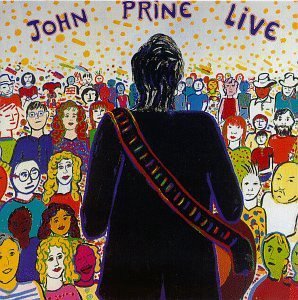
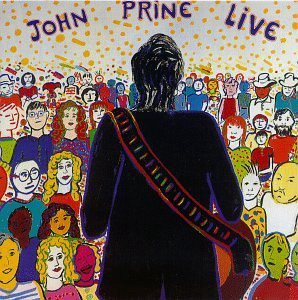
Heartbreaker #2: Six O'Clock News by John Prine, best heard on John Prine Live.
I first heard John Prine when he played the mainstage at the Winnipeg Folk Festival in the early 90s. I knew of him thanks to some former roommates, who enjoyed his slanted take on things, and frequently played a worn-out "Best Of" cassette. Once a month, our room of fellas would phone up this houseful of girls we knew, and we'd take turns hosting a supper for each other. The customary habit was to dust off this Prine tape and slap it in the little stereo. Then, when the girls would enter the room, they could smirk or roll their eyes and say, "John Prine, huh?"
So you could say he was regarded with something approaching frat-boy humour. And to be fair to John, this best-of tape contributed in no small way to this misperception: he was suspiciously verbose during the live tracks, and prone to guffawing at his own jokes, which gave a song like Illegal Smile a dangerous air of authenticity. So, yes: the tape was played in my presence. But the first time I heard John Prine was at the Folk Festival, six years later.
He was the last of a stellar line-up that night. I was lying back and staring at the night sky (as Folk Festival attendees are wont to do) when he finally came onstage. He strummed a bit, then travis-picked an intro to his first song. I can't remember what it was, but when he started singing, I sat bolt upright. His voice had undergone an incredible change since he'd recorded the tape from my college days. I did a little math -- those songs were probably 20 years old by now. The drunken jester I'd expected to see had been replaced by a straight-forward performer with undeniable presence.
I can't recall the songlist from that night, but in my memory it hews closely to the songlist on John Prine Live. Six O'Clock News was close to the beginning of the concert, and when he sang the final verse, I was crying. It's a song about incest, confusion, misplaced desire and trying in vain to play the rotten hand that's been dealt you. In the space of two minutes, the listener is thrown into the song's tragic heart, with a girl, a father, Jimmy, and a town trying to make sense of it all.
Heartbreaker #1
I first heard John Prine when he played the mainstage at the Winnipeg Folk Festival in the early 90s. I knew of him thanks to some former roommates, who enjoyed his slanted take on things, and frequently played a worn-out "Best Of" cassette. Once a month, our room of fellas would phone up this houseful of girls we knew, and we'd take turns hosting a supper for each other. The customary habit was to dust off this Prine tape and slap it in the little stereo. Then, when the girls would enter the room, they could smirk or roll their eyes and say, "John Prine, huh?"
So you could say he was regarded with something approaching frat-boy humour. And to be fair to John, this best-of tape contributed in no small way to this misperception: he was suspiciously verbose during the live tracks, and prone to guffawing at his own jokes, which gave a song like Illegal Smile a dangerous air of authenticity. So, yes: the tape was played in my presence. But the first time I heard John Prine was at the Folk Festival, six years later.
He was the last of a stellar line-up that night. I was lying back and staring at the night sky (as Folk Festival attendees are wont to do) when he finally came onstage. He strummed a bit, then travis-picked an intro to his first song. I can't remember what it was, but when he started singing, I sat bolt upright. His voice had undergone an incredible change since he'd recorded the tape from my college days. I did a little math -- those songs were probably 20 years old by now. The drunken jester I'd expected to see had been replaced by a straight-forward performer with undeniable presence.
I can't recall the songlist from that night, but in my memory it hews closely to the songlist on John Prine Live. Six O'Clock News was close to the beginning of the concert, and when he sang the final verse, I was crying. It's a song about incest, confusion, misplaced desire and trying in vain to play the rotten hand that's been dealt you. In the space of two minutes, the listener is thrown into the song's tragic heart, with a girl, a father, Jimmy, and a town trying to make sense of it all.
Heartbreaker #1
Sunday, February 19, 2006
Bruises & Ice Cream
Heartbreaker #3: old hymns in a Mennonite church.
Blessed are the meek, for they shall inherit the earth: this Christly bromide isn't just something the Mennonites take to heart -- they actually believe Jesus is speaking about them. If you think I'm kidding, go ahead and ask the first Mennonite you meet if that's what they believe. He will likely chuckle (or she will roll her eyes) and say, "Well ... some Mennonites probably do!" They'll wink, or give you a little nudge in the ribs, and try to imply they're not one of those Mennonites, and you'll know: these assholes actually think they'll inherit the earth.
Mennonites should know better. They're anything but meek, and you don't have to look far for the evidence. Go to a Mennonite church some Sunday night, when they're all singing from the old green hymnal. If you can, get the music director to start the evening with This Is My Father's World. The pristine eruption of four-part choral harmonies -- from every member of the congregation -- will settle the question. You can't be meek and sing like that.
Mennonite congregations are the best choirs in the world, and their choirs are something else altogether. Like Muhammad Ali said, "It ain't bragging if it's true." Children hear their parents and grandparents sing like this, and think, Oh man, this is just a little scary! But eventually they learn how to sing like that, too, and then it's not such a big deal. They even start to take it for granted. There dawns a Sunday in their early adulthood when they tag along with a friend who attends an Episcopalian or Anglican church. At the appointed time they reach for the Psalter, open it up, and wonder, Where are the notes?! The congregation clears its throat and starts singing, and our earnest young Mennonites think, Oh dear Lord! These people sing like shit! The post-sermon trip to The Olive Garden is simultaneously grim and giddy, because the penny drops: if Mennonites were truly meek, they'd be singing like that sorry bunch.
There are Sunday mornings when I wonder if I'm living in the wrong acre of Ontario. The closest Mennonite congregation is over an hour's drive away, and to my thinking there isn't a church in the world worth an hour's drive. If you're in a psychoanalytic frame of mind, you are free to speculate that this distance is in some way personally desirable. But man, I miss that singing! The church we attend is on the other side of our back yard hedge. It's a terrific bunch of folks -- Scottish descendants, most of them. Musically (and in many other regards) some of them are freakishly talented. But when it comes to singing, the congregation mostly just ... sings.
So if you want to see me dab at my eyes and honk my nose, insert me into a Mennonite congregation singing old standards like the one above. When Peace Like A River is good, too. So is And Can It Be. But the saddest hymn I can think of is probably Joseph Scriven's What A Friend We Have In Jesus. That man's entire life was one sad and sorry spectacle. So much of his misery was openly invited out of a cussed sense of piety: the second(!) fiance to die on him just days before they could make it to the altar was consumed by pneumonia -- after he'd given her a full-immersion, river-baptism in the middle of winter. This, and other glum facts from his life hit me anew, every time our family makes an ice-cream drive to Port Perry. It's a lovely little town (appearing frequently in Hollywood movies as a lovely little American town), and it's where Scriven was beaten to a bloody pulp by a couple of drunkards, after he'd done a little street-corner preaching.
But there you have it: the life of a True Believer. Bruises and ice-cream.
Heartbreaker #2
Blessed are the meek, for they shall inherit the earth: this Christly bromide isn't just something the Mennonites take to heart -- they actually believe Jesus is speaking about them. If you think I'm kidding, go ahead and ask the first Mennonite you meet if that's what they believe. He will likely chuckle (or she will roll her eyes) and say, "Well ... some Mennonites probably do!" They'll wink, or give you a little nudge in the ribs, and try to imply they're not one of those Mennonites, and you'll know: these assholes actually think they'll inherit the earth.
Mennonites should know better. They're anything but meek, and you don't have to look far for the evidence. Go to a Mennonite church some Sunday night, when they're all singing from the old green hymnal. If you can, get the music director to start the evening with This Is My Father's World. The pristine eruption of four-part choral harmonies -- from every member of the congregation -- will settle the question. You can't be meek and sing like that.
Mennonite congregations are the best choirs in the world, and their choirs are something else altogether. Like Muhammad Ali said, "It ain't bragging if it's true." Children hear their parents and grandparents sing like this, and think, Oh man, this is just a little scary! But eventually they learn how to sing like that, too, and then it's not such a big deal. They even start to take it for granted. There dawns a Sunday in their early adulthood when they tag along with a friend who attends an Episcopalian or Anglican church. At the appointed time they reach for the Psalter, open it up, and wonder, Where are the notes?! The congregation clears its throat and starts singing, and our earnest young Mennonites think, Oh dear Lord! These people sing like shit! The post-sermon trip to The Olive Garden is simultaneously grim and giddy, because the penny drops: if Mennonites were truly meek, they'd be singing like that sorry bunch.
There are Sunday mornings when I wonder if I'm living in the wrong acre of Ontario. The closest Mennonite congregation is over an hour's drive away, and to my thinking there isn't a church in the world worth an hour's drive. If you're in a psychoanalytic frame of mind, you are free to speculate that this distance is in some way personally desirable. But man, I miss that singing! The church we attend is on the other side of our back yard hedge. It's a terrific bunch of folks -- Scottish descendants, most of them. Musically (and in many other regards) some of them are freakishly talented. But when it comes to singing, the congregation mostly just ... sings.
So if you want to see me dab at my eyes and honk my nose, insert me into a Mennonite congregation singing old standards like the one above. When Peace Like A River is good, too. So is And Can It Be. But the saddest hymn I can think of is probably Joseph Scriven's What A Friend We Have In Jesus. That man's entire life was one sad and sorry spectacle. So much of his misery was openly invited out of a cussed sense of piety: the second(!) fiance to die on him just days before they could make it to the altar was consumed by pneumonia -- after he'd given her a full-immersion, river-baptism in the middle of winter. This, and other glum facts from his life hit me anew, every time our family makes an ice-cream drive to Port Perry. It's a lovely little town (appearing frequently in Hollywood movies as a lovely little American town), and it's where Scriven was beaten to a bloody pulp by a couple of drunkards, after he'd done a little street-corner preaching.
But there you have it: the life of a True Believer. Bruises and ice-cream.
Heartbreaker #2
Friday, February 17, 2006
"I know life is more than just survival, but that's all that I can see"
Heartbreaker #4: I'm Still Alive Tonight by Bob Bennett on Songs From Bright Avenue.
In my family, it's traditionally the menfolk who get assigned to the wakeful sprats. That's turning around somewhat in our house, given our chosen "role-reversals", but I grew up expecting my father to answer during the midnights of my soul. I'm not sure who established this precedent, but my father often talked about how his father would sit next to the bed and talk to him as he suffered through leg-aches and growing pains. And I'm told my grandfather also took the night-shift for the family's one colicky babe.
My father took this example to heart. My brother suffered from leg-aches, and it wasn't uncommon for me to wake up in the night and hear him and the old man murmuring to each other like a couple of conspirators. I don't recall my childhood nights being especially troubled, but that could be a case of selective memory. However, I do recall the night when that seemed to change for once and for all.
I was 12 years old. One of my mates put me up to it. We were talking about Star Trek, and comic books, and freaky-deaky adventure stories, when he suddenly said, "Have you read The Book of Revelation?"
No. What was it?
"It's the last book in the Bible, man! Aw, you should -- it is, like, totally wild!"
I didn't take my friend up on this challenge right there on the spot; I let the suggestion fester for a bit. I was intimately familiar with the rest of the Bible -- the narrative books, at least. The last book of the Bible was an epistle -- a letter -- and while I'd read a few epistles (Philemon was popular Sunday school material, what with it being about a runaway slave and all), they seemed dusty and arcane in their concerns. How far removed from this template was the final letter likely to be?
But the inevitable finally occurred: a Saturday with nothing to do. I picked up my Bible and flipped to the back. I read The Revelation from beginning to end. I returned to the beginning, and read it again. I read it a few more times after that -- for a total of 12, actually, because I was beginning to get the idea that numbers were important. This was all the same day, of course: the scales were torn from my eyes, and I now realized there was nothing more important than figuring this book out so that my family could cobble together some plan of escape.
Sleep was a distraction. Not for me of course -- no, sleep was something I didn't have to worry about anymore. It was a distraction for my father. He needed to explain to me all those concepts he'd dealt with in seminary -- eschatology, parousia, ekklesia and all those other five-dollar words you aren't allowed to use in Scrabble. This being the summertime, I stuck to his side and pestered him with questions during the daylight hours. He did what he could to provide answers, but the more pressing questions seemed to occur about two or three hours after I crawled into bed. The poor man, his eyes red and deeply rimmed (had he been crying?), struggling desperately to shift my pre-adolescent perspective from This letter, like the rest of the Bible, has been written to me: what does it mean? to This letter was written 2000 years ago by someone within a particular tradition to a specific recipient within the same tradition: what did it mean to them?
So, yeah: that interrupted our mutual sleep-pattern for quite a stretch. And I think once a child's sheltered perspective of things gets blown wide open by apocalyptic winds, that pretty much affects a person's sleep pattern for life. It has mine.
And so we come to this song, the final number on a "Divorce Album". We don't need to take a sophisticated po-mo approach to these songs -- there isn't a "singer" or "unreliably unreliable narrator" or some other "meta-narrative" to concern ourselves with. There's just Bennett, alone in a shitty apartment:
No one is sleeping down the hallway
No one is here beside me now
And the loneliness, like a fever
Is hot upon my brow
In the middle of this desolation is a striking metaphor: I see an image of my Father / And he bids me: "Come and sleep" The reference is to our "heavenly" Father, of course, and that's fine enough. But to this listener the image speaks directly to an intensely personal memory. It all fits together, and you don't have to experience divorce to recognize the power of the song's final sentiment:
I'm still alive tonight
And that's good enough for me
Heartbreaker #3
In my family, it's traditionally the menfolk who get assigned to the wakeful sprats. That's turning around somewhat in our house, given our chosen "role-reversals", but I grew up expecting my father to answer during the midnights of my soul. I'm not sure who established this precedent, but my father often talked about how his father would sit next to the bed and talk to him as he suffered through leg-aches and growing pains. And I'm told my grandfather also took the night-shift for the family's one colicky babe.
My father took this example to heart. My brother suffered from leg-aches, and it wasn't uncommon for me to wake up in the night and hear him and the old man murmuring to each other like a couple of conspirators. I don't recall my childhood nights being especially troubled, but that could be a case of selective memory. However, I do recall the night when that seemed to change for once and for all.
I was 12 years old. One of my mates put me up to it. We were talking about Star Trek, and comic books, and freaky-deaky adventure stories, when he suddenly said, "Have you read The Book of Revelation?"
No. What was it?
"It's the last book in the Bible, man! Aw, you should -- it is, like, totally wild!"
I didn't take my friend up on this challenge right there on the spot; I let the suggestion fester for a bit. I was intimately familiar with the rest of the Bible -- the narrative books, at least. The last book of the Bible was an epistle -- a letter -- and while I'd read a few epistles (Philemon was popular Sunday school material, what with it being about a runaway slave and all), they seemed dusty and arcane in their concerns. How far removed from this template was the final letter likely to be?
But the inevitable finally occurred: a Saturday with nothing to do. I picked up my Bible and flipped to the back. I read The Revelation from beginning to end. I returned to the beginning, and read it again. I read it a few more times after that -- for a total of 12, actually, because I was beginning to get the idea that numbers were important. This was all the same day, of course: the scales were torn from my eyes, and I now realized there was nothing more important than figuring this book out so that my family could cobble together some plan of escape.
Sleep was a distraction. Not for me of course -- no, sleep was something I didn't have to worry about anymore. It was a distraction for my father. He needed to explain to me all those concepts he'd dealt with in seminary -- eschatology, parousia, ekklesia and all those other five-dollar words you aren't allowed to use in Scrabble. This being the summertime, I stuck to his side and pestered him with questions during the daylight hours. He did what he could to provide answers, but the more pressing questions seemed to occur about two or three hours after I crawled into bed. The poor man, his eyes red and deeply rimmed (had he been crying?), struggling desperately to shift my pre-adolescent perspective from This letter, like the rest of the Bible, has been written to me: what does it mean? to This letter was written 2000 years ago by someone within a particular tradition to a specific recipient within the same tradition: what did it mean to them?
So, yeah: that interrupted our mutual sleep-pattern for quite a stretch. And I think once a child's sheltered perspective of things gets blown wide open by apocalyptic winds, that pretty much affects a person's sleep pattern for life. It has mine.
And so we come to this song, the final number on a "Divorce Album". We don't need to take a sophisticated po-mo approach to these songs -- there isn't a "singer" or "unreliably unreliable narrator" or some other "meta-narrative" to concern ourselves with. There's just Bennett, alone in a shitty apartment:
No one is sleeping down the hallway
No one is here beside me now
And the loneliness, like a fever
Is hot upon my brow
In the middle of this desolation is a striking metaphor: I see an image of my Father / And he bids me: "Come and sleep" The reference is to our "heavenly" Father, of course, and that's fine enough. But to this listener the image speaks directly to an intensely personal memory. It all fits together, and you don't have to experience divorce to recognize the power of the song's final sentiment:
I'm still alive tonight
And that's good enough for me
Heartbreaker #3
Thursday, February 16, 2006
"What could I do? What could I do?!"
"Hang on, hang on -- you've got to hear this!"
So said my friend in his Dodge Caravan, commandeering the stereo while I and his two boys stared out at the highway. He tabbed back to the song's beginning. I took a deep breath, and listened up.
And so I heard for the first time (at an improbably late date) the freakiest song, sung by the freakiest man, in the freakiest setting possible. These three elements of performance merged with such alchemic power that by song's end I had my face turned closer to the window in a comical attempt to choke back my tears.
As I considered the content of this list, I thought back to that moment in my friend's van, and wondered if the song retained any of that original appeal, or if my emotional response had been a matter of circumstance. I couldn't say with any certainty, so I went out and bought a copy of The Legend of Johnny Cash, and tabbed forward to A Boy Named Sue, from At San Quentin.
Yep: same response.
It shouldn't work that way. It's a novelty song, for one thing (somewhere between The Giving Tree and the Playboy Mansion, Shel Silverstein must have scratched his pate and wondered just what happened). And had it been sung by any other man in front of any other audience, it would have played as such. But Cash's nicotine-strained baritone lopes along with a swagger this particular audience recognizes immediately: a would-be bad-ass and a bullshitter, who deep down just wants some recognition and a hug from his pa. The audience and the performer are in a perfect one-to-one act of collusion: you're a bad-ass; tell me I'm a bad-ass, too. Of course, the real trick is somehow acknowledging to each other that we're not as nasty as we want to seem -- and they both pull that off, too.
Performers live for those moments, with an audience like that. They usually find them in the strangest places, too (speaking from some personal experience: if there exists a more grateful audience than the one you find in prison, it's probably stationed either in Kandahar or Iraq). Capturing that elusive magic on tape is a very rare feat. But it's been done, and thus we have:
Heartbreaker #5: A Boy Named Sue sung by Johnny Cash, At San Quentin.
Heartbreaker #4
So said my friend in his Dodge Caravan, commandeering the stereo while I and his two boys stared out at the highway. He tabbed back to the song's beginning. I took a deep breath, and listened up.
And so I heard for the first time (at an improbably late date) the freakiest song, sung by the freakiest man, in the freakiest setting possible. These three elements of performance merged with such alchemic power that by song's end I had my face turned closer to the window in a comical attempt to choke back my tears.
As I considered the content of this list, I thought back to that moment in my friend's van, and wondered if the song retained any of that original appeal, or if my emotional response had been a matter of circumstance. I couldn't say with any certainty, so I went out and bought a copy of The Legend of Johnny Cash, and tabbed forward to A Boy Named Sue, from At San Quentin.
Yep: same response.
It shouldn't work that way. It's a novelty song, for one thing (somewhere between The Giving Tree and the Playboy Mansion, Shel Silverstein must have scratched his pate and wondered just what happened). And had it been sung by any other man in front of any other audience, it would have played as such. But Cash's nicotine-strained baritone lopes along with a swagger this particular audience recognizes immediately: a would-be bad-ass and a bullshitter, who deep down just wants some recognition and a hug from his pa. The audience and the performer are in a perfect one-to-one act of collusion: you're a bad-ass; tell me I'm a bad-ass, too. Of course, the real trick is somehow acknowledging to each other that we're not as nasty as we want to seem -- and they both pull that off, too.
Performers live for those moments, with an audience like that. They usually find them in the strangest places, too (speaking from some personal experience: if there exists a more grateful audience than the one you find in prison, it's probably stationed either in Kandahar or Iraq). Capturing that elusive magic on tape is a very rare feat. But it's been done, and thus we have:
Heartbreaker #5: A Boy Named Sue sung by Johnny Cash, At San Quentin.
Heartbreaker #4
Wednesday, February 15, 2006
Three From Bruuuuuuuuuuce!
Heartbreaker #6: Nebraska, Johnny 99, and Reason To Believe by Bruce Springsteen, as heard on Disc 2 of Live 1975-85.
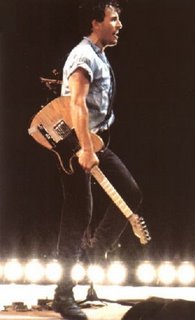 For some, just looking at this image will be enough to provoke tears -- of embarrassment. Who remembers the winter of '86? Record retailers put in such enormous advance orders for this boxed set, that the market was flooded. The set sold for as low as $9.99 in some stores, provoking line-ups that stretched around the block. Add to this a televised concert broadcast around the world, and legions of college girls whose spring break anthem that year was Born In The USA. Those of us who had been waiting for The Boss to make it big were surprised -- nay, appalled -- at just how big he was getting.
To make matters more complicated, Bruce was the uncomfortable third-party in an All-American pop-culture Trinity, whose two other points were Ronald Reagan and Rambo. Or was he uncomfortable? The scrawny kid who'd flunked his draft exam now looked like he'd gambled a stamp on Charles Atlas -- did he share a personal trainer with Stallone? Those of us listening to his between-song patter thought he was pretty clear in his denunciation of Reagan's "interest" in El Salvador, but this political message seemed to be lost on the Reagan-adoring masses who flocked to the concerts. The natural question -- Was The Boss too oblique? -- gradually took an insidious form: Was The Boss being purposefully oblique?
Finally, there was the issue of the music. Listening to Live 75-85 from beginning to end hammered home the point that you either loved the music, with all its maudlin slap-bang energy, or you ... wait, did I just type "maudlin"?
Ah, the creeping chill of self-awareness! Bruce Springsteen and the E Street Band sure enough had their own unmistakable imprint, but after four hours of Live, even diehard Bruuuuce fans had to wonder if he wasn't a little too reliant on the air-horn honkings of sax-man Clarence Clemons. And what was with those freaky little Glockenspiel bits during the slow numbers? Honeymoon ... just about ......... over.
Nerd! Rock snob! Consumer!!! Colour me embarrassed and guilty as charged. There is, however, a moment in this monumental gathering of noise, that still exerts a powerful grip on me and gets me dabbing at my eyes. It's located smack in the centre of disc 2, and it begins unpromisingly with a history lesson and a rendering of Woody Guthrie's This Land Is Your Land*. (Joe Klein's book, BTW, is indeed worth reading.) From there, Bruce slips into his troubling first-person account of an unrepentant killer, in Nebraska. He follows this up with the laid-off GM worker, and unlikely folk hero, Johnny 99. And closes the set with Reason To Believe. "Believe what?" is the natural question. The answer seems to be, "That it's worth your while."
Somehow these three songs act as emotional proof positive. I loved them in 86, and I love them 20 years later. You can even call me a fan of The Boss -- a crummier fan than he deserves, perhaps, but a fan nonetheless.
*Some endnotes: I think this guy's take on The Boss is more perceptive than most. And although Springsteen sings more verses of Guthrie's anthem than we are accustomed to hearing, he sees fit to steer clear of the discomfitingly anarchistic lyric:
As I was walkin' - I saw a sign there
And that sign said - no tress passin'
But on the other side .... it didn't say nothin!
Now that side was made for you and me!
Woody's got more where that came from, at his son Arlo's site, here.
Heartbreaker #5
 For some, just looking at this image will be enough to provoke tears -- of embarrassment. Who remembers the winter of '86? Record retailers put in such enormous advance orders for this boxed set, that the market was flooded. The set sold for as low as $9.99 in some stores, provoking line-ups that stretched around the block. Add to this a televised concert broadcast around the world, and legions of college girls whose spring break anthem that year was Born In The USA. Those of us who had been waiting for The Boss to make it big were surprised -- nay, appalled -- at just how big he was getting.
To make matters more complicated, Bruce was the uncomfortable third-party in an All-American pop-culture Trinity, whose two other points were Ronald Reagan and Rambo. Or was he uncomfortable? The scrawny kid who'd flunked his draft exam now looked like he'd gambled a stamp on Charles Atlas -- did he share a personal trainer with Stallone? Those of us listening to his between-song patter thought he was pretty clear in his denunciation of Reagan's "interest" in El Salvador, but this political message seemed to be lost on the Reagan-adoring masses who flocked to the concerts. The natural question -- Was The Boss too oblique? -- gradually took an insidious form: Was The Boss being purposefully oblique?
Finally, there was the issue of the music. Listening to Live 75-85 from beginning to end hammered home the point that you either loved the music, with all its maudlin slap-bang energy, or you ... wait, did I just type "maudlin"?
Ah, the creeping chill of self-awareness! Bruce Springsteen and the E Street Band sure enough had their own unmistakable imprint, but after four hours of Live, even diehard Bruuuuce fans had to wonder if he wasn't a little too reliant on the air-horn honkings of sax-man Clarence Clemons. And what was with those freaky little Glockenspiel bits during the slow numbers? Honeymoon ... just about ......... over.
Nerd! Rock snob! Consumer!!! Colour me embarrassed and guilty as charged. There is, however, a moment in this monumental gathering of noise, that still exerts a powerful grip on me and gets me dabbing at my eyes. It's located smack in the centre of disc 2, and it begins unpromisingly with a history lesson and a rendering of Woody Guthrie's This Land Is Your Land*. (Joe Klein's book, BTW, is indeed worth reading.) From there, Bruce slips into his troubling first-person account of an unrepentant killer, in Nebraska. He follows this up with the laid-off GM worker, and unlikely folk hero, Johnny 99. And closes the set with Reason To Believe. "Believe what?" is the natural question. The answer seems to be, "That it's worth your while."
Somehow these three songs act as emotional proof positive. I loved them in 86, and I love them 20 years later. You can even call me a fan of The Boss -- a crummier fan than he deserves, perhaps, but a fan nonetheless.
*Some endnotes: I think this guy's take on The Boss is more perceptive than most. And although Springsteen sings more verses of Guthrie's anthem than we are accustomed to hearing, he sees fit to steer clear of the discomfitingly anarchistic lyric:
As I was walkin' - I saw a sign there
And that sign said - no tress passin'
But on the other side .... it didn't say nothin!
Now that side was made for you and me!
Woody's got more where that came from, at his son Arlo's site, here.
Heartbreaker #5
Subscribe to:
Posts (Atom)