Inspired by Michael Allen's The Truth About Writing, here is my truth about self-publication:
I'M SOOOO BLOODY RICH, HA HA HAAAA! I OWN APARTMENT BUILDINGS AND SHOPPING CENTERS, HA HA HAAAAAAA!!!
I'll pour you the first dram if you can identify the origin of that quote.
I start with money, because that seems to be the bottom line for many people thinking about publishing, “professionally” or otherwise. If you are one of those people, here is the truth: I've done better than break even, but not so well that I should bother with a tax claim. In fact, the IRS would very much prefer I didn't, since they will have to pay me for the privilege of giving them a little extra work.
If you're hoping to become rich and famous by self-publishing your short stories, I would say on the basis of my limited experience: there ain't no way it's going to happen. But really, who expects that? I held out hope for a little beer and peanuts money; I got it, and for that I'm grateful. If you're someone who thinks sales figures are indicative of a writer's — or, God forbid, a person's — worth, give your head a shake and think again. You should see the portraits Modigliani drew in exchange for beer, never mind the peanuts. No, really — you should. People love him now, but patiently tolerated him at the time and in metaphysical currency you and I are worth every bit as much as he was.
Having said all that, I suspect there is a modestly lucrative shell-game to be had in the world of self-publishing — provided you have a few cooperative friends (including an adroit accountant) and the prerequisite energy. Basically what you do is this: dream up a catchy name for a publishing house; create, format and self-publish a half-dozen or so books for the market; get your accountant friend to seek out and exploit every possible tax loophole and apply for every available artist's fund and grant (there are still quite a few of those in Canada, particularly if you reside in Quebec). In other words, you become a small publisher. The potential upside to this is when strangers ask you who published your work, they will nod knowingly when you say, “Oh, I was picked up by Catchy Name Publishing House. They're kinda new to the market, but gosh: great group of people!” Additional bonus: you will almost certainly make more money than if you single-handedly publish a solitary collection of short stories.
The potential downside is you will likely be more taken with the business of publishing than with the act of writing.
A publisher's name seems to mean a great deal to a large number of people, and I have to admit I've wrestled a bit with some of the barbs directed toward my ego. “You resorted to a vanity press,” is one of the more common attempts at dismissal. I think there is a difference in kind worth pointing out: I actually formatted my own book, enlisted the talents of others in the cover artwork as well as the proofreading and editing. I can attest to the quality of time and labor that went into the final product. Then there is the business of generating interest and sales. That's why it's called “self-publishing,” and that's why, after I've witnessed the love and attention that others have given to “my” product, I'm prone to bristling at “vanity” accusations. So far as I know, the offer behind most vanity presses is you give them the words and a lump sum of money, and they will give you a box of books.
Vanity is, of course, one of the Seven Deadlies. I hate it when someone in the Church publicly speculates as to my motivations; you can just imagine how I feel when some Secular Fool stands up and with pious high dudgeon pulls the same boneheaded stunt. Taking a deep breath and attempting to give him the benefit of the doubt, I can only presume that the act of multiple submissions, and working what connections one has, and currying what favor one can, followed (not at all inevitably) by acceptance, professional editing, formatting, packaging and selling is a process that scourges all trace of vanity from a writer, thus purifying his soul for the public scrutiny to follow. I can presume, but not for very long.
Or perhaps I misunderstand. Perhaps it's not an accusation at all, but a sentiment informed by the wisdom of Qoheleth. Well then! Let me refill your glass, sir, and we shall lift a toast to our brotherhood of vanity!
There is another way of looking at this: the practical way. I think I'm as clever with words as most people in the business. But what professional publishers want, quite rightly, is a meal-ticket. They want someone who can publicly attract attention to their own product while maintaining a monastic work ethic. Consider some of the names you look for when you visit the big box bookstores. These people have to master the dog-and-pony show to get 90 seconds worth of coverage in magazines, newspapers or (better yet) local television — then they have to retreat to their room to write. And never mind the messy business of paying attention to lovers, spouses and children (while ignoring the critics). How anyone can come up with a book a year is beyond me. It's beyond me, because I very much doubt I have that capacity.
I'm guessing I have three more books of fiction in me, tops, and I am a very slow worker. Frankly, if there is a vice informing my publishing style, it's “sloth.” For better or worse I've come to think if I'm not having fun writing, people won't have any fun reading the end product. Fun takes time, and I hate to be rushed when I'm having fun.
I also loathe waste, and the current publishing industry produces little but. When will this be brought to bear? I think it could be quite soon. I can recall some of the punditry that came after the fall of Communism. “Reagan brought them to their knees!” claimed one. “Yes,” rejoined the other, “but how much of the fall was simply a result of the sheer dead weight of Communism?” I believe commercial publishing is collapsing beneath the sheer, dead weight of its own colossal waste. In contrast, Print On Demand gives you just as many books as are going to be read (or purchased). Call it “vanity publishing” if you are so inclined, but the way I see it, I'm part of the solution, not the problem. In fact, the more accurate sobriquet might be “humility publishing”: modest means attaining reasonable goals.
When it comes to meeting goals, I have to say the experience of self-publishing has been vastly more gratifying than I could ever have imagined. Family and friends have treated my work with more seriousness than I have any right to expect; my blog-friends have been stupendously generous in their encouragement and support; those who read the book but didn't find it to their taste have had the good manners to keep their reactions to themselves; and, wonder of wonders, complete strangers have sent me some of the most touching notes imaginable.
What, if anything, will I change the next time? Having worked with the POD model for a year, I think I'll probably make the next PDF free, and bring the price of the book closer to its actual cost of production. I believe in giving back: why shouldn't the customer buy her own beer and peanuts? Who knows: by the time I conclude my career in fiction, I may just make it a square deal and throw in dinner and a nightcap.
Showing posts with label self-publishing. Show all posts
Showing posts with label self-publishing. Show all posts
Thursday, January 17, 2008
Friday, April 13, 2007
Some Lit-Links
I wasn't aware, until this morning, that humorist David Sedaris was receiving a public scolding for being a bullshit artist. My original response was, "As if we didn't know!" Then the Rodney Rothman affair was raised, and I remembered my own finger-wagging re: Frey and Chabon. Are there distinctions to be made?
Yes, there are. Chabon was straight-facedly telling his audience that his neighbor was a Nazi posing as a Holocaust survivor. The man he referred to was real, but was never a Nazi, a survivor or even Chabon's neighbor: simply an American veteran who had actually fought the Nazis. When I'm generous, I call that ill-advised tom-foolery on Chabon's part; in a less generous mood, I call that malign deceit. Frey walked in with his tattoos and prosaic bravado, asking one and all, "Who's a tough guy?" I call that leading with your chin. Sedaris walks in and says, "Listen to this: isn't it crazy?" I'd call it a crock, if I weren't laughing so hard. As for Rothman, if you scroll to the comments, it looks like he's got a perspective on it all that's worth consideration.
*****
Print On Demand vis-a-vis Lulu is an oh-so-nifty innovation that has relieved me of the burden of wondering if my fiction might ever see the light of day. The burden of cultivating a larger audience, however, is still there. Mary Scriver outlines the challenges facing POD author here.
*****
Fifteen years ago I picked up a bizarre little novel called Strong Motion. It had a conceptual energy that I rather liked. Four years later I noticed its author was featured on the cover of Harper's Magazine, with the proposal: "In the Age of Images, a Reason to Write Novels." Jonathan Franzen's quest was personal, and the answer he finally lit upon was personal. I thought it was terrific.
Since then Franzen's manifesto has come to haunt the pages of Harper's the way Tom Wolfe's did before him. Brainy types are weighing in, trying to put Franzen in his place (somewhere other than post-Oprah best-sellerdom, I assume), proposing we look elsewhere for answers to ailments that beleaguer "serious" fiction. I don't know what Harper's pays per word, but even at rock-bottom prices Ben Marcus made off like a bandit with what was meant to be a high-falutin' broadside of Franzen. Jess Row lamented this sort of pissing-match and wondered if a woman mightn't have a better perspective on it all.
Well, be careful what you wish for: here's Cynthia Ozick giving both lads a maternal pat on the head, telling us they're both a little right, both a little wrong. What our novels really need to survive, she says, is critics. Preferably critics like James Wood.
I think what this patient really needs, if it wants to survive, is yet another doctor. Sheesh. Neither of these Poindexters give more than passing consideration to the genuine issues Franzen raises, namely the demonstrable unrelenting decline in the sales of fiction. Franzen's question was what's the point of devoting three (plus) years of your life writing a novel if only a dozen people read it? He answered it, and so far as I'm concerned, I'd love him to tease apart the point of writing yet another novel after everyone on the continent has bought, read and publically weighed in on the merits of your last one. Franzen was pertinent then; he'd be just as pertinent now.
*****
It's the end of the novel as we know it, and I feel fine. Michael Blowhard throws out three possible publishing scenarios facing the "literary novel" here. He uses a 300 year timeframe, and taken with a grain of salt, they all strike me as entirely possible assuming humanity is still around to play with such concepts.
I've never considered the eBook to be an attractive option, until I read this bit, via ALD. By golly, if those puppies came equipped with a "search" feature, I just might climb on board. But then I read this bit, via Boing Boing, and now I'm not so sure....
Three hundred years, if things keep developing at the current rate, is a Sagan-like "BILL-YUNNS AND BILL-YUNNS" for technology. Still, it's the printed word that fuels well over 90% of the world's education programs. I think this means that print and paper will likely remain an attractive medium for people to aspire to for many, many years to come.
Whether the North American publishing industry will survive is another matter. Beyond the textbook industry, I just don't see how it can. Back in the 90s, when I talked shop with the publishers, sellers and buyers of books, people looked at publishing's return policy, which basically allows stores to stock as many copies and titles as they wish then send them back for free, and figured it was doomed. The store I worked in, when I first came on board, had a publisher return rate that approached nearly 40%. We worked to get that below 20% (I'm proud to say that as a buyer I averaged 12%, and had a trimester that dipped to 9% thanks to strong sales on the floor. No-one got rich from it, but then no-one went broke, either).
Since then, there's been one single Big Box Behemoth that's taken over the Canadian bookselling landscape, and publishers are facing return rates that are wildly beyond anything I encountered. That's just Canada, which is a very small part of the American publishing scene. In the States we've got more box stores, more publishers, more money getting sent through the pulper. Yes, the sky is falling, but at least we've got an engaging history of it.
Yes, there are. Chabon was straight-facedly telling his audience that his neighbor was a Nazi posing as a Holocaust survivor. The man he referred to was real, but was never a Nazi, a survivor or even Chabon's neighbor: simply an American veteran who had actually fought the Nazis. When I'm generous, I call that ill-advised tom-foolery on Chabon's part; in a less generous mood, I call that malign deceit. Frey walked in with his tattoos and prosaic bravado, asking one and all, "Who's a tough guy?" I call that leading with your chin. Sedaris walks in and says, "Listen to this: isn't it crazy?" I'd call it a crock, if I weren't laughing so hard. As for Rothman, if you scroll to the comments, it looks like he's got a perspective on it all that's worth consideration.
*****
Print On Demand vis-a-vis Lulu is an oh-so-nifty innovation that has relieved me of the burden of wondering if my fiction might ever see the light of day. The burden of cultivating a larger audience, however, is still there. Mary Scriver outlines the challenges facing POD author here.
*****
Fifteen years ago I picked up a bizarre little novel called Strong Motion. It had a conceptual energy that I rather liked. Four years later I noticed its author was featured on the cover of Harper's Magazine, with the proposal: "In the Age of Images, a Reason to Write Novels." Jonathan Franzen's quest was personal, and the answer he finally lit upon was personal. I thought it was terrific.
Since then Franzen's manifesto has come to haunt the pages of Harper's the way Tom Wolfe's did before him. Brainy types are weighing in, trying to put Franzen in his place (somewhere other than post-Oprah best-sellerdom, I assume), proposing we look elsewhere for answers to ailments that beleaguer "serious" fiction. I don't know what Harper's pays per word, but even at rock-bottom prices Ben Marcus made off like a bandit with what was meant to be a high-falutin' broadside of Franzen. Jess Row lamented this sort of pissing-match and wondered if a woman mightn't have a better perspective on it all.
Well, be careful what you wish for: here's Cynthia Ozick giving both lads a maternal pat on the head, telling us they're both a little right, both a little wrong. What our novels really need to survive, she says, is critics. Preferably critics like James Wood.
I think what this patient really needs, if it wants to survive, is yet another doctor. Sheesh. Neither of these Poindexters give more than passing consideration to the genuine issues Franzen raises, namely the demonstrable unrelenting decline in the sales of fiction. Franzen's question was what's the point of devoting three (plus) years of your life writing a novel if only a dozen people read it? He answered it, and so far as I'm concerned, I'd love him to tease apart the point of writing yet another novel after everyone on the continent has bought, read and publically weighed in on the merits of your last one. Franzen was pertinent then; he'd be just as pertinent now.
*****
It's the end of the novel as we know it, and I feel fine. Michael Blowhard throws out three possible publishing scenarios facing the "literary novel" here. He uses a 300 year timeframe, and taken with a grain of salt, they all strike me as entirely possible assuming humanity is still around to play with such concepts.
I've never considered the eBook to be an attractive option, until I read this bit, via ALD. By golly, if those puppies came equipped with a "search" feature, I just might climb on board. But then I read this bit, via Boing Boing, and now I'm not so sure....
Three hundred years, if things keep developing at the current rate, is a Sagan-like "BILL-YUNNS AND BILL-YUNNS" for technology. Still, it's the printed word that fuels well over 90% of the world's education programs. I think this means that print and paper will likely remain an attractive medium for people to aspire to for many, many years to come.
Whether the North American publishing industry will survive is another matter. Beyond the textbook industry, I just don't see how it can. Back in the 90s, when I talked shop with the publishers, sellers and buyers of books, people looked at publishing's return policy, which basically allows stores to stock as many copies and titles as they wish then send them back for free, and figured it was doomed. The store I worked in, when I first came on board, had a publisher return rate that approached nearly 40%. We worked to get that below 20% (I'm proud to say that as a buyer I averaged 12%, and had a trimester that dipped to 9% thanks to strong sales on the floor. No-one got rich from it, but then no-one went broke, either).
Since then, there's been one single Big Box Behemoth that's taken over the Canadian bookselling landscape, and publishers are facing return rates that are wildly beyond anything I encountered. That's just Canada, which is a very small part of the American publishing scene. In the States we've got more box stores, more publishers, more money getting sent through the pulper. Yes, the sky is falling, but at least we've got an engaging history of it.
Thursday, October 26, 2006
Formatting A Book Vs. Solving The Rubik's Cube
I was probably 14 when I saw my first Rubik's Cube. I was with my family, visiting another family whose kids were the right ages for my younger siblings, but the wrong ages for me.
Here was this messed-up cube. Here was bored little me.
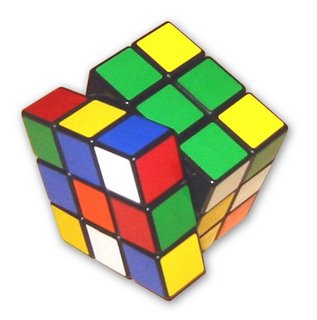
Over the next hour and a half I solved exactly one layer. Try as I might, I could not get beyond that. But I couldn't stop. One unusual shuffle of these little blocks, and ... hey, that's new! Am I closer?
Of course, then my brother's playmate showed up, grabbed the thing from my hands and had it done in two minutes. "It's easy," he said. "You've just got to remember where the center pieces are."
Oh yeah. Sure.
So here I am, nearly 30 years later, tweaking this and that on my book format, pulling out my hair when faced with a change I could never have predicted. But I can't stop. My most recent hang-up? I spent most of yesterday and am beginning today with headers, footers and pagination.
Ah, well. Be assured the colours are slowly being shuffled into their correct order. The final layer is just about there.
Here was this messed-up cube. Here was bored little me.
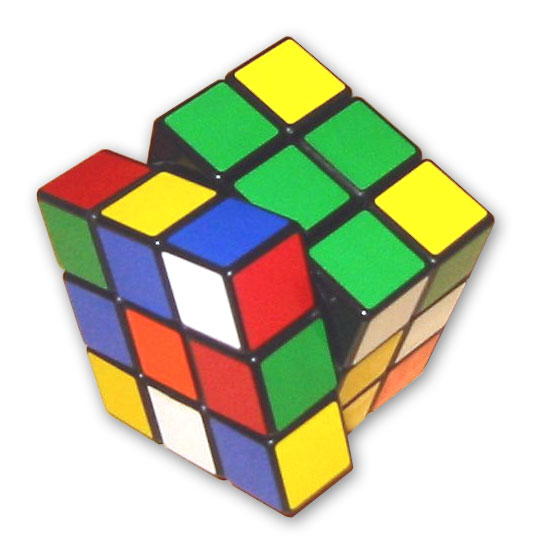
Over the next hour and a half I solved exactly one layer. Try as I might, I could not get beyond that. But I couldn't stop. One unusual shuffle of these little blocks, and ... hey, that's new! Am I closer?
Of course, then my brother's playmate showed up, grabbed the thing from my hands and had it done in two minutes. "It's easy," he said. "You've just got to remember where the center pieces are."
Oh yeah. Sure.
So here I am, nearly 30 years later, tweaking this and that on my book format, pulling out my hair when faced with a change I could never have predicted. But I can't stop. My most recent hang-up? I spent most of yesterday and am beginning today with headers, footers and pagination.
Ah, well. Be assured the colours are slowly being shuffled into their correct order. The final layer is just about there.
Subscribe to:
Posts (Atom)