A 13-year-old boy gives up his iPod for a week to review the Sony Walkman for the Beeb, over here. Favorite quote: "It took me three days to figure out there was another side to the tape." Clearly his parents are fonder of techno-flash than either my wife or I am, because my 10-year-old could have helped him out with that.
It only now occurs to me that the iPod is the first portable music player I've ever owned (discounting the Pioneer boom-box that sat in my various bedrooms from 1981-1984; car stereos too, for that matter). I'm not sure why I never purchased a Walkman, or one of its competitors. I was certainly attracted to them at the time. Sound quality was an issue, I think, as well as longevity. Those little tape players had a reputation for dying within a month or two of the warranty's expiry.
It's amusing to think that back when my group of guys first met we were all in the habit of carrying a briefcase of cassettes just about everywhere we went. The last couple of years it's been a matter of who gets to plug his 'pod into the speakers next. Vive la change, I say.
So tell me: what happened to your Walkman?
Tuesday, June 30, 2009
Thursday, June 25, 2009
Michael Jackson & My Roommate
Dedicated to Raymond Taavel, who was there, and (of course) my roommate John Hough, aka, "The Huffer"!
Michael Jackson died today. I think the last time I listened to an entire song by Jackson was the day I said goodbye to my Bible College roommate. It was his tape, his stereo. He hadn't even begun to pack for home, and I was done. I shook his hand. Then we hugged.
“Sorry it was so difficult.”
“Yeah. Me too.”
The first day of Bible College, he handed me the cassette I was going to learn to loathe and said, “If you ever want to see blubber move, just slap this puppy in the deck.”

He was a very, very big boy. Managing his body odor was a constant challenge, which he never mastered in my year with him. He snored terribly. And even his “cool” music, what little there was of it, set my teeth on edge.
The blunders happened early, and they happened often. Just one example: my tape of Moving Pictures by RUSH (which I valued as deeply as he did Thriller) had a five second segment in the middle of “Tom Sawyer” where my roommate could be heard talking to someone else, because he had accidentally hit “Record” instead of “Eject.”
He knew I was anything but "thrilled" about any of it. Not a week went by when I didn't lobby to get bunked with someone else. My efforts were futile. I finally managed to book a few minutes with the Dean of Students. When I plaintively explained my situation, he templed his fingers and regarded me for a moment, then said, “Did you ever think this might be the will of God?”
In one sense, it was indeed a fortuitous time. I was too young, too naïve, too pious and too insecure to take matters into my own hands. In another year or two, had someone posed the same theological quandary, I'd have smiled, stood up, and asked for my money back: God doesn't work in such mysterious ways when you start speaking the language of finance. But I was just a pup, desperate to stay in Toronto, and not quite desperate enough to escape our tiny, foul-smelling room.
Thriller was bad, but he also listened to The Haven Of Rest Quartet, who made Jackson sound like Led Zeppelin in comparison. He played flute. He sang tenor. He hung out with the cattiest girls in the school — who were, coincidentally, also the most attractive, but seemed to have nothing but an amused contempt for Yours Truly. He loved to laugh, and they brought it out in him. Even when he was with them, however, I never heard him say anything snarky in return.
I absorbed all this, yet never, ever figured him for gay until I read his obituary this April.
John insisted there be no funeral: he asked instead for some “celebration” of his life, which, so far as I could see, consisted of singing beautifully, performing in various choirs and orchestras, playing beach volleyball (believe it) and canoeing. And being nice to absolutely everyone.
When did he come out? What was the process that took him from the guy who stenciled Bible verses on enormous sheets of poster-board, to the guy who finally joined the gay men's volleyball team? The on-line eulogies don't say. “He was never mean.” “He sang like an angel.” “He never said a bad word about anybody.” His inner-life remained, like his beloved performer's, incredibly private.
I don't know what he saw in Michael Jackson, or heard in his music. But this is my old roommate's Pride Weekend, and I have resolved not to kvetch when "Billy Jean" is played, yet again. Because nothing got blubber moving like that song.
Michael Jackson died today. I think the last time I listened to an entire song by Jackson was the day I said goodbye to my Bible College roommate. It was his tape, his stereo. He hadn't even begun to pack for home, and I was done. I shook his hand. Then we hugged.
“Sorry it was so difficult.”
“Yeah. Me too.”
The first day of Bible College, he handed me the cassette I was going to learn to loathe and said, “If you ever want to see blubber move, just slap this puppy in the deck.”
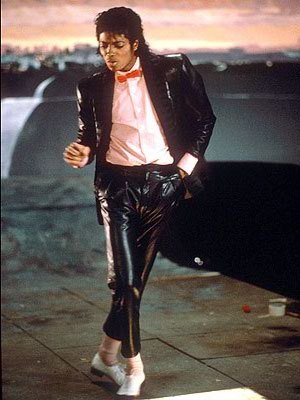
He was a very, very big boy. Managing his body odor was a constant challenge, which he never mastered in my year with him. He snored terribly. And even his “cool” music, what little there was of it, set my teeth on edge.
The blunders happened early, and they happened often. Just one example: my tape of Moving Pictures by RUSH (which I valued as deeply as he did Thriller) had a five second segment in the middle of “Tom Sawyer” where my roommate could be heard talking to someone else, because he had accidentally hit “Record” instead of “Eject.”
He knew I was anything but "thrilled" about any of it. Not a week went by when I didn't lobby to get bunked with someone else. My efforts were futile. I finally managed to book a few minutes with the Dean of Students. When I plaintively explained my situation, he templed his fingers and regarded me for a moment, then said, “Did you ever think this might be the will of God?”
In one sense, it was indeed a fortuitous time. I was too young, too naïve, too pious and too insecure to take matters into my own hands. In another year or two, had someone posed the same theological quandary, I'd have smiled, stood up, and asked for my money back: God doesn't work in such mysterious ways when you start speaking the language of finance. But I was just a pup, desperate to stay in Toronto, and not quite desperate enough to escape our tiny, foul-smelling room.
Thriller was bad, but he also listened to The Haven Of Rest Quartet, who made Jackson sound like Led Zeppelin in comparison. He played flute. He sang tenor. He hung out with the cattiest girls in the school — who were, coincidentally, also the most attractive, but seemed to have nothing but an amused contempt for Yours Truly. He loved to laugh, and they brought it out in him. Even when he was with them, however, I never heard him say anything snarky in return.
I absorbed all this, yet never, ever figured him for gay until I read his obituary this April.
John insisted there be no funeral: he asked instead for some “celebration” of his life, which, so far as I could see, consisted of singing beautifully, performing in various choirs and orchestras, playing beach volleyball (believe it) and canoeing. And being nice to absolutely everyone.
When did he come out? What was the process that took him from the guy who stenciled Bible verses on enormous sheets of poster-board, to the guy who finally joined the gay men's volleyball team? The on-line eulogies don't say. “He was never mean.” “He sang like an angel.” “He never said a bad word about anybody.” His inner-life remained, like his beloved performer's, incredibly private.
I don't know what he saw in Michael Jackson, or heard in his music. But this is my old roommate's Pride Weekend, and I have resolved not to kvetch when "Billy Jean" is played, yet again. Because nothing got blubber moving like that song.
Tuesday, June 23, 2009
David Edelstein
In the early 90s I lived on Brunswick Avenue, a stone's throw away from Toronto's Kensington Market and Spadina Chinatown. In the summer months it was quite common to see several city blocks taped off for the purposes of filming the David Carradine cable TV retread, "Kung Fu: The Legend Continues." There were sooooo many David Carradine stories making the rounds that I was surprised his life-span exceeded that of his (justifiably) short-lived series.
I had also lost touch with just how cool that cat could be. David Edelstein reconnected me. Edelstein doesn't focus on the tawdry — and why should he, since everyone else has that covered? — but he gets the aura right.
Also, having just watched Pixar's Up with my daughters, I couldn't quite put my finger on how this flick could move me so deeply, yet leave me feeling strangely distant when it was all over. I checked in on Edelstein, then cursed myself for doing so. He's got a whole lotta love for the film, but dig this: "Shock us with an inconsolable woe (predator eats fish’s wife and kids; a trash-heap Earth is depopulated save for a robot whose idea of culture is Hello, Dolly!); then gradually introduce sentiment, riotous chases, and a rousing cliff-hanger ... Once Fredricksen’s wife, Ellie, passes away, there are no women characters — but Pixar has always been a boys’ universe." Damn it! David got there first!
Regarding his last observation, I'll simply add a heartfelt "Amen" from the choir loft, and encourage John Lasseter to step forward and take the lead from his hero and mentor, Hayao Miyazaki (wp). The issue isn't just about providing equal time to half the world's population — it's about swimming in the deep end.
Heraclitus, The Movie Goer
How many times have you seen Blade Runner? In the late 80s I would have confidently answered in the double digits. A quarter-century later I'd rather account for the number of times I've stepped in the same river. There are so many versions, and so many different media in which to view these versions, and I'm such a wash at math that I don't think I could construct the necessary algorithm to provide an accurate answer.
Jonathan Rosenbaum tackles the Blade Runner issue, along with several others that hadn't occurred to me, in his quest to help the home-style critics and film historians among us, here.
Jonathan Rosenbaum tackles the Blade Runner issue, along with several others that hadn't occurred to me, in his quest to help the home-style critics and film historians among us, here.
Sunday, June 21, 2009
Grillier Than Thou
It's Father's Day, so let's talk a little about barbecuing.
My wife has been hanging with a video crew from Australia. One of their more popular side projects was a whimsical series on how to barbecue. The producer said, “We just got weary of eating lousy barbecue, so . . . see a need, fill a need.” My wife watched a few of these instructional snippets and admitted they were clever.
 “If you want the entire series I can load it onto your computer,” said Producer-Man.
“Is the series strictly about gas barbecues?” asked my wife.
“Yeah. Why? What do you use?”
“We use charcoal.”
“Charcoal? Whatever for?”
Said my wife, “Well, it's all about the flavor, isn't it?”
Yes, that is indeed what it's all about. And perhaps I should be reticent about enlarging my carbon footprint and endangering my family's health with carcinogen-infused meats and vegetables. But if it's all about the flavor, it must be said: nothing imparts flavor like charcoal.
I bought this Weber drum 11 years ago. I clean it every spring, and use it once or twice a week in the summer. It couldn't be simpler to use — pile the briquettes on an electric starter, plug in for 10 minutes, wait another 15 or so for the pile to reach a white heat, then spread 'em and start grilling. If I'm in an exotic mood I'll soak some mesquite or hickory chips and toss them on the charcoal, but that's hardly necessary for good barbecue.
On the downside, charcoal requires a little more forethought than a gas range does. If you're a dual-income family on the scramble between soccer and softball practices, you'll probably opt for frozen patties searing over propane flames. But even so, a little planning can go a very long distance, and a charcoal drum is a simple, inexpensive indulgence during a pleasurable weekend. If you doubt me, just ask my daughters who makes the best hamburgers in town. The patties are usually ground pork, with a little salt and pepper. But now you know my secret ingredient: charcoal flame.
Sunday, June 14, 2009
Sidney & Lou
As Sidney and Co. took turns smooching Stanley (and congrats to the lot of them, they deserved it, especially Fleury for that final, sensational save) I jumped from hockey to Elvis Costello's talk-show, where the intense Irishman was interviewing Lou Reed. This was the first I'd seen Costello's show, and my very first impression was, he runs a much tighter ship than he needs to.
My second impression was related to Lou Reed, who was once a distant something of a role model for me (romantic, prophetic poet, and all that jazz). I'd always had the impression Reed was a bad interview because he was an incredible asshole. Certainly there is no shortage of evidence when it comes to his capacity in this regard. But as I watched Reed react to Costello -- stifling impatience and reluctantly resorting to his very best behavior -- I began to wonder: does this man even have it in him to do this? I don't believe he does. After all the years he's been Lou Reed and abused (fill in the blank) I don't think he has the capacity to answer a straightforward question. His hard living has eliminated the required "processing" buffer.
The man is a casualty, in other words. He can still lean instinctively toward an apt lyric, but when it comes to mano a mano interaction, he's at a significant loss. The mano is nearly gone.
Thursday, June 11, 2009
Fun! Depressing! Depressing Fun!!
Some quick comments regarding what I've had "On The Platter" this past month, before I switch it up a bit:
Booker T., Potato Hole (A) -- Booker T. is always fun and worth listening to, but with Neil Young and the Drive-By Truckers lending a musical hand, the fun becomes cubed. Small confession: I like the DBTs -- they've got attitude to spare, and an interesting approach to their subject matter -- but I rarely reach for their studio records. The disc that gets the most play in my car is Alabama Ass Whuppin', a (now) hard-to-find live set recorded in some hole-in-the-wall (A). Why? Because they sound like they're having fun, while on their studio discs things just get too damn serious and depressing. I'm fine with depressing, but I'd rather have fun. Potato Hole is incredible fun.
Slaid Cleaves, Everything You Love Will Be Taken Away (A, e) -- Speaking of fun, it would be a mistake to bypass a Slaid Cleaves album just because the title is depressing. Cleaves doesn't shy away from incredibly sad subject matter, but neither does he wallow in it. His subjects might get beaten up by life, but they let shine some genuine character. Cleaves songs can be grimly funny, angry, cussedly stubborn ... they are all, in their sour-breathed way, determinedly life-affirming. This disc, as with Broke Down, is going to be played for a long, long time.
Steve Earle, Townes (A) -- I acknowledge that Townes Van Zandt was an incredible songwriter and an unforgettable performer. But I like Earle's stuff better. I'm not entirely sure why, except that Earle's craft and sensibility have improved since he cleaned up, while TVZ often slid toward an amber-hued sentimentality. Earle is doing this (frequently with his son, Justin Townes Earle) because he knew and loved the man, and that certainly makes the project a deep pleasure to listen to. But I'm looking forward to his next album of original material.
Sarah Borges & The Broken Singles, The Stars Are Out (A, e) -- getting back to the fun: I'd like to compare Sarah's style to Joan Jett or Lucinda Williams (when she feels like cutting loose), but Borges and the Broken Singles have their own thing happening. If you're like me, you want to hear what this sounds like (you won't be disappointed).

Subscribe to:
Posts (Atom)